Cleats
Do toddlers need soccer cleats?
The question that comes before picking a pair, answered with what the rules and the sessions actually require.
By Ryder M. · Published November 6, 2026
The short answer
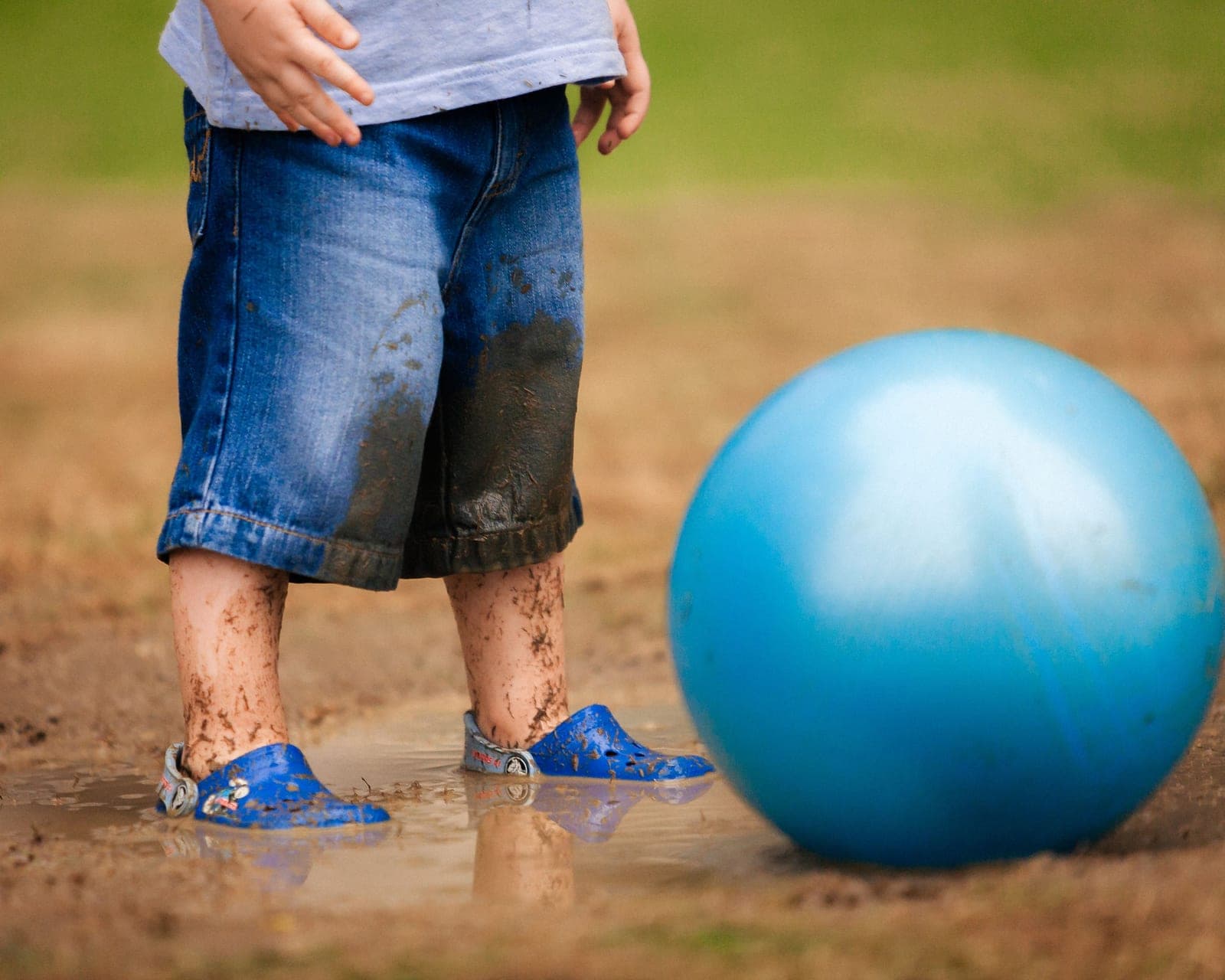
Usually not. No rulebook requires cleats — Law 4 makes footwear compulsory but does not specify studs — and most toddler and U6 programs play on short, dry grass where a flat turf shoe or even a sneaker grips fine. Buy cleats when the league asks for them, when the field is wet or long, or when your child is visibly slipping.
This is the question almost every parent asks about a week before their three- or four-year-old's first session, usually in a store aisle holding a pair of tiny cleats that cost more than they expected. It deserves a straight answer rather than a product recommendation, because for a lot of families the correct purchase is nothing.
So: a toddler almost never needs soccer cleats. Sometimes they do. Here is what actually decides it, in the order the decision happens.
What the rules actually require
Start here, because it is the part most people assume and almost nobody checks.
Under Law 4 of the Laws of the Game, footwear is compulsory equipment — a player must wear shoes — but the Law does not specify cleats, studs or any particular sole. What it does say is that a player must not use equipment that is dangerous, and referee-level guidance treats worn, pointed or exposed-shaft studs and shoes with sharp metal or pointed spikes as not permitted. In other words the Laws are far more interested in what a shoe must not be than in what it must be.
Below that sit your league's own rules, and those are the ones that bind you. Many US toddler and U6 programs explicitly do not require cleats; some require them from a particular age division; a few require shin guards at an age they do not require cleats, which surprises people. Check the registration email or ask the coordinator before buying anything. It is a two-minute question with a real chance of saving you a purchase.
What a toddler soccer session physically is
The second thing that decides this is the activity itself, and it is worth being clear-eyed about what it looks like at three and four.
Small-sided youth soccer is built around short formats — 4v4 and smaller at the youngest ages, on a correspondingly small field, with a size 3 ball at the bottom of the age ladder. At toddler and U6 level the sessions are mostly structured games and drills on a short, usually mown and usually dry field, and the amount of sustained, high-speed, direction-changing running in a thirty- or forty-minute session is genuinely small. There is a great deal of standing, a fair amount of walking, several minutes of looking at a bird, and some sprinting in a straight line.
Studs exist to stop a foot sliding when it loads hard sideways on a surface that would otherwise give way. That is a real problem at U11 on a wet November field. It is a much smaller problem for a three-year-old on dry grass in September, which is why so many programs do not bother requiring them.
What a toddler's foot is doing, and what that argues for
The third input is foot development, and this is where we want to be careful about what is actually known.
General pediatric footwear guidance is consistent and not controversial. Monroe Carell Jr. Children's Hospital at Vanderbilt puts it plainly: "Your child needs a flexible, soft shoe that allows freedom for feet to develop normally", and "Shoes with soles that are too stiff are not good for feet because they limit movement." On fit it advises that "Shoes are much better when they are too large rather than too small", and recommends buying at least half an inch longer than the child's feet "because children's feet grow quickly and because the toes need enough room to move".
What that guidance is about is everyday shoes, and we are not going to stretch it into a claim it does not make. There is no good evidence that an hour a week in a well-fitting molded cleat harms a healthy toddler's foot, and we are not going to tell you there is. What the guidance does support is a tie-break: when a toddler genuinely does not need a stiff, studded sole, the more flexible shoe is the better default, and a flat turf outsole flexes considerably more than a firm-ground plate.
The fit half of that guidance matters much more, and it applies whatever you buy. Under Armour's own kids' cleat buying guide makes the same point from the manufacturer's side: kids' soccer cleats are unisex and sized to normal shoe size, you want roughly half an inch at the toe, and you should fit them with the match socks on. How should kids' soccer cleats fit is the long version, and how to measure kids' feet for cleats is the step most families skip.
The three things you can put on their feet
Practically, there are three options, and the gap between them is smaller than the store layout implies.
| Option | What it is | Works when | Fails when |
|---|---|---|---|
| Sneakers they already own | A flat, flexible athletic shoe | The program does not require cleats, the field is short and dry, and this may not stick | Grass is long, wet or sloped — a flat gum sole slides |
| Turf shoes | Many small rubber nubs across a flat outsole | Almost every toddler and U6 situation: grips short grass, flexes well, and gets worn off the field too | A genuinely muddy field, or a league that specifies cleats |
| Molded cleats | Six to twelve molded rubber studs on a firm-ground plate | The league requires them, the field is wet or long, or the child is slipping | Hard, dry, bare ground, and indoor floors — studs on concrete are worse than nothing |
If we had to pick one default for a three- or four-year-old whose league does not insist, it is the turf shoe, and it is not a close call. A turf outsole grips short grass well enough for the speeds involved, flexes much more like a normal shoe than a firm-ground plate does, and — the part that decides it — it is a shoe a small child will also wear to the park, which means the cost spreads over far more hours than a cleat ever does. Best youth turf soccer shoes covers the category, and soccer cleats vs soccer shoes is the full comparison.
The money, which is the real objection
Nobody asks this question because they are worried about Law 4. They ask it because a toddler's foot grows fast and a pair of cleats gets worn for perhaps an hour a week.
That instinct is right, and it is worth doing the arithmetic out loud. A toddler can move up a shoe size inside a single season, and a cleat has one use — it is unwearable indoors, uncomfortable on pavement and actively bad on a hard court. So a cleat bought in August for a ten-week fall season is realistically a ten- to fifteen-hour shoe that then does not fit. A turf shoe bought in the same week is a shoe worn to preschool, to the playground and to the session, and gets outgrown rather than wasted.
This is also the honest argument against spending up. At this age there is nothing a mid-price cleat does that an entry-price one does not, because none of the things expensive cleats are good at — plate stiffness, strike-zone texturing, weight savings measured in grams — are things a three-year-old can use. Are expensive soccer cleats worth it makes the same case across the whole age range, and it is at its strongest here.
The five situations where the answer flips to yes
All of the above is a default, not a rule. Buy the cleats when one of these is true.
- The league requires them. This ends the conversation. Buy the cheapest pair that fits properly.
- The field is wet, long or soft. Fall and spring seasons in a lot of the country mean wet grass most weeks, and a flat sole on wet grass genuinely slides. Best soccer cleats for rain and wet grass is the wet-field page.
- Your child is actually slipping. Not theoretically — visibly, repeatedly, and in a way that is making them tentative. A child who has stopped trying to turn hard because they fell over twice needs grip, at any age.
- There is an older sibling with hand-me-downs. If a pair in roughly the right size already exists in the house, the money objection disappears. Check the studs are not worn down to nubs and the heel is not collapsed, then use them.
- They very much want them. This is a legitimate reason and we are not going to pretend otherwise. A four-year-old who feels like a real player because of their shoes will run around more, and running around more is the entire point of the exercise at that age.
One thing that is not on that list: metal studs. Molded rubber studs only at this age — and in most US youth soccer, at every age. Are metal cleats allowed in youth soccer has the rule.
If you are buying, what actually matters
Four things, in order. Everything else is marketing.
- Closure they can manage. Hook-and-loop or laceless, not laces. A three-year-old cannot tie laces and a coach with twelve of them cannot either. This narrows the field more than any other criterion.
- About half an inch at the toe, fitted with the soccer socks on. Growing room, measured with the sock they will actually wear, which is thicker than a school sock.
- A soft, flexible upper and the most flexible sole in the size. Bend the shoe before you buy it. If it does not want to bend at the toe, put it back.
- Molded rubber studs, in a firm-ground pattern. Not metal, not soft-ground, not screw-in. Manufacturers' own soft-ground guides describe six to eight longer studs, often metal or metal-and-plastic, built for muddy natural grass — which is not a toddler's shoe.
The two turf shoes and two first cleats that fit this brief
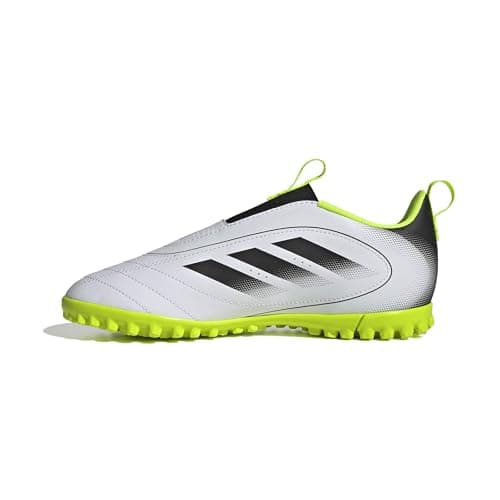
adidas
adidas Goletto IX Laceless Turf
A genuinely useful answer for the pre-lace-tying age, provided the foot is average width or wider.
$35.00View on Amazon#ad — we may earn a commission · price as of November 11, 2026
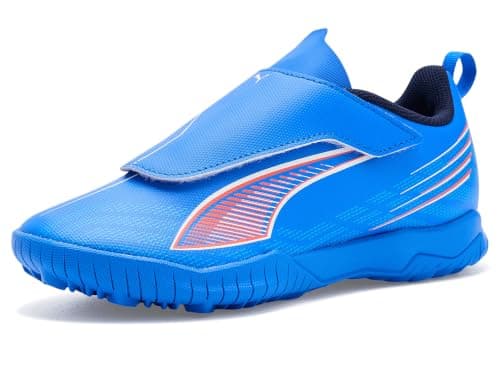
PUMA
PUMA Ultra 6 Play Hook and Loop Turf
The better no-laces option for a narrow foot, with the caveat that the strap is a wear item.
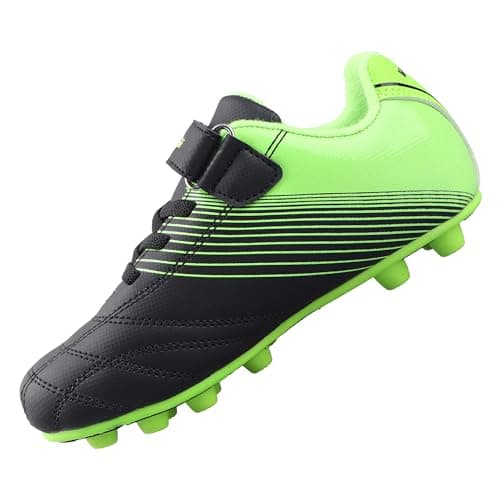
Vizari
Vizari Firm Ground Youth Soccer Cleats (hook-and-loop)
A reasonable first cleat for a three-to-five-year-old, on the understanding that most U6 leagues do not require cleats at all.
$26.52$31.99−17%View on Amazon#ad — we may earn a commission · price as of November 11, 2026
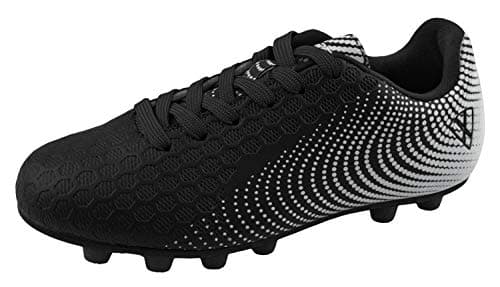
Vizari
Vizari Stealth Firm Ground
The honest choice for a first-season player: enough cleat to play in, not enough money to regret if they switch to basketball.
$25.19$36.97−32%View on Amazon#ad — we may earn a commission · price as of November 11, 2026
Product photos come from each item’s current Amazon listing.
Those four are here as illustrations of the shapes described above — two flat turf outsoles with no laces, and two entry firm-ground cleats with hook-and-loop closure in genuinely small sizes. The ranked picks, with sizing notes on each, live on best toddler soccer cleats and best soccer cleats for 4 year olds. This page is only about whether to buy at all.
What to buy instead, if the answer is no
If you have just decided not to buy cleats, the money is better spent on the two things a toddler genuinely does need.
The first is the right size ball. AYSO publishes ball size by age division and a size 3 is the bottom of the ladder; a size 5 handed to a four-year-old is the single most common youth soccer equipment mistake and it makes everything harder. How to choose a soccer ball has the sizes, and best mini soccer balls covers the smaller skills balls that suit this age indoors.
The second is shin guards, if the program asks for them — and a surprising number ask for guards before they ask for cleats, because a guard prevents a specific injury while a stud prevents a slip. Guards at this age are sized by height rather than by foot, and best shin guards for toddlers has the smallest band. For this age the one-piece option is usually the right one, which is what best youth soccer shin socks is about — a guard sewn into the sock cannot be put on backwards or left in the car. Are shin guards required in soccer explains why that purchase is less optional than the shoes.
After that, the honest answer is nothing. A ball, a pair of shoes that fit, and a yard. If you are adding a first target to the yard, best soccer goal brands for kids explains which names are worth paying for at this age — the short version is almost none of them. U6 — first kicks is the full kit list, and it is deliberately short.
Common questions
Do toddlers need soccer cleats?
Usually no. Law 4 makes footwear compulsory but does not specify cleats or studs, and many US toddler and U6 programs do not require them either — check your registration material, because that is the rule that binds you. At this age sessions are short, on small fields, usually on short dry grass, and a flat turf shoe grips well enough. Buy cleats if the league asks, if the field is wet or long, or if your child is visibly slipping.
What age should a child start wearing soccer cleats?
There is no rule-based age. In practice most players end up in cleats somewhere around U6 to U8, driven by two things rather than by their birthday: a league that starts requiring them, and fields that get wet enough that a flat sole slides. A player who stays on short, dry, mown grass can reasonably stay in turf shoes longer than most parents assume.
Can my toddler just wear sneakers for soccer?
Often yes, and it is legal — Law 4 requires shoes, not studs. Sneakers work when the program does not require cleats, the grass is short and dry, and you are not yet sure the child will stick with the sport. They stop working on long, wet or sloped grass, where a flat gum sole slides. If you want one shoe that covers both, a turf shoe is the better version of the same idea.
Are turf shoes better than cleats for a 3 year old?
For most three-year-olds, yes. A turf outsole grips short grass fine at the speeds involved, flexes much closer to a normal shoe than a firm-ground plate does — and general pediatric footwear guidance favors a flexible sole — and it is a shoe a small child will also wear off the field, so the cost spreads over far more hours. The exception is a wet or long field, where molded studs genuinely do more.
Are soccer cleats bad for toddlers' feet?
There is no good evidence that an hour a week in a well-fitting molded cleat harms a healthy toddler's foot, and we are not going to claim there is. What children's footwear guidance does say is that stiff soles limit movement and that young feet do better in flexible, soft shoes with growing room — about half an inch at the toe. That is a reason to prefer the more flexible option when nothing requires the stiffer one, not a reason to fear cleats.
What size cleats should I buy for a toddler who is still growing?
The size that fits now with roughly half an inch of room at the toe, fitted with the soccer socks on — not a size up as insurance. Manufacturers' own kids' guides say the same, and children's footwear guidance prefers slightly too large to too small. A cleat that is more than about a half-size long slides on the foot, which causes blisters and makes a child tentative. Measure rather than guess.
Do toddlers need shin guards if they do not need cleats?
Quite possibly, yes — and it catches people out. Plenty of programs require shin guards at an age they do not require cleats, because a guard prevents a specific injury from a kicked shin while studs only prevent a slip. Guards at this age are sized by the child's height rather than by foot size. Check the program's equipment line for both items at once.
Sources
- Coaching American Soccer — Law 4, The Players' Equipment — The Law 4 requirements quoted on this site: footwear is compulsory but cleats are not specified; shinguards must be of suitable material, appropriate size and covered by the socks, with the player responsible for suitability; a player must not use equipment that is dangerous; and the referee-level guidance that worn, pointed or exposed-shaft studs and shoes with sharp metal or pointed spikes are not permitted.
- IFAB Laws of the Game — Law 4, The Players' Equipment — The Law text quoted on this site: undershorts and tights must be the same color as the main color of the shorts or the lowest part of the shorts, and players of the same team must wear the same color; shinguards must be of suitable material and appropriate size, covered by the socks, with the player responsible for their suitability; non-dangerous protective equipment of soft, lightweight padded material is permitted; and a player must not use equipment or wear anything that is dangerous, which must be removed rather than taped or covered. Law 4.3 is also the source for the kit-color rules quoted here: the two teams must wear colors that distinguish them from each other and the match officials, and each goalkeeper must wear colors that are distinguishable from the other players and the match officials. Law 4.4 names gloves, headgear, facemasks and knee and arm protectors of soft, lightweight padded material as permitted non-dangerous protective equipment, and separately permits goalkeepers caps and tracksuit bottoms.
- Monroe Carell Jr. Children's Hospital at Vanderbilt — how to choose shoes for your child — A children's hospital's published footwear guidance, quoted on the toddler-cleats page: "Your child needs a flexible, soft shoe that allows freedom for feet to develop normally"; "Shoes with soles that are too stiff are not good for feet because they limit movement"; "Shoes are much better when they are too large rather than too small"; and the advice to buy shoes at least half an inch longer than the child's feet "because children's feet grow quickly and because the toes need enough room to move". Used for general foot development and fit, not for any claim specific to cleats.
- Under Armour — how to buy soccer cleats for kids — A manufacturer's own buying guide, and the source for the statement that kids' soccer cleats are unisex and sized to normal shoe size, plus its guidance on leaving about half an inch at the toe and fitting with match socks on.
- AYSO — Size of Ball and Field by Age Division — Official ball sizes, circumference and weight ranges, and field dimensions by age division. Used for every ball-size and field-size figure on this site.
- US Youth Soccer small-sided playing formats — Player counts, game lengths and format progression (4v4, 7v7, 9v9, 11v11) by age group.
- Vizari — guide to soft ground soccer cleats — A manufacturer's description of soft-ground construction: six to eight studs, often metal or metal-and-plastic, frequently replaceable, built for wet, muddy or soft natural grass so the longer studs penetrate deeper. Used for what SG cleats are, not for whether a child should wear them.
Read next
- Best toddler soccer cleatsGenuine toddler sizing, the laceless options, and an honest answer on whether cleats are needed at all.
- Best soccer cleats for 4 year oldsPicks for a first U6 season, whether cleats are actually required, and the sizing rule that saves a wasted pair.
- Best youth turf soccer shoesTurf shoe picks by age and width, and why the turf outsole does more for comfort than any upper.
- Soccer cleats vs soccer shoesThe difference between studded cleats and flat-soled soccer shoes, which surfaces each is for, and which one a kid needs first.
- How to measure kids' feet for soccer cleatsHow to take a usable foot measurement at home, which foot to trust, when in the day to do it, and how the number turns into a cleat size.
- Best shin guards for toddlersThe XXS height band, which guards are genuinely sold that small, why ankle cover matters most at this age, and how to get a sock over a tiny leg.
- U6 first kicks: what your kid actually needsAges 3 to 5. Size 3 ball, shin guards, and an honest answer on whether cleats are needed at all.