Heads up: we earn a commission if you buy through our links, at no extra cost to you. It never changes which product we recommend — here’s how that works.
The short answer
Franklin Sports — the default. The broad-line brand that sells the goal, the net, the rebounder and the guards, sized honestly for U6 to about U10.
QuickPlay — the engineer. Founded by two product-design graduates in 2007, patents in the UK and internationally, and the brand to buy from about U11 when the goal has to be a real size.
SKLZ — the training brand. Excellent at mini and indoor goals; its portable outdoor goal is a licensed QuickPlay KICKSTER design sold as the QUICKSTER.
GoSports — the pair. Two small goals, cones and a case in one box, which turns a lawn into a game rather than a shooting drill.
NET PLAYZ — the deep net. Good value and genuine net depth, with no brand-owned website and therefore no manufacturer spec to check.
Open Goaaal — the backstop. The only brand here that solves stray shots, at the highest price and the biggest footprint.
Kwik Goal — the professional. The #1 soccer goal supplier in North America by its own account, and the one brand that does not really sell a backyard goal to a parent.
Soccer balls and cleats have brand hierarchies a parent can mostly reason about: the famous names make the good stuff and the unknown names make the cheap stuff. Backyard goals do not work like that, and it catches people out.
In this category the name printed on the carrying bag is often not the company that designed what is inside it, the companies with the best engineering sell almost exclusively to clubs and schools, and several of the brands with the most reviews have no website of their own at all. So the brand question here is less "which name is best" and more "what am I actually buying from this name, and can I check it".
Before any name below matters, three things decide whether a backyard goal was the right purchase. Getting all three right from a brand you have never heard of beats getting any of them wrong from a famous one.
The size, measured against your yard rather than your child. A 4 ft x 3 ft goal is right for a U8 and filled by a single shot from a U11. An 8 ft x 5 ft goal is right for a U12 and will not fit in a lot of suburban yards with run-up behind it. What size backyard soccer goal works through the actual measurement.
How it is anchored. The US Consumer Product Safety Commission publishes specific anchoring, counterweighting and storage recommendations for movable soccer goals because unsecured ones tip over, and no brand name substitutes for pegging the thing down. How to anchor a backyard soccer goal covers it, and it is the most important page on this hub.
Whether the net is replaceable. The net is the component guaranteed to fail first, and the difference between a goal that lasts four years and a goal that lasts one season is usually whether you can buy a new net for it. Best replacement soccer goal nets exists for exactly this reason.
Franklin Sports — the default, and the whole kit from one brand
Franklin is the brand most American families end up with, and the reason is range rather than excellence. It is the one name here that sells the goal, the replacement net for the goal, the rebounder, the shin guards, the mini goal for indoors and the ball, all at roughly the same entry price and all stocked in the same places.
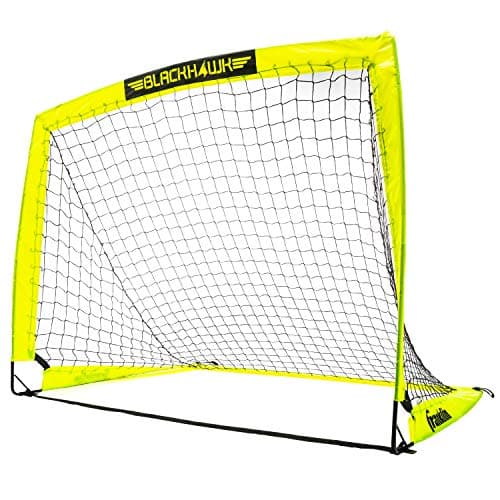
That matters more than it sounds. A family starting out does not have one purchase to make, it has five, and being able to make them all in one order from a brand whose sizes are at least internally consistent removes a lot of friction. The Blackhawk, which Franklin calls its best-selling soccer goal, is a 4 ft x 3 ft portable that Franklin states sets up from a carrying case in two to five minutes on a fiberglass frame with weather-resistant netting. Its mini goal set is a 22 in x 17 in x 16 in goal that ships with a rotation-molded ball and an inflation pump, with quick-fold corner joints Franklin says fold and lock so the goal sets up and breaks down in seconds.
Where Franklin is weakest is the ceiling. A fiberglass frame flexes, which is fine under a seven-year-old and visible under an eleven-year-old; hard shots distort it and it will not survive a teenager. And the consumer size run effectively stops at the small end, so a family whose player grows into needing a 6 ft or 8 ft goal has to leave the brand rather than size up inside it.
Buy Franklin when: the player is U10 or younger, this is the first goal, and you would rather make one order than five.
Skip Franklin when: the player is already shooting hard, or you want a goal still standing in three years.
QuickPlay — the one that actually designs things
QuickPlay has the strongest engineering claim of any brand on this page, and unlike most marketing claims it comes with a paper trail. QuickPlay states it was founded in 2007 by Allen Holland and Will Parsons, both product design graduates of Sheffield Hallam University; that it is headquartered in Sheffield in the UK and in San Diego; that the KICKSTER was its first product, launched in two sizes in 2007 and designed to set up in seconds and be easy to carry; and that its design work has earned patents in the UK and internationally.
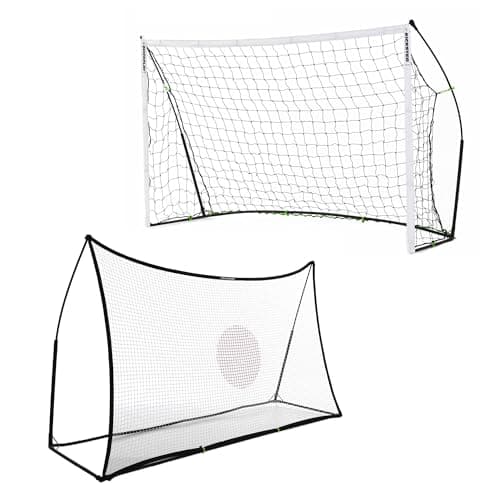
In practice QuickPlay is where you go when the goal needs to be a real goal. The Kickster 2-in-1 is an 8 ft x 5 ft frame in a proper goal shape that switches between goal and rebounder with a swappable panel, which is the one feature on this page that genuinely changes how a child uses a yard — a kid can do finishing practice and passing practice in the same session with nobody resetting anything for them.
The honest limitation is money and space. QuickPlay costs substantially more than a plain pop-up, an 8 ft x 5 ft frame needs a genuinely large flat area plus run-up behind the shooting line, and the rebound returns are firm enough that a younger player struggles to control them. This is a U11-and-up brand, and buying into it early is wasted money.
Buy QuickPlay when: the player is about U11 or above, trains alone, and the yard can take a full-size frame.
Skip QuickPlay when: the goal is for a six-year-old. The engineering is real and a six-year-old cannot use any of it.
SKLZ — a training brand, and a licensed goal
SKLZ is the most interesting brand on this page, because what you are buying from it depends entirely on which product you pick up.
SKLZ states it was founded in 2001 out of the Hit-A-Way Baseball Trainer, which it names as its first product, and describes itself as a sport training equipment brand across baseball, soccer, golf and basketball whose products "target specific skill sets" for "athletes of all ages and levels". Its website footer lists Implus Footcare LLC of Durham, North Carolina. That is an accurate self-description: SKLZ is a drills-and-trainers company, and its best soccer products are the solo trainers, the ladders and the Pro Mini goal rather than anything full-size.
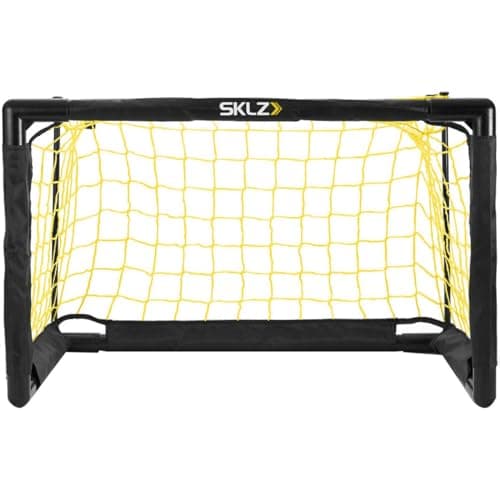
The Pro Mini is genuinely good at what it does. Implus publishes the figures: a goal measuring 22 in x 15 3/4 in x 16 in, supplied with a 5 in soft foam ball, in an 85% PVC / 15% PP build. Shipping the correct ball in the box is the part parents get wrong on their own, and it is why this is the mini goal we point indoor buyers at.
Here is the part worth knowing before you compare SKLZ against QuickPlay on a shelf: QuickPlay states that the KICKSTER design was licensed to SKLZ, which sells it in the US as the QUICKSTER. So on the portable outdoor goal, SKLZ and QuickPlay are not two competing engineering approaches. One is the other under a different name. Compare those two on price and on which size is in stock, not on brand quality, because the brand quality is the same brand.
Buy SKLZ when: you want an indoor or mini goal, or a solo trainer. That is what the brand is for.
Skip SKLZ when: you are weighing its portable outdoor goal against a QuickPlay on quality grounds. It is a licensed QuickPlay design; decide on price and stock instead.
GoSports — the brand that sells you two goals
GoSports occupies a narrow and genuinely useful slot: it is the brand that understands a yard needs two goals, not one.
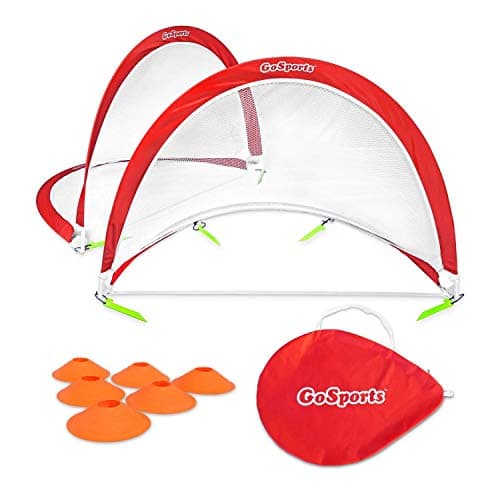
Its pop-up set is listed as two collapsible goals plus six training cones, a carrying case and both plastic and metal stakes, at a 3 lb set weight, in premium nylon fabric with netting and a metal frame, with high-visibility reflective fabric for low-light play, setting up and taking down in seconds with no assembly required. The listing also notes the goals can be secured to grass or taped to hard courts, which is what makes the same box usable in a garage. GoSports lists the pair in 2.5 ft, 4 ft and 6 ft versions.
One goal is shooting practice; two goals is a game, and a game is what children choose to do without being asked. For a household with two kids close in age, a pair of small goals gets used far more often than a single bigger one.
The honest limitation is that GoSports is a direct-to-retail house brand. It publishes listing copy rather than engineering, there is no manufacturer spec sheet behind the numbers, and at 4 ft these are small-sided targets rather than something a U12 can practice hitting corners in. The stakes also do nothing on a hard floor, so indoors the goals slide under a firm shot unless they are taped down or backed against something.
Buy GoSports when: the point is a game between two children, or the same set has to work in a yard and a garage.
Skip GoSports when: you want one properly sized goal for one serious player.
NET PLAYZ — good value, no paperwork
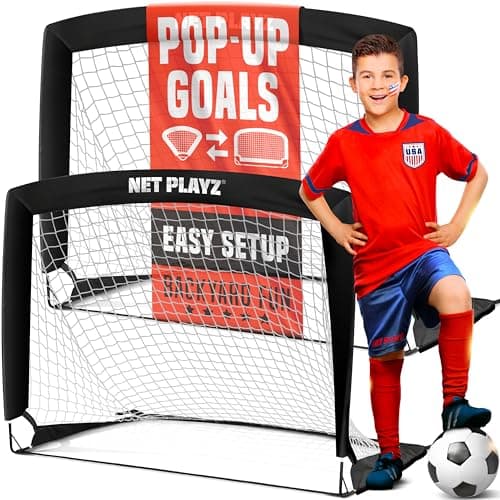
NET PLAYZ sells a lot of backyard goals in the US, and its fold-up 4 ft x 3 ft goals have a real advantage over a flat pop-up: roughly 36 inches of net depth, from a fold-up frame that holds a goal shape instead of sagging. Depth is an underrated feature. A shot that stays in the net is a shot nobody has to go and fetch, and over an afternoon that roughly halves the walking.
The brand-level caveat is one we think a parent should know, because it is invisible from a product listing. NET PLAYZ has no brand-owned website — netplayz.com does not resolve to a company site — so there is no manufacturer specification, no published warranty terms you can read at source and no parts diagram. Everything verifiable about a NET PLAYZ goal comes from whichever retailer listing you happen to be standing in front of, and those listings vary.
That does not make it a bad goal. It makes it a goal to buy on the retailer's return policy rather than on the manufacturer's support, and it is why we will not quote a frame material or a load rating for one: there is no source to quote.
Buy NET PLAYZ when: your actual complaint about backyard goals is chasing the ball, and you buy somewhere with a good returns window.
Skip NET PLAYZ when: you want published specifications, readable warranty terms or replacement parts from the maker.
Open Goaaal — the only brand solving the neighbor problem
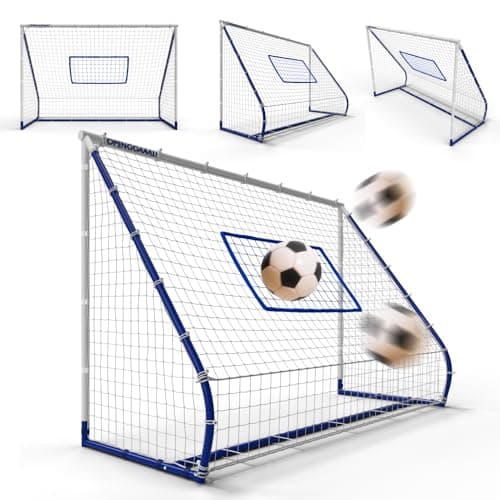
Open Goaaal is a one-idea brand, and the idea is a good one. It sells a patented system that combines a full-size goal, a ball-returning rebounder and a protective backstop, with netting that extends above and around the goal, in several size options.
No other brand here addresses the actual reason backyard practice stops happening, which is not the goal. It is the ball going over the fence for the ninth time. A backstop turns twenty minutes of shooting into twenty minutes of shooting rather than eight minutes of shooting and twelve minutes of retrieval, and the rebounder function means a child can run the session themselves.
It is also by a wide margin the most expensive and most involved option on this page. Assembly is a real job, the footprint is semi-permanent rather than something you fold away each evening, and the backstop's footprint is considerably larger than the goal's — read the required clearances before ordering, not after.
Buy Open Goaaal when: the player will use it for years, the yard is small, and stray shots are a genuine problem with the neighbors.
Skip Open Goaaal when: the goal needs to come down between sessions, or you are not yet sure the child will stick with soccer.
Kwik Goal — the best goals here, and you cannot really buy one
Kwik Goal is the brand whose goals your child already plays in on Saturdays. By its own account the idea began on Christmas Eve 1980, with the Caruso brothers building the first prototype afterward, and "Since 1981" it describes itself as rising to market leadership. It calls itself the leading supplier of soccer goals, field equipment, training equipment and seating for domestic and international markets, the #1 soccer goal supplier in North America, and Technical Partner and the Official Goal of U.S. Soccer.
You can see the difference in how it documents a single component. For its 3 mm twisted net in the 4 ft x 6 ft size, Kwik Goal publishes High Tenacity Polypropylene construction, a 3 mm cord, a 3.5 in (90 mm) mesh, a 2 ft top depth and a 4 ft bottom depth, UV treatment against sunlight damage, knotless solid braid rope, and a construction that meets playground safety entrapment prevention requirements. That is a specification. Nothing else on this page has one at that level, for any part.
The catch for a parent is the channel. Kwik Goal's business is clubs, schools and municipalities; its own site runs a dealer search and a catalog and pricing request form rather than a consumer checkout, and its goals are priced and shipped as institutional equipment. What a family realistically buys from Kwik Goal is the hardware around a goal — a replacement net, a ball pump, disc cones — and that is a genuinely smart way to use the brand. Buy the cheap frame from someone else and put the good net on it.
Buy Kwik Goal when: you need the net, the pump, the cones or anything else that has to survive being left outside.
Skip Kwik Goal when: you are shopping for a backyard frame. That is not what this brand sells to families, and the price reflects a different buyer.
The seven brands side by side
Positioning as each brand and its listings present it. Price tiers are qualitative — nothing here has been tested, measured or compared by us, this site publishes no scores, and every actual price comes from the live listing.
Brand
What it really sells
Price tier
Strongest at
The honest limitation
Franklin Sports
The whole starter kit
Budget
Being the right answer for a first-time family
Fiberglass flexes; the size run tops out small
QuickPlay
Frames designed in-house
Premium
Real goal sizes and the goal/rebounder swap
Wasted money below about U11; needs a big flat yard
SKLZ
Trainers and mini goals
Budget to mid
Indoor and mini goals that ship the right ball
Its portable outdoor goal is a licensed QuickPlay KICKSTER
GoSports
A pair of goals plus cones
Budget
Turning a lawn into a game
House brand: listing copy, no published engineering
NET PLAYZ
Net depth per dollar
Budget
Keeping shots in the net
No brand-owned website, so no spec you can check
Open Goaaal
A goal plus a backstop
Premium
Stray shots staying in your yard
Semi-permanent footprint and real assembly
Kwik Goal
Club equipment and parts
Mid for parts, institutional for goals
Published specifications and durability
Does not sell a backyard frame to parents
Scroll the table sideways on a narrow screen.
Which brand at which level
Mapped against the age bands this site uses throughout. Your yard overrules every row — measure before ordering.
Level
What the goal is for
Brand that fits
Why
U6
A target indoors and a target outdoors
SKLZ or Franklin, mini
Brand is irrelevant; the ball in the box is the whole purchase
U7–U8
First real backyard goal
Franklin Blackhawk
4 ft x 3 ft is honestly sized for this age and cheap enough to be wrong about
U9–U10
Two goals so there is a game
GoSports pair, or NET PLAYZ for depth
Playing matters more than shooting technique at this age
U11–U12
A goal mouth worth aiming at
QuickPlay
The age a flexible frame starts visibly losing
U13+
Solo training with real returns
QuickPlay or Open Goaaal
Volume of touches is now the point
Any age, small yard with neighbors
Containment
Open Goaaal
The only brand here that addresses it at all
Any age, replacing a part
Net, pump, cones
Kwik Goal
The only brand publishing a cord diameter and a mesh size
Scroll the table sideways on a narrow screen.
Quick picks
Tap any row to jump to the full write-up. The price in each button is the one Amazon reported on the date stamped under it — tap through for today’s number, which is the only one that can be relied on.
GoSports Portable Pop Up Soccer Goals, 4 ft (set of two)
The pick when the point is a game between two kids rather than shooting practice, and the easiest set here to pack away.
Best for
A garage, a gym floor or a yard, U8 through U12
Levels
U7–U8 rec · U9–U10 · U11–U12
Type / surface
4 ft pop-up pair, hard floor or grass
How it fits
The 4 ft pair is the version to buy for a garage or a yard. GoSports also lists 2.5 ft for tight indoor spaces and 6 ft for older players — check the size on the listing before ordering. The pair needs clear floor between them, not just behind them.
What we like
A pair rather than a single goal, which is what makes a space a game instead of shooting practice
Both stake types in the box, so the same set works on turf and on grass without a second purchase
Collapses into a carry case, so it genuinely moves between a garage, a gym and a yard
Where it falls short
At 4 ft these are small-sided targets, not a goal a U12 player can practice shooting corners into
Stakes do not work on a hard floor, so indoors the goals shift under a hard shot unless they are backed against something
Manufacturer’s published specs
Two collapsible 4 ft goals plus six training cones and a carrying case (GoSports)
Both plastic and metal stakes included (GoSports)
Sets up and takes down in seconds with no assembly (GoSports)
Also listed in 2.5 ft and 6 ft sizes (GoSports)
These are the manufacturer’s own claims, not measurements we took.
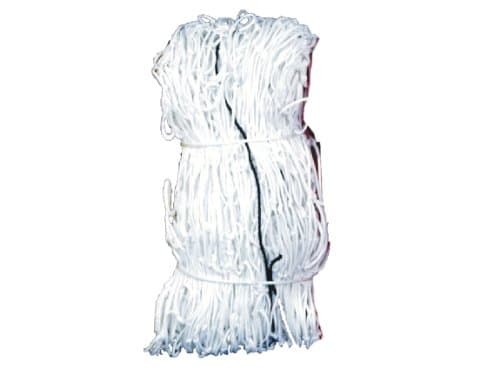
Kwik Goal 3mm Twisted Soccer Net, (4-Feet H X 6 W X 2-Feet D X 4-Feet B), White
The buy-it-once net for a goal that is staying up, and overkill for anything portable. It is also the only one here whose specs you can actually check.
Best for
A permanent backyard goal, or a club replacing netting properly
Levels
U7–U8 rec · U9–U10 · U11–U12 · U13+ travel & club
Type / surface
4 H x 6 W x 2 D x 4 B ft net, 3 mm twisted
How it fits
This is the net where measuring matters most. The 2 ft top depth and 4 ft bottom depth describe a real goal's box shape; a flat-backed pop-up has neither, and the net will not hang correctly on one.
What we like
The only net here that publishes a cord diameter, a mesh size and a full four-dimension size, which is the specification language clubs buy in and the reason you can tell whether it fits
UV-treated HTPP rather than unspecified polyethylene, and UV is what actually kills a net that lives outdoors all year
3.5 in (90 mm) mesh is small enough that a size 3 ball cannot pass through it, which the 120 mm backyard nets cannot promise
Kwik Goal is the brand most US clubs already use for field equipment, so this is the net on the goals your kid plays on at the park
Where it falls short
It costs more than three generic nets, which is hard to justify on a pop-up goal that will be outgrown in two seasons
Heavier netting needs a frame that can take the tension — on a flexible fiberglass pop-up it will pull the uprights inward
The four-dimension size has to match your frame's depth as well as its face, which rules out a lot of backyard goals
Manufacturer’s published specs
High Tenacity Polypropylene (HTPP), UV-treated to resist damage from sunlight (Kwik Goal)
3 mm cord, 3.5 in (90 mm) mesh (Kwik Goal)
4 ft high, 6 ft wide, 2 ft top depth, 4 ft bottom depth (Kwik Goal)
Whether it fits your yard. The most respected brand in the category in an 8 ft x 5 ft is the wrong goal for a 20 ft lawn. What size backyard soccer goal is the measurement, and it comes before the brand.
Whether it will stay upright. The CPSC publishes anchoring, counterweighting and storage recommendations for movable goals because they tip. No badge substitutes for pegs — see how to anchor a backyard soccer goal.
Who designed the frame. On the portable outdoor goal, the SKLZ QUICKSTER is a licensed QuickPlay KICKSTER by QuickPlay's own account. Two badges, one design.
Whether you can repair it. A goal with a replaceable net outlasts a goal with a better frame and no parts. Best replacement soccer goal nets covers what fits what.
Whether a goal is even the right purchase. For a player who mostly needs touches rather than targets, a rebounder does more — soccer goal vs rebounder is the honest comparison.
Common questions
What is the best soccer goal brand for kids?+
Franklin Sports, for most families starting out. It is the one brand that sells the goal, the replacement net, the rebounder, the mini goal and the shin guards at the same entry price, so a first season can be bought in one order, and its Blackhawk 4 ft x 3 ft portable is honestly sized for U6 to about U10. From roughly U11, when a flexible frame starts visibly losing to a hard shot, QuickPlay is the brand worth moving to.
Is SKLZ the same as QuickPlay?+
On the portable outdoor goal, effectively yes. QuickPlay states that its KICKSTER design was licensed to SKLZ, which sells it in the US as the QUICKSTER. So comparing those two on brand quality is comparing one design against itself — decide on price, on which size is in stock and on warranty terms instead. SKLZ's own designs are its trainers, its ladders and the Pro Mini indoor goal, and those are genuinely good.
Does Kwik Goal make backyard soccer goals?+
Kwik Goal makes the goals most US clubs and schools use — it describes itself as the #1 soccer goal supplier in North America and as Technical Partner and the Official Goal of U.S. Soccer — but its channel is dealers, catalogs and pricing requests rather than consumer checkout, and its goals are priced as institutional equipment. For a family the smart way to use the brand is the hardware: its nets, pumps and cones are the best-documented parts in the category.
Is NET PLAYZ a good soccer goal brand?+
Its fold-up goals offer real net depth for the money, which genuinely cuts down on chasing the ball. The caveat is documentation: NET PLAYZ has no brand-owned website, so there is no manufacturer specification, no readable warranty at source and no parts diagram — everything verifiable comes from the retailer listing in front of you. Buy it on the retailer's return policy rather than on manufacturer support.
Are expensive soccer goals worth it for a child?+
Below about U10, no. A young player cannot shoot hard enough to find the limits of a cheap fiberglass frame, and the money is better spent on a second goal so there is a game. From about U11 the picture flips: a hard shot distorts a flexible frame, a small mouth stops being a useful target, and a designed frame from QuickPlay or a contained system from Open Goaaal starts earning its price.
Which soccer goal brand lasts the longest?+
Judged on published specifications rather than on our own testing, Kwik Goal — it is the only brand here that publishes figures like cord diameter, mesh size and UV treatment for a component. Among brands that actually sell to families, longevity depends less on the name than on two things: whether the net can be replaced, and whether the goal is anchored and stored rather than left to blow across the lawn all winter.
Do I need a brand-name soccer goal at all?+
No. For a first goal the size, the anchoring and whether the net is replaceable all matter more than the badge, and a correctly sized unbranded goal that is pegged down will outlast a famous one that is not. What a known brand buys you is a published size run you can plan around and, in some cases, spare parts — which is why the brand question becomes real at about U11 and barely exists at U7.
Sources
Kwik Goal — about the company — Kwik Goal's own account of itself and the source for every Kwik Goal brand claim on the goal-brands page: the idea originating on Christmas Eve 1980 with the Caruso brothers building the first prototype afterward, "Since 1981" as the start of its rise to market leadership, its description of itself as the leading supplier of soccer goals, field equipment, training equipment and seating for domestic and international markets and the #1 soccer goal supplier in North America, its statement that it is Technical Partner and the Official Goal of U.S. Soccer, and its dealer search and catalog/pricing request pages, which are the trade channel referred to there.
QuickPlay — about us — QuickPlay's own company history and the source for: founding in 2007 by Allen Holland and Will Parsons, product design graduates of Sheffield Hallam University; headquarters in Sheffield, UK and San Diego, USA; the KICKSTER as the company's first product, launched in two sizes in 2007 and designed to set up in seconds and be easy to carry; design work that the company states has earned patents in the UK and internationally; and its statement that the KICKSTER design was licensed to SKLZ, which sells it in the US as the QUICKSTER.
SKLZ — about us — SKLZ's own account of itself and the source for the SKLZ brand claims on the goal-brands page: founded in 2001 out of the Hit-A-Way Baseball Trainer, which it names as its first product; a sport-training equipment brand spanning baseball, soccer, golf and basketball whose products it says "target specific skill sets"; grouped into skill training, performance training, brain training and measurement; and aimed at "athletes of all ages and levels". The site footer lists Implus Footcare LLC of Durham, NC.
Implus (SKLZ) — Pro Mini Soccer product data — The manufacturer's own product data for the SKLZ Pro Mini Soccer set and the source for every figure quoted about it: a goal measuring 22 in x 15 3/4 in x 16 in supplied with a 5 in soft foam ball, an 85% PVC / 15% PP build, an "authentic shape mini soccer goal", "durable construction to withstand long hours of play", and an easy-to-assemble frame.
Scheels — Franklin MLS Mini Soccer Goal set — The retailer listing for Franklin's kids mini goal set and the source for its published figures: a 22 in x 17 in x 16 in goal supplied with a rotation-molded ball and an inflation pump, and quick-fold corner joints that fold and lock for assembly in seconds. Confirmed in stock when checked.
GoSports Portable Pop Up Soccer Goals Set (pair) — The retailer listing for the GoSports pop-up pair and the source for its published figures: two collapsible goals plus six training cones, a carrying case and both plastic and metal stakes; a 3 lb set weight; premium nylon fabric, netting and a metal frame; high-visibility reflective fabric for low-light play; goals that set up and take down in seconds with no assembly required; and the listing's own note that they can be secured to grass or taped to hard courts, which is the detail that makes the pair usable on an indoor floor. Confirmed in stock when checked.
Kwik Goal 3mm twisted soccer net — published specification — The retailer listing carrying Kwik Goal's own specification for the 3 mm net in the 4 ft x 6 ft size, and the source for every figure quoted about it: High Tenacity Polypropylene (HTPP), 3 mm cord, 3.5 in (90 mm) mesh, 4 ft x 6 ft with a 2 ft top depth and a 4 ft bottom depth, UV-treated to resist damage from sunlight, knotless solid braid rope, and a construction that meets playground safety entrapment prevention requirements. This is the only net on the replacement-net page with a published cord diameter and mesh size.
US CPSC — Guidelines for Movable Soccer Goals — Tipover fatality and injury figures, and the CPSC's specific anchoring, counterweighting and storage recommendations. The source for every safety figure on the goal pages.