Heads up: we earn a commission if you buy through our links, at no extra cost to you. It never changes which product we recommend — here’s how that works.
The short answer
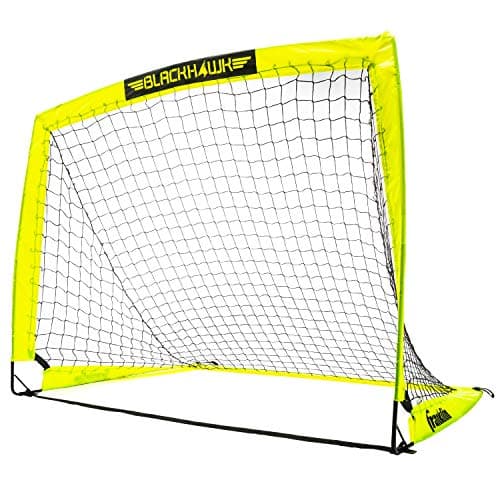
For a toddler, buy a 4 ft x 3 ft pop-up goal and peg it down — the Franklin Sports Blackhawk is the pick, because it sets up from a bag in two to five minutes and is small enough that a three-year-old can actually score. The non-negotiable part is anchoring: the US CPSC's guidance on movable soccer goals exists because unanchored goals tip over onto children.
The instinct with a first goal is to buy big so it lasts. At this age that is backwards on both counts — a big goal is less fun for a toddler and more dangerous, and no goal survives to be the goal a twelve-year-old wants anyway.
Anchoring is the whole safety story
Start here, because it is the only part of this page that is not a preference. The US Consumer Product Safety Commission publishes guidelines for movable soccer goals specifically because of tipover deaths and injuries, and its recommendations are about anchoring, counterweighting and storage.
A toddler is the exact population those guidelines are about: light enough to be hurt by a falling frame, and inclined to hang on the crossbar the moment nobody is looking. Three rules follow.
Peg or weight it from day one, not after the first time it moves. A lightweight frame that skips across the lawn under a shot is a frame that can come down.
Never leave it standing while nobody is watching. The CPSC's storage advice is to secure or disassemble goals when they are not in use, and a folding pop-up makes that practical.
No hanging on the crossbar, ever. This is the behavior behind the injuries, and it starts younger than parents expect.
The full method, including what to use on a lawn versus a hard surface, is in how to anchor a backyard soccer goal. Read that before the goal arrives rather than after.
The size that fits a toddler
Scale the goal to the player, not to the sport. A U6 program plays small-sided formats on small fields with a size 3 ball, and the goal should match that logic.
Goal size scaled to the player rather than to the pitch. Youth formats progress from small-sided play upward, and backyard equipment should follow the same curve.
Age
Goal size
Why
2-4 (toddler)
4 ft x 3 ft
A toddler can see the whole goal and score. Anything bigger is a net they kick into, not a goal.
5-7 (U6-U8)
4 ft x 3 ft to 6 ft x 4 ft
Still rewarding to score in; starts to need aiming
8-10 (U9-U10)
6 ft x 4 ft
A 4x3 is now filled by the kid standing in it
11+
8 ft x 5 ft or larger
Real finishing practice, real keeper practice
Scroll the table sideways on a narrow screen.
The honest consequence: a goal bought for a three-year-old will be too small by about eight. That is fine — it costs less than one season of club fees, and what size backyard soccer goal covers the sizing decision in full if you would rather buy once for later.
Start here
Pick by your kid’s level
The right answer changes with the level, not just the shoe size. Find your kid’s bracket and start there.
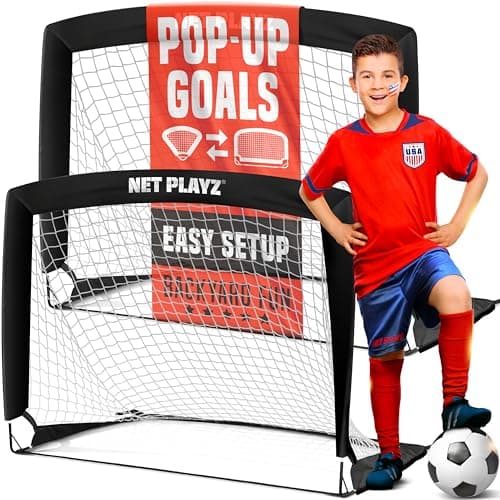
The right first goal: 4 ft x 3 ft, sets up from a carrying case in two to five minutes, and cheap enough that outgrowing it in a few years is not a problem. Peg it down from day one — the fiberglass frame is light.
NET PLAYZ 4ft x 3ft Fold-Up Training Soccer Goal (set of 2)
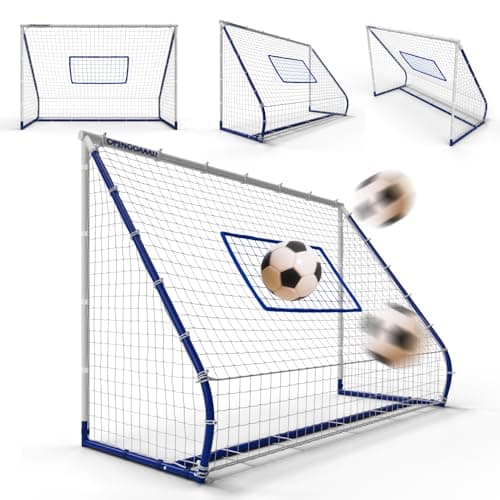
The pick once the kicking gets harder and you are tired of fetching. Roughly 36 inches of net depth means shots stay in the net rather than rebounding back down the yard.
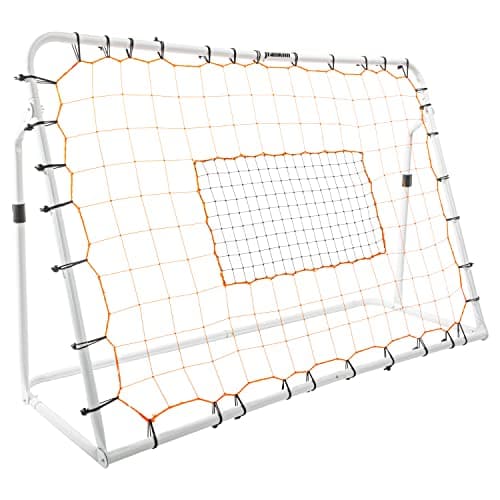
Not a goal, and worth considering instead of one. An adjustable-angle rebounder returns the ball, which is what actually produces touches when a young child is playing alone. Peg it down on grass from day one.
Tap any row to jump to the full write-up. The price in each button is the one Amazon reported on the date stamped under it — tap through for today’s number, which is the only one that can be relied on.
Product photos come from each item’s current Amazon listing.
Do toddlers need a goal at all?
No, and it is worth saying before you spend anything. Two cones, two shoes or two water bottles make a goal, and for a two-year-old the game is kicking the ball rather than beating a keeper.
What a real net adds is feedback. A ball that goes in and stays in reads as a goal to a small child in a way that a ball rolling between two shoes does not, and that feedback is most of why they want to do it again. That is the case for buying one, and it is a reasonable case — it is just not a necessity.
If you are assembling a whole first kit, the order of priority is in U6 first kicks and a goal is not near the top of it.
1. Franklin Sports
Franklin Sports Blackhawk Portable Soccer Goal
The right first goal for a young player, sized honestly for the ages where it earns its keep.
Best for
A first backyard goal for U6–U10
Levels
U6 — first kicks · U7–U8 rec · U9–U10
Type / surface
4 ft x 3 ft portable
How it fits
Measure your yard before ordering and leave run-up space behind the shooting line, not just the goal footprint.
What we like
Genuinely fast to put up and take down, which is the difference between a goal that gets used and one that lives in the garage
Small enough for an ordinary suburban yard without dominating it
Cheapest route to a real goal rather than two cones
Where it falls short
4 ft x 3 ft is too small to be useful much past U10 — a ten-year-old will fill it
A flexible fiberglass frame flexes: hard shots distort it, and it will not survive a teenager
Manufacturer’s published specs
4 ft x 3 ft goal that sets up from a carrying case in two to five minutes (Franklin)
Fiberglass frame with weather-resistant netting (Franklin)
Franklin's best-selling soccer goal
These are the manufacturer’s own claims, not measurements we took.
Three categories, and for a toddler only two of them are sensible.
Pop-up / flat-frame. Fastest to put up and take down, lightest, cheapest. The right answer at this age, and the pop-up goal picks cover the category.
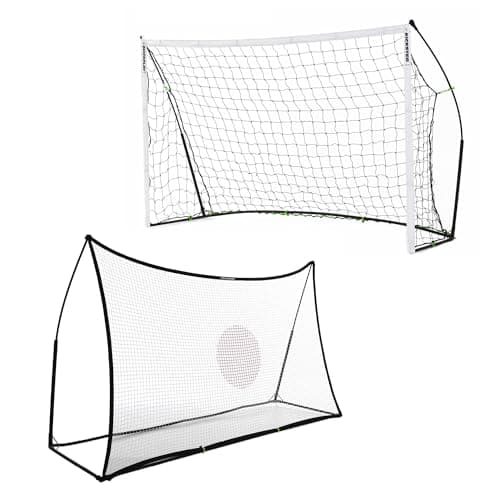
Fold-up with depth. A real net shape that holds the ball. Slower to fold, takes more yard, and the step up once the kicking is harder.
PVC build-your-own. Cheap per square foot and a nice weekend project, but a rigid frame left standing in a yard is exactly what the CPSC's guidance is about. See how to build a backyard soccer goal if you go this way — and anchor it.
What to buy with it
A size 3 ball, which is the right size for U8 and under, and ground pegs if the goal does not include decent ones. That is the list.
Not a keeper's gloves, not cones, not a rebounder yet. A toddler with a small goal and a correctly sized ball has everything the activity needs — the size 3 ball picks are the other half of the purchase.
A toddler goal that lives outside and a goal that lives in a playroom are not the same purchase: indoors the constraints are noise, breakables and a frame that cannot be pegged down. The indoor goal picks cover the mini goals that work on a floor, and the smallest of them arrives with a soft foam ball.
Common questions
What size soccer goal is best for a toddler?+
4 ft x 3 ft. A toddler can see the whole goal and score in it, which is the entire point at this age, and a smaller frame is lighter, takes less yard and folds away quickly. Anything bigger becomes a net they kick into rather than a goal they score in.
Are backyard soccer goals safe for toddlers?+
Only if they are anchored. The US Consumer Product Safety Commission publishes guidelines for movable soccer goals precisely because unanchored goals tip over onto children, and its advice covers anchoring, counterweighting and securing or disassembling goals when they are not in use. Peg or weight the goal from the first day, never leave it standing while nobody is watching, and do not let a child hang on the crossbar.
Do toddlers need a soccer goal?+
No. Two cones or two shoes make a goal, and for a two-year-old the game is kicking the ball rather than beating a keeper. What a real net adds is feedback — a ball that goes in and stays in reads as a goal to a small child, and that is most of why they want to do it again.
What is the best soccer goal for a 3 year old?+
A 4 ft x 3 ft pop-up, pegged down. The Franklin Sports Blackhawk is the pick: it sets up from a carrying case in two to five minutes, which is the difference between a goal that gets used and one that lives in the garage, and it is cheap enough that outgrowing it is not a problem. Its fiberglass frame is light, so anchor it.
Should I buy a bigger goal so it lasts longer?+
Generally no at toddler age. A big goal is less fun for a small child and heavier if it comes over, and it is the one most likely to be left standing all summer rather than folded away — which is exactly what the CPSC's guidance warns about. If you would rather buy once for later, read the size guide and accept that a toddler will not use it properly for a few years.
What ball should a toddler use with a backyard goal?+
A size 3, which is the standard size for roughly U8 and under. Ball size matters more than goal size for a young child, because an oversized ball is genuinely difficult to kick cleanly and that frustration is what ends the session.
Sources
US CPSC — Guidelines for Movable Soccer Goals — Tipover fatality and injury figures, and the CPSC's specific anchoring, counterweighting and storage recommendations. The source for every safety figure on the goal pages.
AYSO — Size of Ball and Field by Age Division — Official ball sizes, circumference and weight ranges, and field dimensions by age division. Used for every ball-size and field-size figure on this site.