Heads up: we earn a commission if you buy through our links, at no extra cost to you. It never changes which product we recommend — here’s how that works.
The short answer
From about U12, a backyard goal needs to be 8x5 feet or larger and in a real goal shape — a 4x3 pop-up is something a twelve-year-old fills standing still, and the flexible frames do not survive a teenager's shot. Anchoring matters more as goals get bigger: the CPSC's tipover figures are about full-size goals.
Two things change when a kid hits twelve or thirteen. They strike the ball hard enough to destroy a lightweight frame, and they are big enough that a small goal is no longer a target — hitting it is not an achievement, so it stops being interesting.
At that point the honest options narrow to two: a properly sized goal, or nothing. A cheap pop-up in a teenager's yard is money spent on something that will be ignored by July.
Start here
Pick by your kid’s level
The right answer changes with the level, not just the shoe size. Find your kid’s bracket and start there.
Tap any row to jump to the full write-up. We do not show prices because we do not hold live pricing — the button opens the current Amazon listing so you see today’s number rather than last month’s.
Product photos are licensed representative stock images, not photographs of the exact model.
Size, honestly
A full-size adult goal is 8 yards by 8 feet, which nobody has room for in a yard. The useful target for a teenager is 8 feet by 5 feet — big enough to require placement rather than just contact, small enough to fit a large lawn.
Size
Verdict for a teenager
4 x 3 ft
Too small. Fills it standing still.
6 x 4 ft
Workable for a U12; outgrown quickly.
8 x 5 ft
The sweet spot. Requires aim, fits a big lawn.
12 x 6 ft and up
Genuinely good, and needs a field rather than a yard.
Scroll the table sideways on a narrow screen.
Measure the yard before ordering, and measure the run-up behind the shooting position rather than only the goal footprint. An 8x5 needs a properly large flat area, and the ground needs to be reasonably level — these frames rely on even tension. What size backyard soccer goal do you need covers it.
The real constraint is where the misses go
With a teenager, this stops being an annoyance and becomes the binding constraint. A thirteen-year-old striking a ball properly and missing sends it a long way, and in an ordinary suburban yard that means a road, a flowerbed, or a neighbor's window.
Eventually somebody says stop, and that — not the equipment — is what limits how much practice actually happens. Two things address it:
A backstop. Netting extending above and around the goal, catching the misses. Open Goaaal's system builds this in, and it is the main reason to pay what it costs for a small yard.
Net depth. Keeps the shots that go in from rebounding back down the yard, which halves the retrieving.
If your yard genuinely cannot contain a missed shot from a teenager, a backstop is not a luxury — it is the thing that makes the goal usable at all.
Goal, rebounder, or both?
For a teenager, a combined unit is usually the right answer, because most of their extra work happens alone.
A panel-swap unit like the QuickPlay Kickster switches between a goal shape and a rebound surface in seconds, which is quick enough that it genuinely happens mid-session. That covers shooting and passing from one purchase, and passing repetition is what a solo player actually needs most.
The CPSC's recommendations for goals of this size are specific: anchor firmly at the rear at all times, with the anchors flush to the ground. Use at least two auger-style helical anchors screwed into the ground, or two to four peg or stake anchors about ten inches long driven in at angles, or sandbags and counterweights on a hard surface where staking is not possible. When the goal is not in use, remove the nets and lock or chain it — to another goal or to a fixed structure such as a permanent fence.
A bigger goal in a yard where younger siblings also play is exactly the scenario those figures describe. The full method is here.
Portable, or leave it up?
Leave it up, if the yard allows. The goal that gets used is the one already standing when a teenager wanders outside with a ball — and a teenager who has to assemble a goal first mostly does not.
The consequence is that anchoring stops being advice and becomes the whole point. A permanently erected goal in a yard with children is precisely the situation the CPSC guidance addresses.
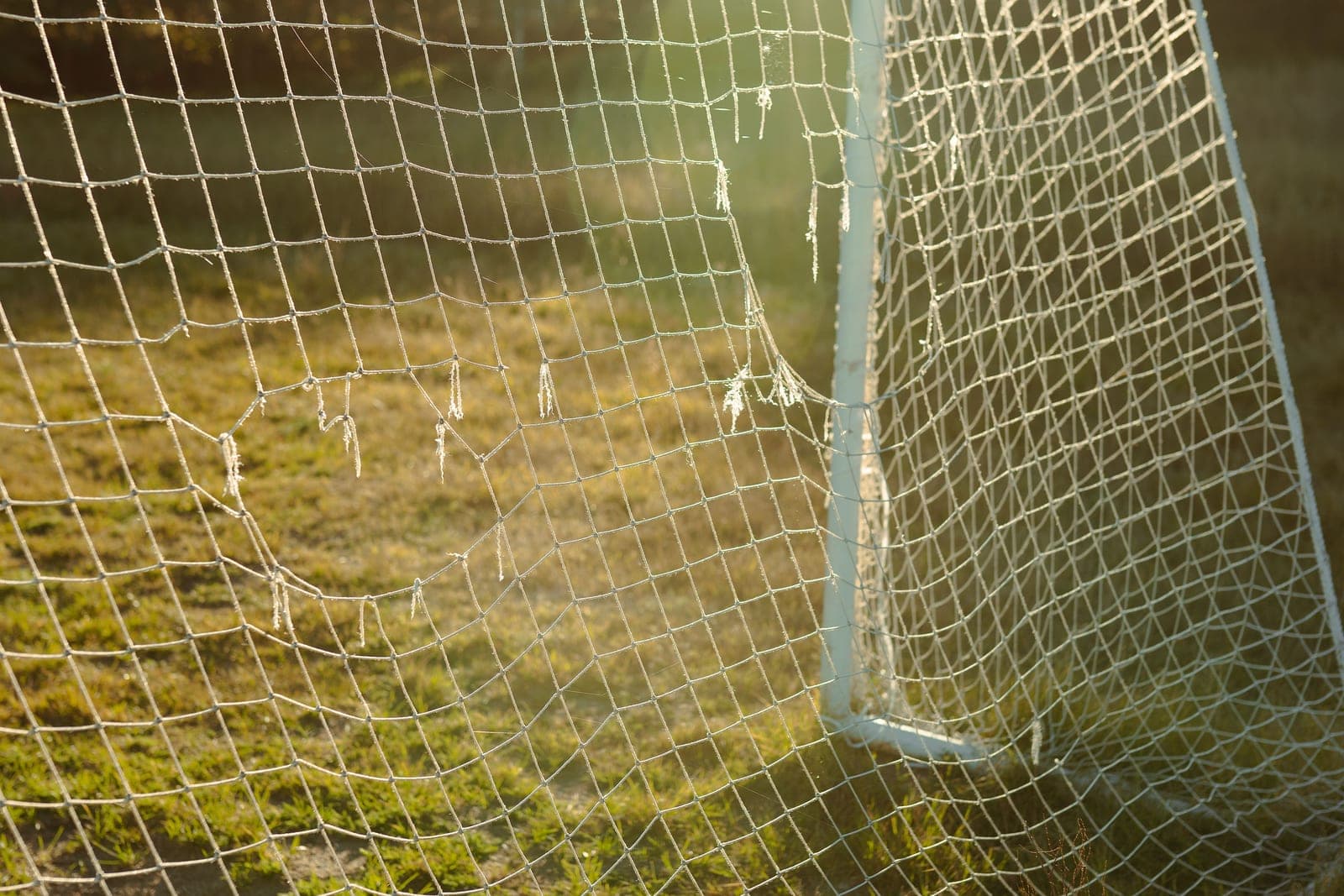
8 feet by 5 feet is the sweet spot — big enough that hitting it requires placement rather than just contact, and small enough to fit a large lawn. A 4x3 pop-up is something a teenager fills standing still, and the flexible frames do not survive their shot.
Are backyard soccer goals worth it for teenagers?+
Yes, if it is the right size and it stays up. A properly sized goal that lives in the yard gets used; a small one gets ignored by July, and one that has to be assembled each time gets used on the days somebody organizes a session. The binding constraint is usually where the missed shots go.
How do you stop missed shots leaving the yard?+
A backstop — netting extending above and around the goal — is the only thing that genuinely solves it. Open Goaaal's system builds one in, which is the main reason to pay what it costs in a small yard. Net depth helps separately, by keeping the shots that go in from rebounding back down the yard.
Can you leave a backyard soccer goal up all year?+
Yes, and it will get used far more if you do — but it must be properly anchored and checked. The CPSC's guidance is to anchor firmly at the rear with the anchors flush to the ground, and to remove the nets and secure the goal when it is not in use, because an unattended goal is what children climb on.
Should a teenager get a goal or a rebounder?+
Usually a combined unit, because most of a teenager's extra work happens alone. A panel-swap unit switches between a goal shape and a rebound surface fast enough that it happens mid-session, covering shooting and passing from one purchase — and passing repetition is what a solo player needs most.
Sources
US CPSC — Guidelines for Movable Soccer Goals — Tipover fatality and injury figures, and the CPSC's specific anchoring, counterweighting and storage recommendations. The source for every safety figure on the goal pages.