Heads up: we earn a commission if you buy through our links, at no extra cost to you. It never changes which product we recommend — here’s how that works.
The short answer
For a hallway or living room, the SKLZ Pro Mini Soccer set — a 22-inch goal that ships with a 5-inch soft foam ball, which is the part that keeps it legal indoors. For a playroom, Franklin's 22-inch kids mini goal set adds a ball and a pump in the box. For a basement or garage game, the GoSports 4 ft pop-up pair is the only set here designed to be taped down on a hard floor.
This page exists because of February. A kid who trains twice a week outdoors in September wants to kick something in a corridor in February, and the choice is between a goal that is built for it and a laundry basket.
It is a different purchase from a backyard goal, and not a smaller version of one. Everything that makes a yard goal work — stakes, size, a frame that shrugs off weather — is either useless or actively a problem on a floor inside a house. If the goal is going outside, what size backyard soccer goal and the pop-up goal picks are the right pages instead.
What makes a goal usable indoors
Five things, and only the first is about the goal's quality:
It cannot need stakes. A yard goal is held down by pegs driven into turf. On a floor there is nothing to peg into, so the goal has to be either heavy enough to stay put, light enough not to matter when it moves, or tapeable — the GoSports listing is the only one here that mentions securing to a hard court.
It has to be small enough that the room is still a room. A 22-inch goal lives against a wall and nobody trips over it. A 6 ft goal in a basement means the basement is now a soccer field.
It has to come with, or tolerate, the right ball. This is the whole game and it is covered below.
It has to be quiet. A metal-framed goal on a hardwood floor is a drum. PVC and nylon are not.
It has to fold. An indoor goal that cannot be put away gets put away permanently, by an adult, in a garage.
Start here
Pick by your kid’s level
The right answer changes with the level, not just the shoe size. Find your kid’s bracket and start there.
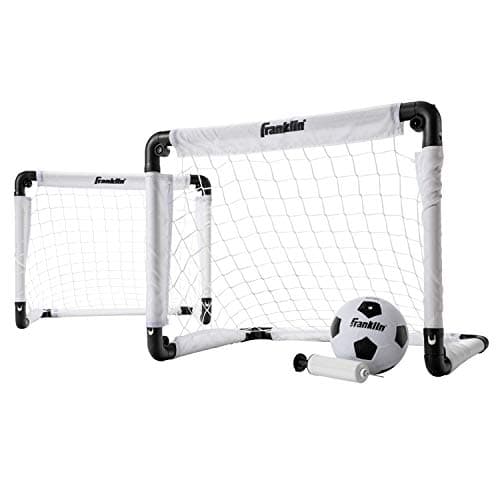
Franklin Sports Kids Mini Soccer Goal Set (22 in, with ball and pump)
The widest mini goal here at 28 inches, which is the difference between a target a four-year-old can hit and one they can miss all afternoon. The included pump lets you soften the ball for indoor use.
The best true indoor goal at this age, mostly because the 5-inch foam ball comes in the box. A rigid 22-inch frame holds a goal shape instead of sagging like a flat pop-up.
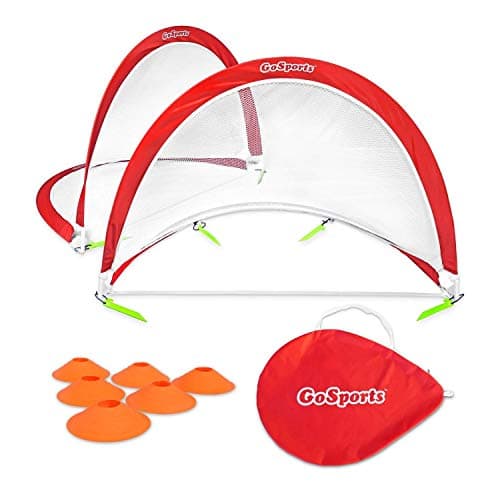
GoSports Portable Pop Up Soccer Goals, 4 ft (set of two)
Two goals rather than one, which is what turns a basement into a game. The listing's own note that they can be taped to hard courts is the reason this is the pick for a floor.
Tap any row to jump to the full write-up. The price in each button is the one Amazon reported on the date stamped under it — tap through for today’s number, which is the only one that can be relied on.
#
Product
Best for
Surface
Fit notes
Price
1
SKLZ Pro Mini Soccer GoalThe best true indoor goal for a young child, mostly because it arrives with the right ball already in the box.
U6, U7–U8 rec
22 in mini goal, indoor
Measure the shooting lane, not the goal: 22 inches of goal needs about ten feet of clear floor in front of it to be worth setting up..
Product photos come from each item’s current Amazon listing.
Sizing a goal to a room, not to a child
Outdoors, goal size tracks age. Indoors it tracks square footage, and the age question barely enters into it — a twelve-year-old in a hallway needs the same small goal a five-year-old does, because the hallway has not changed size.
Measure the shooting lane, not the goal. Roughly ten feet of clear floor in front of a mini goal is the minimum for it to be worth setting up.
Space
Goal size
What works
Ball
Hallway or corridor
About 22 in
SKLZ Pro Mini
Foam only
Living room or playroom
About 22 in
Franklin 22 in mini set
Foam, or the softened ball supplied
Finished basement
2.5-4 ft pair
GoSports pop-up pair
Foam or low-bounce
Garage with clear floor
4 ft
GoSports 4 ft pair
Low-bounce or futsal
Gym or rec hall
4 ft+
A real pop-up goal
Futsal or indoor ball
Scroll the table sideways on a narrow screen.
The depth measurement is the one people forget. A goal is not a flat object: the SKLZ frame is about 16 inches deep, and the clearance you need in front of it is several times that. A goal set up with two feet of run-up gets one shot and then becomes a storage bin.
1. SKLZ
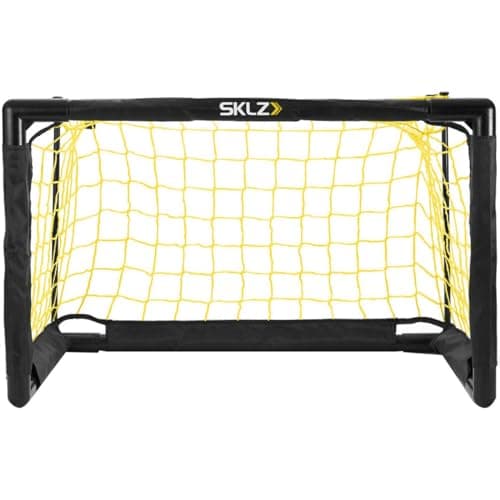
SKLZ Pro Mini Soccer Goal
The best true indoor goal for a young child, mostly because it arrives with the right ball already in the box.
Best for
A hallway or living room, from first kicks to about U8
Levels
U6 — first kicks · U7–U8 rec
Type / surface
22 in mini goal, indoor
How it fits
Measure the shooting lane, not the goal: 22 inches of goal needs about ten feet of clear floor in front of it to be worth setting up.
What we like
It ships with the foam ball, which is the part parents get wrong — the goal is never what breaks a lamp
At 22 inches wide it fits in a hallway, which is where small children actually want to shoot in February
Rigid enough to hold a goal shape, unlike a flat pop-up that sags the moment a ball hits the top of the net
Where it falls short
Too small to be interesting past about U8, and a nine-year-old will fill the mouth of it with one shot
A PVC frame on a hard floor slides on impact unless it is backed against something, and repeated hard shots will crack the joints
Manufacturer’s published specs
Goal measures 22 in x 15 3/4 in x 16 in (SKLZ)
Supplied with a 5 in soft foam ball
85% PVC / 15% PP frame and net
Easy-to-assemble frame, designed for indoor use
These are the manufacturer’s own claims, not measurements we took.
GoSports Portable Pop Up Soccer Goals, 4 ft (set of two)
The pick when the point is a game between two kids rather than shooting practice, and the easiest set here to pack away.
Best for
A garage, a gym floor or a yard, U8 through U12
Levels
U7–U8 rec · U9–U10 · U11–U12
Type / surface
4 ft pop-up pair, hard floor or grass
How it fits
The 4 ft pair is the version to buy for a garage or a yard. GoSports also lists 2.5 ft for tight indoor spaces and 6 ft for older players — check the size on the listing before ordering. The pair needs clear floor between them, not just behind them.
What we like
A pair rather than a single goal, which is what makes a space a game instead of shooting practice
Both stake types in the box, so the same set works on turf and on grass without a second purchase
Collapses into a carry case, so it genuinely moves between a garage, a gym and a yard
Where it falls short
At 4 ft these are small-sided targets, not a goal a U12 player can practice shooting corners into
Stakes do not work on a hard floor, so indoors the goals shift under a hard shot unless they are backed against something
Manufacturer’s published specs
Two collapsible 4 ft goals plus six training cones and a carrying case (GoSports)
Both plastic and metal stakes included (GoSports)
Sets up and takes down in seconds with no assembly (GoSports)
Also listed in 2.5 ft and 6 ft sizes (GoSports)
These are the manufacturer’s own claims, not measurements we took.
A single goal is shooting practice. Two goals is a game, and a game is the thing that gets played for an hour instead of ten minutes. This is the strongest argument for the GoSports pair indoors: two goals, six cones and a carry case in one box, and the range is listed in 2.5 ft as well as the 4 ft pair if the room is tight. Two small goals fit in a basement where one full-size goal would be awkward.
It is also the small-sided principle every youth federation applies outdoors, arriving indoors by a different route. Fewer players, a smaller field and more touches per child is better practice than a full-size game, and a pair of mini goals in a basement produces exactly that whether anyone intended it or not.
If there is only room for one goal, the alternative is a rebounder rather than a bigger goal: a wall-return net turns one child into two players. That is a different purchase with different trade-offs, and soccer goal vs rebounder weighs them against each other properly.
The safety part, which is short but not optional
Mini goals are not the goals that hurt children. The US Consumer Product Safety Commission's guidance on movable soccer goals exists because full-size metal goals tip over onto people, and its anchoring, counterweighting and storage recommendations are written for those. A 22-inch PVC goal weighing a couple of pounds is not in that category.
Two indoor-specific risks are real, though, and neither is the goal falling over:
The frame sliding on impact. A light goal on a hard floor moves when a ball hits the net, and a child chasing a rebound into a moving frame is how indoor games produce bruises. Back the goal against a wall, or tape it down.
Tape residue and floor marks. The GoSports listing says the goals can be taped to hard courts, which is useful and also a warning: test any tape in a corner of a finished floor before committing to it, and pull it up the same day.
What is behind the goal. The net stops most shots and not all of them. Anything breakable within a few feet of the back of the goal should move before the first game, not after it.
The anchoring question changes completely the moment a goal goes outside, where tipping genuinely is the hazard — how to anchor a backyard soccer goal covers that, and it is worth reading before a mini goal gets promoted to the yard.
What to pair with the goal
The goal is the cheap part of making indoor soccer work. Three things matter more:
A ball that belongs inside. Foam for a hallway, a low-bounce or futsal ball for a basement or garage. A futsal ball is built with a damped bounce rather than simply being smaller, which is why it behaves on a hard floor — futsal ball vs soccer ball explains the difference, and the indoor ball picks are sorted for hard surfaces.
Flat shoes, or none. Cleats indoors are both dangerous and destructive. A flat indoor sole is the right footwear if any is worn, and the indoor soccer shoe picks cover what actually grips a gym or basement floor.
Cones, for the half of indoor practice that is not shooting. A 22-inch goal only entertains for so long; dribbling drills around cones use less space and last longer. The cones in the GoSports set are there for exactly this, and the training equipment picks cover the rest.
A skills or mini ball is the other quiet upgrade for indoor use. Select sells its size 1 as a mini ball alongside the skills range rather than as a match ball, which is the right way to think about it, and a smaller ball in a small space genuinely works — it is slower, lower and harder to control, which is the point. Size 1 vs size 3 soccer ball covers which one a child should actually be using.
When to skip the indoor goal entirely
Two situations, said plainly, because a page recommending goals should say when not to buy one.
The first is a house with no clear ten-foot lane anywhere. A goal with no run-up is not a goal, and the money is better spent on a ball and a wall — a foam ball against a garage door is a real training session, and it is what a lot of good players actually grew up doing.
The second is a player past about U10 who wants to practice shooting properly. A 2.5 ft target does not teach placement, and a mini goal at that age is a toy rather than training. The honest answer there is a yard goal, a rebounder or a gym booking, not a smaller version of the thing they need. The teen backyard goal picks are the right page for a player who has outgrown this one, and the rebounder picks are what works when a full goal will not fit.
And if the indoor games are producing a volunteer goalkeeper, the shirt is the cheap part of that kit — the youth keeper jersey picks explain which ones are padded, which is not the ones the prices suggest.
Common questions
What is the best indoor soccer goal for kids?+
The SKLZ Pro Mini Soccer set for most homes. The goal is a rigid 22 in x 15 3/4 in x 16 in frame, which fits against a wall in a hallway or living room, and it ships with a 5 in soft foam ball — the part that decides whether indoor play survives contact with a lamp. For a wider target, Franklin's 28-inch MLS mini goal includes a ball and a pump.
Can you use a backyard soccer goal indoors?+
Usually not well. A yard goal is held in place by stakes driven into turf, and on a floor there is nothing to stake into, so a light frame slides every time a ball hits the net. Yard goals are also sized for a yard: a 4 ft goal dominates a basement and a 6 ft goal is unusable in one. A mini goal that can be backed against a wall or taped down is the indoor answer.
What size soccer goal fits in a basement?+
Between about 2.5 ft and 4 ft, and ideally two of them. A pair of small goals turns a basement into a small-sided game, which is what gets played for an hour, while a single larger goal is shooting practice that stops after ten minutes. Measure the shooting lane rather than the goal — roughly ten feet of clear floor in front of each goal is the working minimum.
What ball should kids use for indoor soccer at home?+
A soft foam ball in a hallway or living room, and a futsal or low-bounce ball in a basement, garage or gym. A standard outdoor ball at normal pressure is what breaks things, and it is the usual reason indoor play gets banned. If the goal you buy ships with a PVC ball and a pump, use the pump to deliberately under-inflate it for indoor use.
Are mini soccer goals safe indoors?+
The tipping hazard that the CPSC's movable-goal guidance addresses applies to full-size metal goals, not to a two-pound PVC mini goal. The real indoor risks are different: a light frame sliding when a ball hits it, which is solved by backing it against a wall or taping it down; tape residue on a finished floor, worth testing in a corner first; and whatever breakable object is sitting a few feet behind the net.
How much space do you need for an indoor soccer goal?+
Roughly ten feet of clear floor in front of the goal, plus the goal's own depth — the SKLZ frame is about 16 inches deep, and a pop-up is deeper. Width matters less than the shooting lane. A goal set up with two feet of run-up gets one shot and then becomes a storage bin.
Is an indoor soccer goal worth it for an older kid?+
Not usually past about U10 if the aim is real practice. A 2.5 ft target does not teach placement, so a mini goal at that age is a toy rather than training. A yard goal, a rebounder that returns the ball, or gym time are the honest alternatives — a rebounder in particular turns one player into two and takes less floor than a pair of goals.
Sources
Implus (SKLZ) — Pro Mini Soccer product data — The manufacturer's own product data for the SKLZ Pro Mini Soccer set and the source for every figure quoted about it: a goal measuring 22 in x 15 3/4 in x 16 in supplied with a 5 in soft foam ball, an 85% PVC / 15% PP build, an "authentic shape mini soccer goal", "durable construction to withstand long hours of play", and an easy-to-assemble frame.
Scheels — Franklin MLS Mini Soccer Goal set — The retailer listing for Franklin's kids mini goal set and the source for its published figures: a 22 in x 17 in x 16 in goal supplied with a rotation-molded ball and an inflation pump, and quick-fold corner joints that fold and lock for assembly in seconds. Confirmed in stock when checked.
GoSports Portable Pop Up Soccer Goals Set (pair) — The retailer listing for the GoSports pop-up pair and the source for its published figures: two collapsible goals plus six training cones, a carrying case and both plastic and metal stakes; a 3 lb set weight; premium nylon fabric, netting and a metal frame; high-visibility reflective fabric for low-light play; goals that set up and take down in seconds with no assembly required; and the listing's own note that they can be secured to grass or taped to hard courts, which is the detail that makes the pair usable on an indoor floor. Confirmed in stock when checked.
US CPSC — Guidelines for Movable Soccer Goals — Tipover fatality and injury figures, and the CPSC's specific anchoring, counterweighting and storage recommendations. The source for every safety figure on the goal pages.
Select Sport — soccer balls — Select's current ball range, used to confirm that its outdoor balls start at size 3 and that its size 1 offering is a mini ball sold alongside the skills range rather than as a match ball.