Heads up: we earn a commission if you buy through our links, at no extra cost to you. It never changes which product we recommend — here’s how that works.
The short answer
Futsal ball
Outdoor ball (size 5)
Circumference
62-64 cm
68-70 cm
Weight
400-440 g
410-450 g
Pressure
0.6-0.9 atmosphere
0.6-1.1 atmosphere
First bounce from 2 m
50-65 cm (regulated)
Not regulated
Scroll the table sideways on a narrow screen.
Read that table and the whole difference falls out of two rows. A futsal ball is noticeably smaller but weighs almost exactly the same, so it is heavier for its size. And its bounce is a written specification — not more than 65 cm and not less than 50 cm on the first rebound when dropped from two meters — where an outdoor ball has no bounce rule at all.
That is the answer to the question most parents are actually asking. Can your kid use the outdoor ball for the winter indoor season? They can kick it, and it will play nothing like the game they are being coached to play.
Why the low bounce is the point
Futsal is played on a hard flat surface in a small space. A ball that bounced like an outdoor ball would spend the match in the air and against the walls, and the game would stop being futsal.
So manufacturers kill the rebound deliberately. Select fills the bladder of its futsal balls with microfibre polyester specifically to do it — that is the construction difference behind the number in the table, and it is why a cheap indoor ball that is simply a resized outdoor ball does not deliver the behavior the coach is expecting.
The coaching argument is the part worth knowing: a ball that stays on the floor forces the close control futsal exists to teach. Give a kid an outdoor ball in the same session and they practice a different sport.
The sizing trap
Futsal uses its own sizing convention and it does not match outdoor sizing. This catches almost everybody once.
Senda's own guidance on futsal junior and senior sizing. A futsal ball marked size 4 is the senior ball, not a U9-U12 ball.
Futsal size
For
Roughly equivalent to
Futsal 3 (junior)
Under 13
A size 3 from other brands
Futsal 4 (senior)
13 and up
A size 4 from other brands
Scroll the table sideways on a narrow screen.
So a box marked size 4 means something different depending on which shelf it came from. Futsal at least splits cleanly into two: a Junior ball for under-13 play and a Senior ball for 13 and up, which is how Select labels its Jinga range. Two options beats five numbers that mean different things on different shelves.
Start here
Pick by your kid’s level
The right answer changes with the level, not just the shoe size. Find your kid’s bracket and start there.
Age-graded rather than size-numbered, which removes the one mistake this category invites. The microfibre-filled bladder is the construction that actually produces the low bounce.
Tap any row to jump to the full write-up. The price in each button is the one Amazon reported on the date stamped under it — tap through for today’s number, which is the only one that can be relied on.
#
Product
Best for
Surface
Fit notes
Price
1
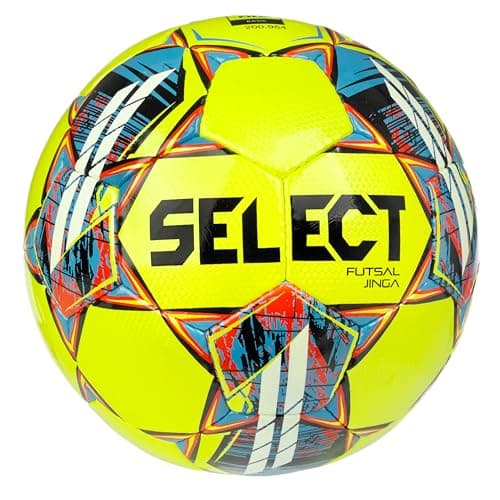
Select Jinga Futsal Ball (Junior)The right ball for a real indoor or futsal season, and the Junior size means a younger player is not handed an adult ball.
U7–U8 rec, U9–U10, U11–U12
Futsal (low bounce)
Buy the Junior size for U8 through about U12 and the Senior (size 4) above that.
Product photos come from each item’s current Amazon listing.
Futsal ball or indoor ball — the same thing?
Not quite, and the labels are used loosely. A futsal ball is a specific regulated object: the sizes, weight, pressure and bounce above. An indoor soccer ball is a looser category that often just means a ball with a cover built for a hard surface, with no bounce specification behind it.
If the program says futsal, buy a futsal ball. If it says indoor soccer and plays on a hard court, a futsal ball is still the better equipment. If it plays on indoor artificial turf in a cage, an ordinary ball is fine — that is closer to outdoor soccer than to futsal. The indoor and futsal picks sort the whole category by age.
What about the footwear?
Worth raising because the two purchases arrive together. Futsal and hard-court indoor play need a flat non-marking gum sole, not studs and not turf nubs — indoor soccer shoes for kids covers it, and most venues enforce it at the door.
If there is a winter futsal season and an outdoor season, two. They are not interchangeable in either direction, and a futsal ball used outdoors on grass is as wrong as the reverse — it is heavy for its size and the cover is built for a court, not for wet grass.
If the indoor season is a few weeks of informal sessions, borrow or use whatever the program supplies. Many do supply balls, and it is worth asking before buying anything — the same advice applies to the full kit list by level.
1. Select
Select Jinga Futsal Ball (Junior)
The right ball for a real indoor or futsal season, and the Junior size means a younger player is not handed an adult ball.
Best for
Indoor and futsal play, sized by age
Levels
U7–U8 rec · U9–U10 · U11–U12
Type / surface
Futsal (low bounce)
How it fits
Buy the Junior size for U8 through about U12 and the Senior (size 4) above that. A futsal ball is graded by bounce rather than by the outdoor size chart, so do not read Junior as a size 3 outdoor ball.
What we like
Split into Junior and Senior rather than sold in one adult size, so an U8 is not playing with a size-4 ball
The genuinely low bounce is the whole point of a futsal ball and cheap indoor balls do not deliver it
Where it falls short
The heavy, low-bounce feel is wrong for outdoor grass play, so this cannot be the only ball
Costs more than a rec outdoor ball of the same nominal size
Manufacturer’s published specs
Butyl bladder with polyester fibers inside, which Select credits for the bounce and control (Select)
Sold in a Junior size as well as Senior — the Junior is the youth futsal ball (Select)
Durable PU surface with a textured pattern (Select)
FIFA Basic approved, one-year warranty (Select)
These are the manufacturer’s own claims, not measurements we took.
The shoes are the other half of a first futsal season, and they are governed by the same Law — futsal shoes vs indoor soccer shoes covers which to buy.
Common questions
What is the difference between a futsal ball and a soccer ball?+
A futsal ball is smaller at 62-64 cm circumference against an outdoor size 5's 68-70 cm, but weighs almost the same at 400-440 g, so it is heavier for its size. The decisive difference is bounce: futsal Law 2 requires a first rebound of 50-65 cm when dropped from 2 m, where an outdoor ball has no bounce specification at all.
Can you use a regular soccer ball for futsal?+
You can kick it, but it will not play like futsal. The game is built around a ball that stays on the floor on a hard surface in a small space, and an outdoor ball bounces far more. If your kid is being coached futsal, an outdoor ball has them practicing something else. For a few informal sessions it is fine.
Is a futsal ball size 4 the same as a soccer ball size 4?+
No, and this is the trap. Futsal uses its own convention: futsal 3 is the junior ball for under-13 play and futsal 4 is the senior ball for 13 and up. So a futsal ball marked size 4 is the senior ball, not a U9-U12 ball. Select labels its Jinga range Junior and Senior rather than by number, which removes the ambiguity.
Why do futsal balls bounce less?+
Because the Laws require it, and manufacturers build to that. Select fills the bladder of its futsal balls with microfibre polyester specifically to kill the rebound. The low bounce keeps the ball on the floor on a hard court in a small space, which is what forces the close control futsal is played to develop.
Is a futsal ball the same as an indoor soccer ball?+
Not necessarily. Futsal balls are a regulated object with specified size, weight, pressure and bounce. Indoor soccer ball is a looser label that often just means a cover built for hard surfaces, with no bounce specification. For hard-court play a futsal ball is the better equipment either way; for indoor artificial turf an ordinary ball is fine.
What pressure should a futsal ball be?+
Futsal Law 2 sets it at 0.6 to 0.9 atmosphere at sea level, which is a narrower range than the 0.6 to 1.1 atmosphere allowed for an outdoor ball. In practice, inflate to the middle of the range printed next to the valve on the ball itself, and check it with a gauge rather than by feel.
Sources
The FA — Futsal Laws of the Game, Law 2: The Ball — The futsal ball specification quoted on this site: circumference not more than 64 cm and not less than 62 cm, weight 400-440 g at the start of the match, pressure equal to 0.6-0.9 atmosphere at sea level, and a first rebound of not less than 50 cm and not more than 65 cm when dropped from 2 m.
IFAB Laws of the Game — Law 2, The Ball — The official size 5 specification quoted on this site: circumference between 68 cm (27 in) and 70 cm (28 in), weight between 410 g (14 oz) and 450 g (16 oz) at the start of the match, and pressure equal to 0.6-1.1 atmosphere at sea level, which the Law itself states as 8.5-15.6 lbs per square inch.
Select Sport — futsal balls — Select's futsal range including the Junior and Senior Jinga models, and Select's own description of the low-bounce bladder construction.
AYSO — Size of Ball and Field by Age Division — Official ball sizes, circumference and weight ranges, and field dimensions by age division. Used for every ball-size and field-size figure on this site.
adidas — kids' soccer — Verified current availability of the adidas models named here, plus adidas's published material and construction claims.