Balls
How to inflate a soccer ball
Six steps, one number, and the mistake almost everybody makes with a dry needle.
By Ryder M. · Published October 4, 2026
The short answer
- Wet the needle — a drop of water or saliva. A dry needle tears the valve.
- Screw the needle fully into the pump hose.
- Push it straight into the valve, not at an angle.
- Pump in short strokes, checking the gauge as you go.
- Stop at the pressure printed next to the valve on the ball.
- Withdraw the needle straight out and store it in the pump handle.
Two of those six steps are the ones people skip, and both cause the same outcome a week later: a ball that will not hold air. Wetting the needle, and pushing it in straight.
Why the dry needle matters
A ball's valve is a self-sealing rubber sleeve. A needle pushed through it dry drags against the rubber instead of sliding, and the damage does not show — the ball inflates normally and then goes soft over a few days while you blame the bladder.
A single drop of water on the needle is enough. Some pumps ship with a tiny bottle of needle oil, which is the same idea. Pushing the needle in at an angle does the same damage from the other direction, by levering the sleeve sideways.
What pressure should a soccer ball be?
For a size 5, there is an official answer. The Laws of the Game set a match ball at a pressure equal to 0.6 to 1.1 atmosphere at sea level, which the Law itself states as 8.5 to 15.6 lbs per square inch. The same Law sets the circumference at 68 to 70 cm and the weight at 410 to 450 g at the start of the match.
For sizes 3 and 4, there is no figure in the Laws, because the Laws describe the ball used in eleven-a-side adult football. Small-sided youth ball sizes come from the competition's own rules — AYSO and US Youth Soccer specify which size belongs to which age group, with circumference and weight ranges, but not a pressure.
So the honest answer for a youth ball is the one printed next to the valve on the ball itself. Every manufacturer prints its own range there and they differ. We are not going to invent a number for you.
| Ball | Official pressure | Where it comes from |
|---|---|---|
| Size 5 (U13+) | 8.5-15.6 lbs/sq in | IFAB Law 2 |
| Size 4 (U9-U12) | Not specified | Use the range printed on the ball |
| Size 3 (U6-U8) | Not specified | Use the range printed on the ball |
| Futsal ball | 0.6-0.9 atmosphere | Futsal Law 2 |
Which size your kid should be using in the first place is a separate question, and it maps onto age group exactly. How to choose a soccer ball and the size 3 vs size 4 comparison both cover it.
Inflate to the middle of the range, not the top
This is the practical advice that matters most and it runs against instinct. A ball at the top of its range feels impressive and plays badly for a child.
- Over-inflated, the ball gets hard. It hurts to head, it stings off the laces, and at these ages that genuinely puts kids off striking the ball properly.
- Under-inflated, it goes sluggish, the seams flex more than they should, and it wears faster.
- Middle of the range is the answer for every youth ball, and it is also kinder to the bladder over a season.
No gauge? Use the thumb test
A properly inflated ball barely dents under firm thumb pressure. If your thumb sinks in, it needs air. If it feels like a rock and your thumb makes no impression at all, let a little out.
It is a rough test and it is good enough for a rec game. It is not good enough if a kid is practicing striking regularly, which is when a gauge earns its keep — a pen gauge costs very little and the pump picks cover the options.
What this needs
Kwik Goal
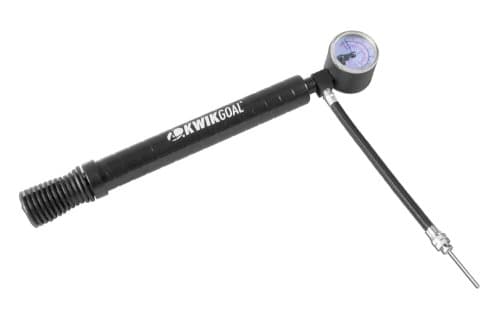
Kwik Goal Premier Hand Pump
The pump to buy if you are buying one: an inline gauge turns inflating a ball from a guess into a reading.
$29.99View on Amazon#ad — we may earn a commission · price as of October 16, 2026
Kwik Goal
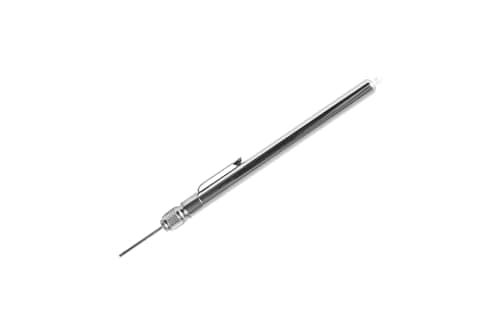
Kwik Goal Pressure Gauge
The cheapest way to stop guessing, if you already own a pump you otherwise like.
$10.00View on Amazon#ad — we may earn a commission · price as of October 16, 2026
Kwik Goal
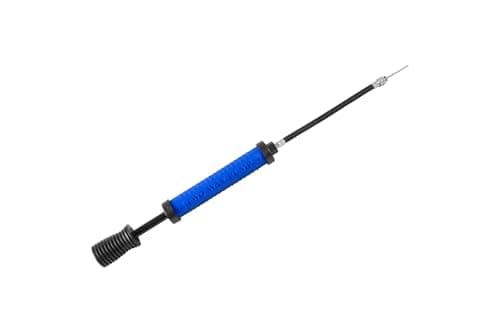
Kwik Goal Mini Hand Pump
The second pump, or the only pump for a family who will realistically never inflate anything bigger than a size 4.
$17.67View on Amazon#ad — we may earn a commission · price as of October 16, 2026
Product photos come from each item’s current Amazon listing.
How often will you be doing this?
That depends entirely on the bladder, and it is the single most useful thing to know before buying a ball.
- Butyl bladder — holds air for weeks. Check it monthly.
- Latex bladder — holds air for days. Expect to pump before nearly every session.
In practical terms that is the difference between a ball that gets used spontaneously and one that never quite works when your kid wants it. Nearly every ball recommended on this site has a butyl bladder for exactly that reason — the size 4 picks go through it in detail.
What to do with a ball that will not hold air
- Inflate it, then put a little soapy water around the valve and look for bubbles. Bubbles at the valve mean a torn valve — usually from a dry needle — and that is not repairable at home.
- No bubbles at the valve means the leak is in the bladder or a seam. Also not worth repairing on a cheap ball.
- Before writing it off, check whether it is simply a latex bladder behaving normally. A ball that goes soft over four days is not faulty, it is latex.
If it is genuinely dead, it is worth keeping as a garden ball and buying a butyl replacement rather than fighting it. A rebounder or a goal gets far more use from a ball that is always ready.
Storing a ball between seasons
Let roughly half the air out and keep it somewhere that is not freezing or baking. A ball stored fully inflated in a hot garage stretches the carcass and goes out of round; stored flat and folded, the panels crease. Half-inflated and indoors is the compromise that works.
Pull the needle out of the pump, wipe it, and put it back in the handle. The needle is the part that gets lost over a winter, and a pump without one is the reason the first session of next season starts with a flat ball.
The number you are inflating to is the part most charts get wrong. Soccer ball PSI by size sets out what the Laws of the Game actually specify, which is a size 5 and nothing else, and where the figure for a size 3 or 4 really comes from.
Common questions
What pressure should a soccer ball be?
For a size 5, the Laws of the Game set it at 0.6 to 1.1 atmosphere at sea level, which the Law states as 8.5 to 15.6 lbs per square inch. For a size 3 or size 4 no governing body publishes a pressure, so use the range printed next to the valve on the ball itself and aim for the middle of it rather than the top.
How do you inflate a soccer ball without a pump?
You cannot do it properly, and the workarounds circulating online either do not work or damage the ball. With the right needle a bicycle or ball-sports pump will do it, which is the practical answer. If you have no pump at all, a ball-and-pump bundle costs less than buying the two separately.
Why do you wet the needle before inflating a ball?
A ball's valve is a self-sealing rubber sleeve, and a dry needle drags against it rather than sliding through. The damage does not show immediately — the ball inflates normally and then goes soft over a few days. A single drop of water or saliva on the needle prevents it, and pushing the needle in straight rather than at an angle matters just as much.
How do you know if a soccer ball is properly inflated without a gauge?
Press firmly with your thumb. A correctly inflated ball barely dents. If your thumb sinks in, it needs air; if it makes no impression at all, let a little out. It is a rough test that is fine for a rec game, but a kid practicing striking regularly is better served by a pen-style gauge.
Can you over-inflate a soccer ball?
Yes, and it is the commoner mistake. An over-inflated ball is hard, stings off the foot and hurts to head, which at youth ages genuinely discourages kids from striking it properly. It also stresses the seams. Inflate to the middle of the printed range rather than the top.
How often should you pump up a soccer ball?
It depends on the bladder. A butyl bladder holds air for weeks, so check it monthly. A latex bladder holds air for days, so expect to pump before nearly every session. A ball that goes soft over four days is not faulty — that is latex behaving exactly as designed.
Sources
- IFAB Laws of the Game — Law 2, The Ball — The official size 5 specification quoted on this site: circumference between 68 cm (27 in) and 70 cm (28 in), weight between 410 g (14 oz) and 450 g (16 oz) at the start of the match, and pressure equal to 0.6-1.1 atmosphere at sea level, which the Law itself states as 8.5-15.6 lbs per square inch.
- The FA — Futsal Laws of the Game, Law 2: The Ball — The futsal ball specification quoted on this site: circumference not more than 64 cm and not less than 62 cm, weight 400-440 g at the start of the match, pressure equal to 0.6-0.9 atmosphere at sea level, and a first rebound of not less than 50 cm and not more than 65 cm when dropped from 2 m.
- AYSO — Size of Ball and Field by Age Division — Official ball sizes, circumference and weight ranges, and field dimensions by age division. Used for every ball-size and field-size figure on this site.
- Kwik Goal — ball pumps, needles and pressure gauges — The current pump range and the stock check for every pump named on this site: the Premier, Fingergrip and Mini hand pumps, the Digital Ball Pump, the PG-3 pressure gauge and the replacement needle packs.
- Kwik Goal — Premier Hand Pump (1A561) — Kwik Goal's published specification: an inline gauge reading 0-30 PSI so pressure is visible while pumping, a needle included, and a stated weight of about one pound.
- Kwik Goal — Mini Hand Pump (1A341) — Kwik Goal's description of the Mini as a compact, dual-action, high-volume hand pump with the needle stored in the handle.
- Kwik Goal — Fingergrip Hand Pump (1A722) — Kwik Goal's description of the Fingergrip as a dual-action pump built for air compression on both strokes, and easy to carry.
- Kwik Goal — Digital Ball Pump (1A571) — The published figures used on this site: up to 30 balls inflated per charge, 135 minutes from empty to full charge, 0.70 lb, 1.63 x 2.63 x 6.5 inches, and a four-inch hose, two needles, a USB cable and a storage bag in the box.
- Kwik Goal — Pressure Gauge (PG-3) — Kwik Goal's specification for the PG-3: a pen-style metal gauge reading 0-20 PSI, sold for checking pressure rather than inflating.
Read next
- Best soccer ball pumpsWhich pump to buy, why dual action matters, and why the gauge is the feature worth paying for.
- How to choose a soccer ball for your kidThree checks in order — size, bladder, where it lives — and what you can safely ignore below U12.
- Size 3 vs size 4 soccer ballThe U9 cutoff, what changes at the transition, and when to start practicing with the bigger ball.
- Best size 4 soccer ballsSize 4 picks for U9 through U12, and the point where a match-quality ball starts earning its money.
- Futsal ball vs soccer ballThe official circumference, weight, pressure and bounce specs side by side, plus which ball a winter indoor season needs.
- Soccer goal vs rebounder: which first?The decision table for goal versus rebounder, the combined units, and the case for waiting.
- Soccer ball size by age — and which ball to buyThe official size-by-age chart, plus picks for size 3, size 4, size 5 and indoor futsal.
- U7–U8 rec: the first real kitAges 6 to 8. Still a size 3 ball, but this is where the first real pair of cleats earns its place.