Balls
Soccer ball PSI by size
Only one ball size has an official pressure range. For the rest, the number is printed on the ball.
By Ryder M. · Published October 10, 2026
The short answer
| Ball | Official pressure range | Source |
|---|---|---|
| Size 5 (14U and up) | 8.5-15.6 psi (0.6-1.1 atm) | IFAB Law 2 |
| Futsal ball | 0.6-0.9 atm | FA Futsal Law 2 |
| Size 4 (10U, 12U) | The figure printed on the ball | Manufacturer |
| Size 3 (6U, 8U) | The figure printed on the ball | Manufacturer |
This page exists because the honest answer is not the one people expect. There is no official PSI for a size 3 or a size 4 soccer ball, because the Laws of the Game only specify the ball used in the eleven-a-side game — a size 5. Every chart you will find online that confidently gives a single PSI for a size 3 has either copied it from somewhere or made it up.
What there is, on essentially every ball sold, is a pressure printed next to the valve by the manufacturer. That number is the answer for your ball, and manufacturers say so: Molten's own care instructions are to use a thin inflation needle to avoid damaging the valve and to inflate the ball slowly to the pressure printed on it.
What Law 2 actually says
For a size 5, the specification is precise and worth knowing in full, because it also sets the ball's circumference and weight. Law 2 requires a circumference between 68 cm and 70 cm, a weight between 410 g and 450 g at the start of the match, and a pressure equal to 0.6 to 1.1 atmosphere at sea level — which the Law itself converts to 8.5 to 15.6 pounds per square inch.
Two things follow from that. First, the legal window is far wider than most people assume: a ball at 9 psi and a ball at 15 psi are both legal and feel completely different. Second, the correct pressure is in single digits to low teens, which is why no soccer pump ever has to work hard and why a bicycle pump reading in the hundreds is the wrong tool.
| Size | Divisions (AYSO) | Circumference | Weight | Pressure |
|---|---|---|---|---|
| Size 3 | 6U, 8U | 23.0-25.0 in | 10-12 oz | Printed on the ball |
| Size 4 | 10U, 12U | 25.0-26.0 in | 11-13 oz | Printed on the ball |
| Size 5 | 14U and up | 68-70 cm (27-28 in) | 410-450 g (14-16 oz) | 8.5-15.6 psi |
| Futsal | Indoor / futsal | 62-64 cm | 400-440 g | 0.6-0.9 atm |
Futsal is specified separately and more tightly. The FA's Futsal Law 2 sets a circumference of 62-64 cm, a weight of 400-440 g at the start of the match, a pressure of 0.6-0.9 atmosphere at sea level, and a first rebound of between 50 cm and 65 cm when dropped from 2 m — that last figure being the low bounce that defines the format.
How to find the number for your ball
- Look next to the valve. Almost every ball has the recommended pressure printed there, usually in both psi and bar.
- If it has rubbed off, check the manufacturer's listing for that model. Brands publish it.
- If you cannot find it at all, treat the size 5 window as the guide — low single digits is too soft for any ball, and the mid range of 8.5 to 15.6 psi is a safe place to be.
- Inflate slowly, with a thin needle, and stop at the number rather than at the feel.
Do not use the squeeze test as your primary measure. An adult hand cannot distinguish 9 psi from 14 psi on a size 4, and the difference is the difference between a ball that dies on the first touch and one that flies. A gauge turns guessing into reading.
What to inflate with
Kwik Goal
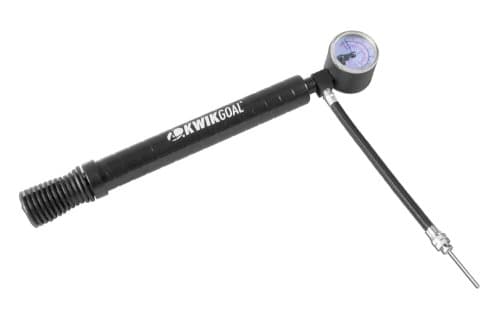
Kwik Goal Premier Hand Pump
The pump to buy if you are buying one: an inline gauge turns inflating a ball from a guess into a reading.
$29.99View on Amazon#ad — we may earn a commission · price as of October 16, 2026
Kwik Goal
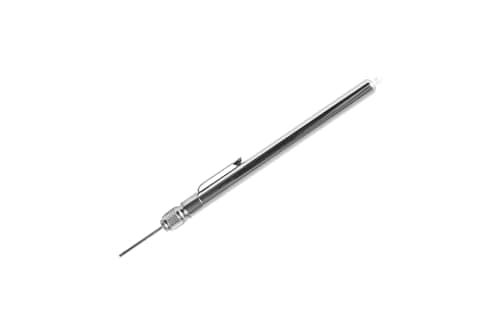
Kwik Goal Pressure Gauge
The cheapest way to stop guessing, if you already own a pump you otherwise like.
$10.00View on Amazon#ad — we may earn a commission · price as of October 16, 2026
Kwik Goal
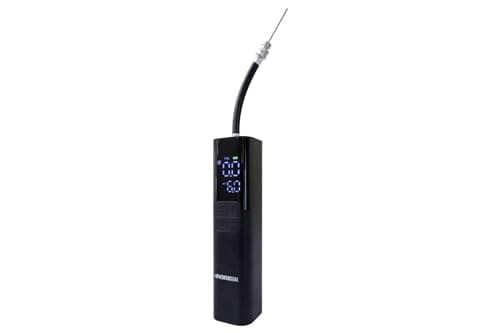
Kwik Goal Digital Ball Pump
Right for a coach or a team manager with a sack of balls. Overkill for one family with one ball.
$100.00View on Amazon#ad — we may earn a commission · price as of October 16, 2026
Product photos come from each item’s current Amazon listing.
Why the wrong pressure costs you a ball
Pressure is not only about feel. A ball kept under-inflated loses its shape permanently, because the panels and the carcass are designed to be held taut. A ball kept over-inflated stresses the seams. Both failures are slow and both are avoidable with a gauge, which is why a pump that reads a number is the cheapest genuinely useful thing a soccer family can own.
Bladder material decides how often you have to think about it. A butyl bladder holds air considerably longer than latex, which in practice is the difference between pumping monthly and pumping weekly. That is also why a cheap yard ball needs checking before every session and a mid-tier ball does not.
- Under-inflated: dead first touch, permanent loss of shape, the ball goes out of round.
- Over-inflated: stressed seams, a harsh ball on a cold morning, and a hard strike on a young foot.
- Correct, and checked: the ball behaves the same way every week, which is the point.
Temperature, altitude and the cold Saturday problem
Law 2's pressure figures are specified at sea level, which is a reminder that pressure is not a fixed property of a ball. Air contracts as it cools, so a ball inflated to the top of its range in a warm house will read lower on a frosty field, and a ball pumped up outside on a cold morning will read higher once it warms up indoors.
The practical version: check the pressure where you are going to play, not in the garage, and check it again in the first cold week of the season. That one habit explains most of the mid-autumn complaints that a ball has gone soft.
Storage matters for the same reason. Molten's care guidance is explicit that a ball should never be left in high temperatures or humidity — a car trunk on a hot day is the example it gives — because that costs the ball its carefully tuned shape and deteriorates the carcass.
The step-by-step is on how to inflate a soccer ball, the pump options are on best soccer ball pumps, and if the ball needs cleaning before it goes away for the winter, how to clean a soccer ball has the routine. For which size a given age should be playing with at all, start at how to choose a soccer ball.
Common questions
What PSI should a size 5 soccer ball be?
Between 8.5 and 15.6 psi. Law 2 of the Laws of the Game specifies a pressure equal to 0.6 to 1.1 atmosphere at sea level and converts it in the Law text to 8.5 to 15.6 pounds per square inch. That is a wide legal window, and a ball at the bottom of it feels very different from one at the top.
What PSI should a size 4 soccer ball be?
There is no official figure, because the Laws of the Game only specify the size 5 ball. The correct pressure for a size 4 is the one printed next to the valve by the manufacturer, and the manufacturer's own instruction is to inflate slowly to that number. Any chart giving a single universal PSI for a size 4 is not citing a governing body.
What PSI should a size 3 soccer ball be?
The figure printed on the ball. No governing body specifies a pressure for a size 3 — Law 2 covers the size 5 only, and AYSO's published figures for a size 3 cover circumference (23.0-25.0 in) and weight (10-12 oz) rather than pressure. Check next to the valve, or the manufacturer's listing for that model.
How do I know if my soccer ball is properly inflated?
Read it with a gauge rather than squeezing it. An adult hand cannot reliably tell 9 psi from 14 psi on a youth ball, and that gap is the difference between a dead first touch and a lively one. A pen-style gauge or a pump with an inline gauge turns it into a number.
Can you over-inflate a soccer ball?
Yes, and it stresses the seams. The other failure is more common: an under-inflated ball permanently loses its shape, because the cover and carcass are built to sit taut. Both are slow, both ruin a ball, and both are avoided by inflating to the printed number instead of to feel.
Why does my ball go soft in cold weather?
Because air contracts as it cools, and Law 2's pressure figures are specified at sea level for a reason — pressure is not a fixed property of a ball. A ball inflated in a warm house reads lower on a frosty field. Check the pressure where you are going to play, and re-check in the first cold week of the season.
What pressure should a futsal ball be?
0.6 to 0.9 atmosphere at sea level, which the FA's Futsal Law 2 specifies alongside a circumference of 62-64 cm, a weight of 400-440 g at the start of the match, and a first rebound of 50-65 cm when dropped from 2 m. The tighter range reflects how much the format depends on the ball's low bounce.
Sources
- IFAB Laws of the Game — Law 2, The Ball — The official size 5 specification quoted on this site: circumference between 68 cm (27 in) and 70 cm (28 in), weight between 410 g (14 oz) and 450 g (16 oz) at the start of the match, and pressure equal to 0.6-1.1 atmosphere at sea level, which the Law itself states as 8.5-15.6 lbs per square inch.
- The FA — Futsal Laws of the Game, Law 2: The Ball — The futsal ball specification quoted on this site: circumference not more than 64 cm and not less than 62 cm, weight 400-440 g at the start of the match, pressure equal to 0.6-0.9 atmosphere at sea level, and a first rebound of not less than 50 cm and not more than 65 cm when dropped from 2 m.
- AYSO — Size of Ball and Field by Age Division — Official ball sizes, circumference and weight ranges, and field dimensions by age division. Used for every ball-size and field-size figure on this site.
- Molten — ball care instructions — A ball manufacturer's published care instructions, and the source for the ball-care facts on this site: always use a thin inflation needle to avoid damaging the valve, and inflate slowly to the pressure printed on the ball; a very dirty synthetic-leather ball is cleaned with plenty of water and a mild detergent, never left immersed in detergent, and rinsed and drained thoroughly; detergent chemicals may fade the colors; the ball is then left to dry in a well-ventilated place out of the sun, and never dried with a hair dryer or similar appliance; store it in a cool dry place away from direct sunlight; never leave a ball in high temperatures or humidity such as a car trunk in summer, which costs it its tuned shape and deteriorates the carcass; leather protection creams and sprays must not be used because they make the surface slippery; and rotating two or more balls extends the life of each.
- Kwik Goal — Premier Hand Pump (1A561) — Kwik Goal's published specification: an inline gauge reading 0-30 PSI so pressure is visible while pumping, a needle included, and a stated weight of about one pound.
- Kwik Goal — Pressure Gauge (PG-3) — Kwik Goal's specification for the PG-3: a pen-style metal gauge reading 0-20 PSI, sold for checking pressure rather than inflating.
Read next
- How to inflate a soccer ballStep by step, the official pressure range, and the thumb test for when there is no gauge in the bag.
- Best soccer ball pumpsWhich pump to buy, why dual action matters, and why the gauge is the feature worth paying for.
- How to clean a soccer ballHow to get mud and turf rubber off a soccer ball the way manufacturers tell you to, what to never use on one, and how to store it between seasons.
- How to choose a soccer ball for your kidThree checks in order — size, bladder, where it lives — and what you can safely ignore below U12.
- Futsal ball vs soccer ballThe official circumference, weight, pressure and bounce specs side by side, plus which ball a winter indoor season needs.