Heads up: we earn a commission if you buy through our links, at no extra cost to you. It never changes which product we recommend — here’s how that works.
The short answer
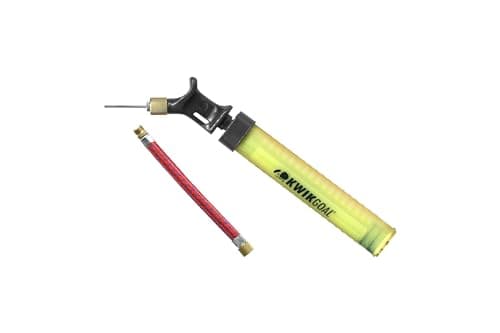
Buy a dual-action hand pump with an inline gauge — the Kwik Goal Premier reads 0-30 PSI while you pump, which is the only way to hit a number instead of guessing. Dual action moves air on both strokes, so a flat ball comes up in half the effort. An electric pump only earns its place if you are inflating a bag of balls, not one.
Balls ship deflated. Nobody tells you that at the point of sale, and the discovery happens at eight o'clock on a Saturday morning with a kid already in their kit. Every ball roundup on this site mentions it; this is the page that actually solves it.
A pump is also the cheapest thing in youth soccer that changes whether equipment gets used. A ball that is soft is a ball nobody takes into the garden, and the gap between a ball that is always ready and a ball that needs twenty minutes of effort first is the entire difference.
The three features that matter
An inline gauge. Without one you are inflating by feel and then either living with it or buying a second tool. With one, inflating a ball is a reading rather than a judgment.
Dual action. A dual-action pump compresses air on the push and the pull. Single action only works one way, which roughly doubles the strokes for the same ball.
Somewhere to keep the needle. The needle is the part families lose, and a pump without one is useless. The pumps worth buying store it in the handle.
What does not matter: the length of the barrel beyond a point, the color, and anything described as high pressure. A soccer ball's correct pressure is in single digits of PSI — the Laws of the Game put a size 5 between 8.5 and 15.6 lbs per square inch — so no soccer pump is ever working hard.
Start here
Pick by your kid’s level
The right answer changes with the level, not just the shoe size. Find your kid’s bracket and start there.
Tap any row to jump to the full write-up. The price in each button is the one Amazon reported on the date stamped under it — tap through for today’s number, which is the only one that can be relied on.
#
Product
Best for
Surface
Fit notes
Price
1
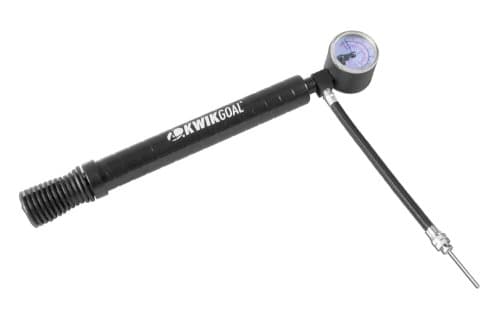
Kwik Goal Premier Hand PumpThe pump to buy if you are buying one: an inline gauge turns inflating a ball from a guess into a reading.
U6, U7–U8 rec, U9–U10, U11–U12, U13+ travel & club
Product photos come from each item’s current Amazon listing.
Hand pump or electric?
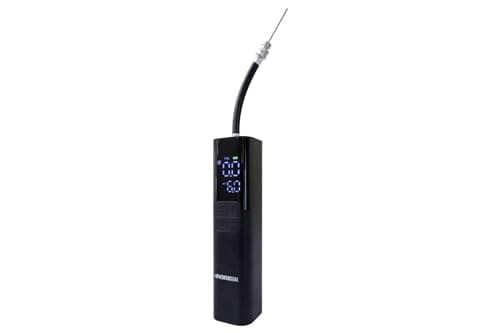
Charge-time and capacity figures are Kwik Goal's published specification for the 1A571 Digital Ball Pump.
Hand pump
Electric pump
One ball, once a month
Right tool
Overkill
A team's bag of balls
Slow
Right tool
Needs charging
Never
135 min from empty (Kwik Goal)
Works when flat
Always
No
Price step
Entry
Several times higher
Scroll the table sideways on a narrow screen.
The honest summary: an electric pump is a coach's tool. Kwik Goal rates the Digital at up to 30 balls per charge and 135 minutes to recharge from empty, which tells you exactly who it is for. For one family with one or two balls, a hand pump is faster end to end because it never needs planning.
Do you need a separate gauge?
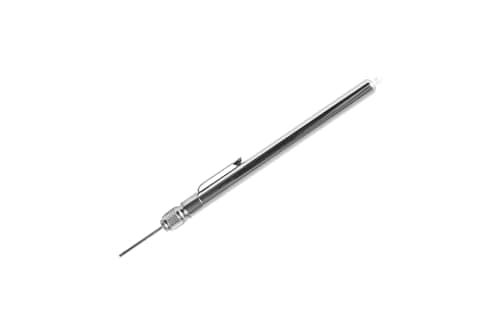
Only if your pump has no gauge on it. A pen-style gauge like the Kwik Goal PG-3 reads 0-20 PSI and does nothing but check pressure, which is the right resolution for a ball. It is the cheapest way to stop guessing with a pump you otherwise like.
One technique note, because it is the commonest way a gauge misleads people: press it squarely onto the valve. A gauge held at an angle vents air past the needle and reads low, so you over-inflate chasing a number that was never real.
The whole routine — needle, moisture, pressure, the thumb test when you have no gauge at all — is on how to inflate a soccer ball.
What we would not buy
The cheapest unbranded pump on the shelf. The failure is always the same: the plastic barrel splits at the base or the hose perishes, usually within a season, and it costs more in the end than one pump that lasts.
A bike pump as a soccer pump. It works in an emergency with the right needle, and the pressures it is built for are an order of magnitude higher, so fine control is hard. Keep it as the backup.
A pump with no spare needles available. Needles bend and snap. Kwik Goal sells replacement packs, which is a small thing that matters a year later.
Or buy the bundle, if you have no ball yet
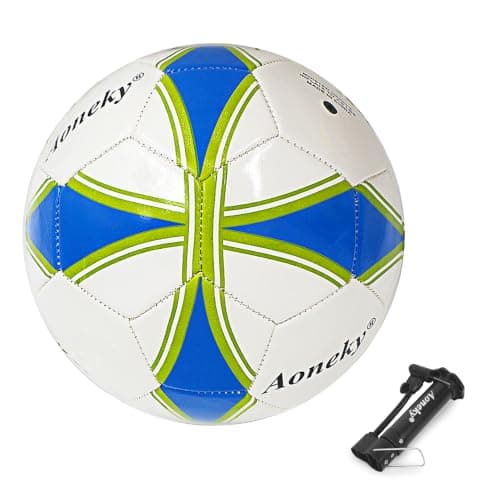
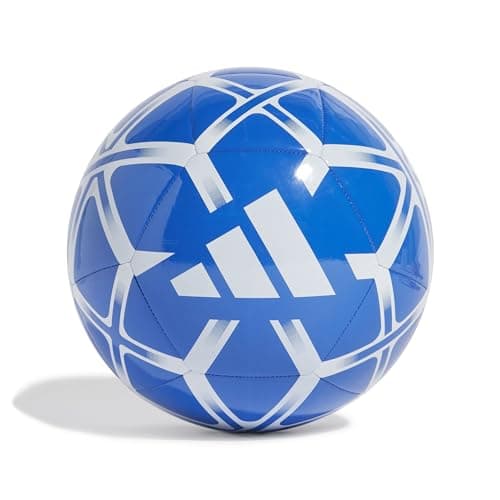
If you are starting from nothing, a ball-and-pump bundle is the cheaper route and the bundled pump is adequate even if it is not durable. The adidas Starlancer package is the version of this worth knowing about, and it is covered properly on the size 3 picks.
The bundle option
Aoneky
Aoneky Size 3 Soccer Ball with Pump
The right first purchase for a brand-new soccer family, purely because of the pump.
Product photos come from each item’s current Amazon listing.
If you already own balls, buy the pump on its own — bundling a second ball you do not need is not a saving. How to choose a soccer ball covers the bladder question, which is the other half of how often you end up pumping.
1. Kwik Goal
Kwik Goal Premier Hand Pump
The pump to buy if you are buying one: an inline gauge turns inflating a ball from a guess into a reading.
Best for
The one pump a family should own, any level
Levels
U6 — first kicks · U7–U8 rec · U9–U10 · U11–U12 · U13+ travel & club
Type / surface
Hand pump with inline gauge
How it fits
Not a sized item. The needle screws into the hose and stores in the handle, which is the part families lose — buy a spare pack of needles at the same time.
What we like
The gauge is on the pump, which is the whole point — you inflate to a number instead of guessing and then checking with a second tool
A 0-30 PSI range comfortably covers every soccer ball size, which all sit in single figures
Built for club equipment rooms rather than for the toy aisle, so it survives being thrown in a bag every week
Where it falls short
Bigger and heavier than a mini pump, so it lives in the car rather than in a kid's backpack
Costs several times what a bundled ball-and-pump set costs, which only makes sense if you already own balls
Manufacturer’s published specs
Inline gauge reads 0-30 PSI so you can see the pressure while you pump (Kwik Goal)
Needle included
Stated weight about 1 lb
Sold in black
These are the manufacturer’s own claims, not measurements we took.
A pump is only as useful as the number you aim for with it, and for sizes 3 and 4 that number is not what most online charts claim. Soccer ball PSI by size explains where it comes from.
Common questions
What is the best soccer ball pump?+
A dual-action hand pump with an inline gauge. The Kwik Goal Premier Hand Pump reads 0-30 PSI while you pump, which means you inflate to a number rather than by feel, and it includes a needle that stores in the handle. Dual action compresses air on both strokes, so a flat ball comes up in roughly half the work.
Do you need a pump with a gauge?+
You need a gauge somewhere. Either on the pump, which is one item to own, or as a separate pen-style gauge like the Kwik Goal PG-3. Without one you are judging pressure by feel, and the usual result is an over-inflated ball that is hard to head and unpleasant to strike properly — which puts young players off more than a soft ball does.
Are electric soccer ball pumps worth it?+
For a coach or team manager, yes. Kwik Goal rates its Digital Ball Pump at up to 30 balls on a single charge, which is the case it is built for. For a family with one or two balls it is several times the price of a hand pump, needs 135 minutes to recharge from empty, and does nothing at all when the battery is flat.
Can you use a bike pump on a soccer ball?+
Yes, with the right inflation needle, and it is a reasonable emergency measure. The drawback is control: a bike pump is built for pressures many times higher than a ball's, so fine adjustment is awkward and over-inflating is easy. Keep it as the backup rather than the plan.
How much does a soccer ball pump cost?+
We do not publish prices on this site, because the live price layer is empty and a figure copied from a listing goes stale within days. Check the current price on the retailer's own page. The useful guidance is relative: a hand pump with a gauge is an entry-level purchase, and an electric pump costs several times as much.
Why does my ball pump not work?+
Almost always the needle. Either it is missing, bent, or it is not screwed fully into the hose, which lets air escape at the join rather than into the ball. Check the needle first, then that the hose is seated in the pump body. A drop of water on the needle before it goes in also helps it pass the valve without tearing it.
Sources
Kwik Goal — ball pumps, needles and pressure gauges — The current pump range and the stock check for every pump named on this site: the Premier, Fingergrip and Mini hand pumps, the Digital Ball Pump, the PG-3 pressure gauge and the replacement needle packs.
Kwik Goal — Premier Hand Pump (1A561) — Kwik Goal's published specification: an inline gauge reading 0-30 PSI so pressure is visible while pumping, a needle included, and a stated weight of about one pound.
Kwik Goal — Mini Hand Pump (1A341) — Kwik Goal's description of the Mini as a compact, dual-action, high-volume hand pump with the needle stored in the handle.
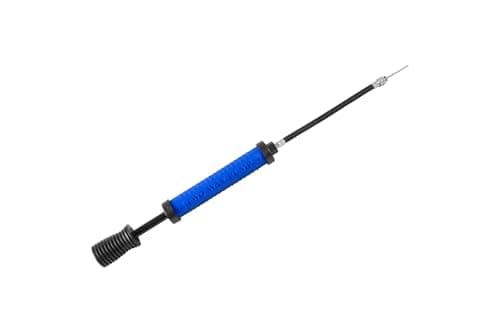
Kwik Goal — Fingergrip Hand Pump (1A722) — Kwik Goal's description of the Fingergrip as a dual-action pump built for air compression on both strokes, and easy to carry.
Kwik Goal — Digital Ball Pump (1A571) — The published figures used on this site: up to 30 balls inflated per charge, 135 minutes from empty to full charge, 0.70 lb, 1.63 x 2.63 x 6.5 inches, and a four-inch hose, two needles, a USB cable and a storage bag in the box.
Kwik Goal — Pressure Gauge (PG-3) — Kwik Goal's specification for the PG-3: a pen-style metal gauge reading 0-20 PSI, sold for checking pressure rather than inflating.
IFAB Laws of the Game — Law 2, The Ball — The official size 5 specification quoted on this site: circumference between 68 cm (27 in) and 70 cm (28 in), weight between 410 g (14 oz) and 450 g (16 oz) at the start of the match, and pressure equal to 0.6-1.1 atmosphere at sea level, which the Law itself states as 8.5-15.6 lbs per square inch.
AYSO — Size of Ball and Field by Age Division — Official ball sizes, circumference and weight ranges, and field dimensions by age division. Used for every ball-size and field-size figure on this site.
adidas — kids' soccer — Verified current availability of the adidas models named here, plus adidas's published material and construction claims.