Heads up: we earn a commission if you buy through our links, at no extra cost to you. It never changes which product we recommend — here’s how that works.
The short answer
Buy cones first. A 25-pack of flat disc cones costs less than a ball and turns any flat ground into a drill. Add a solo trainer next, because it removes ball chasing and is what actually makes a kid practice alone. Ladders and hurdles are the fourth purchase, not the first.
There is a version of this page that lists eleven products and tells you to buy all of them. This is not that page. Youth soccer training gear has a clear order of usefulness, most of the money gets spent in the wrong order, and the single biggest predictor of whether a thing gets used is whether it can be set up in under a minute.
So the picks below are ordered by what you should buy first, not by price and not by how impressive the product looks. Everything here was checked as currently sold on the manufacturer's own site on October 1, 2026, and every specification is the manufacturer's published figure, attributed.
Start here
Pick by your kid’s level
The right answer changes with the level, not just the shoe size. Find your kid’s bracket and start there.
At this age the gear is almost irrelevant and the only thing that matters is that nothing trips anybody. Two-inch flat discs mark a dribbling line, a gate and a goal mouth, and a four-year-old can run straight over one without noticing.
This is the age kids start wanting to practice on their own and then stop after ten minutes because they are tired of fetching. The tether fixes exactly that, and it fits the size 4 ball they are already using.
Footwork patterns only become real training once a player can run them without looking down. By U13 that is true, the ladder stops being hopscotch, and 15 feet of it is enough for a proper run-through.
Tap any row to jump to the full write-up. The price in each button is the one Amazon reported on the date stamped under it — tap through for today’s number, which is the only one that can be relied on.
#
Product
Best for
Surface
Fit notes
Price
1
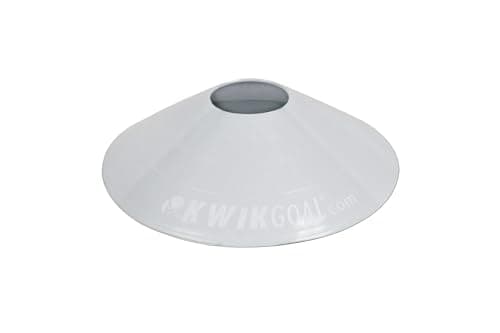
Kwik Goal Small Disc Cones (25-pack)The single most useful thing you can put in a soccer bag, and the one piece of training gear that is genuinely right at every age.
U6, U7–U8 rec, U9–U10, U11–U12, U13+ travel & club
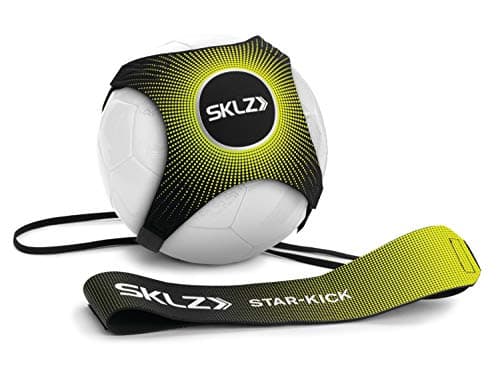
SKLZ Star-Kick Solo Soccer TrainerThe best value in youth soccer training gear, as long as you understand it is a touch and technique tool rather than a shooting one.
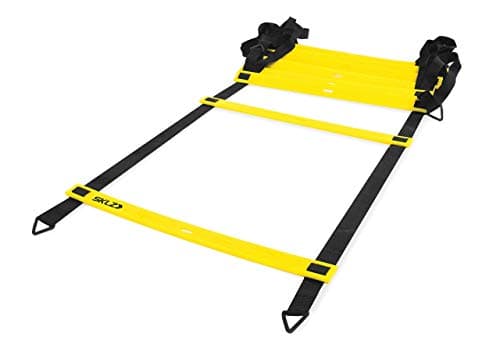
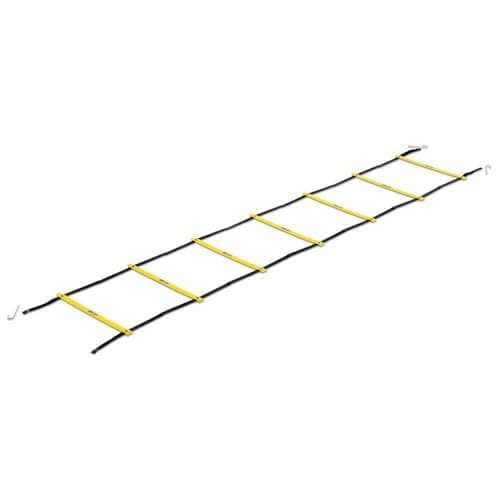
SKLZ Speed and Agility Ladder ProBuy it if you are the parent who ends up running the drills for the whole team. Otherwise the standard Quick Ladder does the same job for far less.
Product photos come from each item’s current Amazon listing.
Buy cones first, and it is not close
Cones are the only piece of training equipment that is correct at every age on this site, from a four-year-old at their first session to a fourteen-year-old at club training. Nothing else on this page can claim that. They are also the cheapest thing here, which makes the ordering easy.
What cones actually buy you is structure. A ball in a yard produces ten minutes of kicking it at a fence. The same ball with two cones ten yards apart produces a dribbling course, and the kid will run it twenty times because there is now a thing to get better at. That is the whole mechanism, and it costs about what a pair of socks costs.
Kwik Goal's small disc cones are the standard — 25 per pack at two inches high on a seven-and-a-half-inch base, in six colors. The height is the point. At two inches there is nothing to trip over, nothing to catch a stud, and no reason to be careful, which is what you want for ages where carefulness is not on offer.
Flat discs or 9-inch cones? They do different jobs
This is the one genuine decision in the category, and most families end up owning both. The short version: flat discs mark where things are, and tall cones are things the ball has to go around.
Both are cheap and they are not substitutes. If you are buying one set, buy the flat discs.
Flat disc cones (2 in)
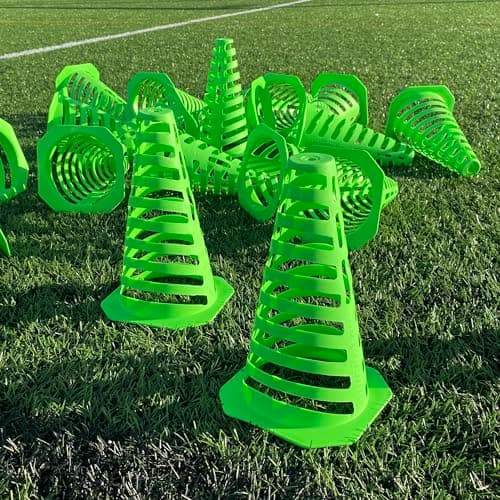
Collapsible cones (9 in)
Best for
Marking space — grids, gates, goal mouths, start lines
Dribbling obstacles — slalom lines, tight turns, mini goals
Underfoot
Safe to run straight over
A trip hazard in a sprint drill
Does the ball go over it?
Yes, every time
No — it has to be taken around
Pack size
25
10
Packs down
Flat stack, pocket-sized
Slotted stack, bag-sized
Indoors
Fine
Non-marking, per QUICKPLAY
Buy it
First
Second
Scroll the table sideways on a narrow screen.
The reason to pay attention to the collapsible kind rather than a hard plastic traffic cone is the rebound. QUICKPLAY's 9-inch cones are built from PVC that compresses when stepped on and springs back into shape — the difference being that a kid who lands on one bends the cone rather than the other way round. At these ages someone lands on a cone roughly every session.
Ladder work beside the balls, not instead of them — the ordering matters more than the gear.
Agility ladders: what they do, and what they do not
Ladders are the most-bought and least-understood item in this category. They are genuinely good at something specific and routinely sold as being good at something broader, so here is the honest split.
A controlled 2026 comparison published in Frontiers in Physiology put rope-ladder training against a stimulus-driven computerized agility system and found the ladder group's gains were largely confined to rhythm, step frequency and basic coordination, with relatively limited transfer to reaction time and decision making. Two caveats you should have: that study ran in male collegiate basketball players aged 18 to 24, not in youth soccer players, and it was comparing the ladder against a more demanding alternative rather than against nothing.
Read sensibly, that is not a reason to skip a ladder. It is a reason to know what you bought. Rhythm, step frequency and coordination are real things a nine-year-old does not have yet and can improve. What a ladder cannot do is teach a player to read a game, because every rung is in a place the player already knows about. That part only comes from playing.
On the hardware: SKLZ's standard Quick Ladder is 11 plastic rungs over 15 feet at 17 inches wide, with a carry bag, and it is the sensible family buy. The Speed and Agility Ladder Pro throws out the webbing entirely for rigid hinged sides that fold accordion-style, with seven rungs at 17.25-inch spacing, extensible ends so several link together, low-profile edges and ground stakes. It costs several times as much.
Whether that is worth it comes down to one question: how many times a week do you set it up? Once a week, buy the standard one and accept thirty seconds of untangling. Three times a week with a group of kids, the accordion fold and the stakes stop being a luxury — a webbed ladder on grass walks downhill all session and a tangled one eats the attention span you were trying to use.
The solo trainer is the one that changes behavior
Everything else on this page makes practice better. A solo trainer makes practice happen, which is a different and larger effect.
The reason kids stop practicing alone is not boredom with the ball. It is fetching. A ten-year-old striking a ball at a fence spends roughly four seconds hitting it and twenty seconds walking after it, and after fifteen minutes of that ratio they go inside. SKLZ's Star-Kick is a neoprene glove around the ball on an adjustable cord that stretches to 18 feet, tethered to a waistband, and it inverts the ratio.
It adjusts to fit size 3, 4 and 5 balls, which covers the whole youth span — size 3 to roughly U8, size 4 through U12, size 5 from U13, per AYSO's ball table. Buy the ball right for the age and the trainer follows it up the ladder. If you need to check which size you are on, the soccer ball size by age guide has the full table.
The honest limit is power. The cord is doing work on every strike, so what the player builds is a repeatable contact and a clean first touch, not a shot. Shooting power needs a ball that is allowed to leave. That is what a rebounder or a backyard goal is for, and it is why the two purchases sit well together rather than competing.
Hurdles, and the age they start making sense
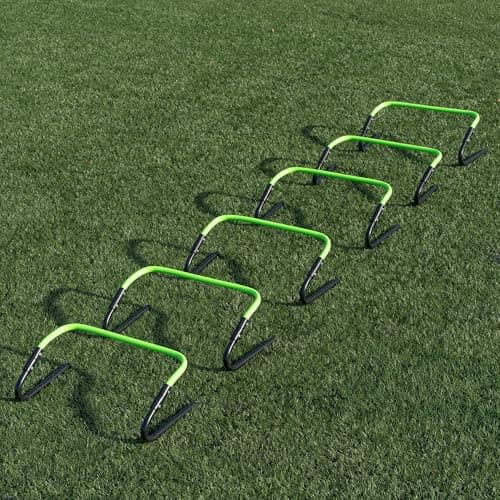
Hurdles are the last thing on this page for a reason: nothing a kid does with them involves a ball. That is not a disqualification, it is a ranking. Ball time beats non-ball time at every youth age, so hurdles earn their place only after the gear that creates touches is already in the bag.
When they do earn it, QUICKPLAY's set of six adjusts between 6, 9 and 12 inches in high-impact polypropylene with a breakaway design, and comes with a bag. The breakaway part is the one to care about. Kids clip hurdles. A hurdle that gives way turns that into nothing; a rigid one turns it into a face-first fall onto the one piece of equipment that was supposed to be making them more agile.
Start at the lowest setting regardless of age and only raise them once the pattern is clean and fast. A hurdle set too high stops being a speed drill and becomes a jumping drill, which is a different exercise that nobody intended to buy.
What we would not buy
Three categories come up constantly in this search and we think they are poor value for a youth player:
Speed chutes and resistance parachutes. Sold for sprint work, bought for ages whose sprint mechanics are still forming. A kid who runs with an altered gait to drag a chute has practiced an altered gait. Save it for a teenager working with an actual coach.
Weighted training balls. The whole skill being learned is how a normal ball behaves off a normal foot. Changing the ball's weight changes the thing being learned, and growing feet and ankles are the wrong place to run that experiment.
All-in-one bundle kits. The 20-foot-ladder-plus-12-cones-plus-hurdles-plus-parachute boxes are tempting because of the price, and the usual outcome is one usable item, three that break and one nobody opens. Two good purchases beat five cheap ones, and the cones are the two.
There is a fourth thing we would not buy, which is a second ladder before a second set of cones. Families overwhelmingly buy upward in sophistication when the useful direction is sideways in quantity — more markers, more gates, more space mapped out, which is what actually lets a drill change shape.
A 20-minute backyard session you can actually run
Gear is only as good as the thing you do with it, and the most common failure is a parent with a bag of cones and no plan. This is a session that uses only what is on this page, fits in a small yard and does not require you to know anything about coaching:
Two minutes, ladder or hurdles. A warm-up, not the session. Two patterns, down and back twice each.
Five minutes, dribbling line. Six flat discs a yard apart. Through and back, then the same with only the weak foot. The weak-foot run is the whole point and it is the one kids skip.
Five minutes, gates. Four pairs of 9-inch cones scattered a yard apart each. Score a point for every gate dribbled through in sixty seconds, then try to beat it. This is the drill kids ask to repeat.
Six minutes, solo trainer. Thirty touches on each foot, then thirty first-time returns. Stop at the number, not at the point of boredom.
Two minutes, shooting. Take the tether off and let them hit the ball properly at a goal or a wall. Always finish with this.
That session runs on a 25-pack of disc cones, a set of 9-inch cones and a solo trainer — the first three purchases on this page, in order. Everything after that is refinement.
Where this sits next to a goal or a rebounder
Training aids and a target are complementary, and the order depends on who is in the yard. If your kid has someone to play with, a goal comes first because games beat drills at these ages. If they mostly play alone, the cheap end of this page — cones and a solo trainer — does more per dollar than anything else you can buy, and a rebounder is the natural next step up.
One safety note carries over from the rest of this hub and it is not optional. If a movable goal is in the yard alongside this gear, it has to be anchored: the US Consumer Product Safety Commission has documented at least 21 deaths between 1979 and 1994 from goals tipping over, nearly all of them involving children climbing on an unanchored goal. Cones and ladders carry no such risk; goals do. How to anchor one properly covers the method.
1. Kwik Goal
Kwik Goal Small Disc Cones (25-pack)
The single most useful thing you can put in a soccer bag, and the one piece of training gear that is genuinely right at every age.
Best for
The first training purchase at any age, U6 to U13+
Levels
U6 — first kicks · U7–U8 rec · U9–U10 · U11–U12 · U13+ travel & club
Type / surface
Flat disc cones
How it fits
No sizing to get wrong. These suit a four-year-old and a fourteen-year-old equally, so buy two colors rather than fifty of one.
What we like
Two inches high means nothing to trip over and nothing to catch a stud, which matters most at the ages where kids run into things
Twenty-five markers is enough to set a dribbling line, a pair of gates and a small-sided pitch at the same time
Stacks into a pocket of a kit bag, so it actually comes to the park instead of living in the garage
Where it falls short
One color per pack, so two packs are needed before you can mark two teams or two gates by color
Too low to work as a dribbling obstacle a ball will not simply roll over, and far too low to make a goal
Manufacturer’s published specs
25 cones per pack, sold one color per pack (Kwik Goal)
2 inches high on a 7.5-inch base
Available in yellow, blue, green, orange, red and white
Kwik Goal item 6A10
These are the manufacturer’s own claims, not measurements we took.
QUICKPLAY Slotted Collapsible Training Cones (set of 10)
The right second set of cones, and the one that makes backyard dribbling drills behave like the ones at practice.
Best for
Gates, mini goals and anything a ball has to go around, U7 up
Levels
U6 — first kicks · U7–U8 rec · U9–U10 · U11–U12 · U13+ travel & club
Type / surface
9-inch cones
How it fits
No sizing. The dividing line is the drill rather than the age: flat discs for anything the kids run through, 9-inch cones for anything the ball goes around.
What we like
Tall enough that a ball has to be taken around rather than over, which is the whole reason to own cones rather than flat markers
The collapse-and-rebound construction is the honest difference from a hard plastic cone — a kid lands on one and the cone gives, not the kid
Slot together into a short stack, so a set of ten carries like a single cone
Where it falls short
Ten markers is a thin set on its own; this is a second purchase alongside flat discs, not a replacement for them
Nine inches is still a trip hazard in a sprint drill in a way a flat disc is not, so they belong in dribbling and gate work rather than underfoot
Manufacturer’s published specs
Ten cones, 9 inches tall, in rebounding PVC (QUICKPLAY)
Collapsible body compresses when stepped on and springs back into shape
Slotted and stackable; works with QUICKPLAY agility poles to make hurdles
Non-marking on indoor floors; stated for ages 5 and up; one-year warranty
These are the manufacturer’s own claims, not measurements we took.
The sensible ladder for a family: enough length to run real patterns, cheap enough that occasional use is not a waste.
Best for
Footwork and coordination work from about U9
Levels
U9–U10 · U11–U12 · U13+ travel & club
Type / surface
Agility ladder
How it fits
Works from roughly U9. That is when kids can run a two-step pattern without watching their feet; below it, a ladder is hopscotch rather than training.
What we like
A full 15 feet of ladder for roughly the price of a decent ball, which is the right amount to spend on a tool a kid will use twice a week at most
Folds flat into its bag, so it stores with the rest of the kit rather than needing a corner of the garage
Rung spacing is fixed, which sounds like a limitation and is actually what keeps a young player honest about stride length
Where it falls short
Webbing tangles. Every webbed ladder does, and the five minutes spent untangling it is five minutes of a short attention span gone
The rungs sit proud of the grass and will be caught by a studded cleat at speed, so it is a sneakers-and-flat-ground tool more than a cleats-on-the-pitch one
Manufacturer’s published specs
11 heavy-duty plastic rungs, 17 inches wide and 15 feet long (SKLZ)
Webbed, foldable design with a carry bag included
SKLZ positions it for acceleration, lateral speed and change of direction
One-year warranty
These are the manufacturer’s own claims, not measurements we took.
Buy it if you are the parent who ends up running the drills for the whole team. Otherwise the standard Quick Ladder does the same job for far less.
Best for
A team, a coach, or a household that trains several times a week
Levels
U11–U12 · U13+ travel & club
Type / surface
Agility ladder
How it fits
No sizing. The value is age-related instead: it earns its price for a coach or an older player training often, not for an occasional backyard session.
What we like
The accordion fold is the real feature — it opens and closes in seconds and cannot tangle, which is worth more than it sounds when you are setting up with eight impatient kids
Ground stakes stop it walking down the garden, the failure mode that makes webbed ladders frustrating on grass
Low-profile edges are a genuine design answer to the one thing that makes ladders risky in cleats
Where it falls short
Several times the price of the standard Quick Ladder, which is hard to justify for one child practicing once a week
Seven rungs is a short run on its own — getting a useful length means buying two and linking them, which compounds the cost
Manufacturer’s published specs
No webbing: rigid hinged sides fold accordion-style (SKLZ)
7 rungs at 17.25-inch spacing
Extensible ends and sides so several ladders link into one longer run
Low-profile edges to reduce the chance of catching a cleat; ground stakes and carry bag included
These are the manufacturer’s own claims, not measurements we took.
What soccer training equipment should I buy for my kid first?+
Cones, and it is not a close call. A 25-pack of flat disc cones costs less than a ball, works from U6 to U13 and up, and turns any flat ground into a drill with a point to it. Buy a solo trainer second if your kid practices alone, and leave ladders and hurdles until later.
Are agility ladders worth it for young soccer players?+
For rhythm, step frequency and basic coordination, yes — a 2026 Frontiers in Physiology comparison found exactly those gains from ladder work, though in adult basketball players rather than youth soccer, and it also found limited transfer to reaction time and decision making. Use one as a ten-minute warm-up before ball work, never instead of it.
What age can kids start using an agility ladder?+
Around U9 is where it becomes training rather than a game. Before that, most kids run a ladder while watching their own feet, which is hopscotch with extra steps. It is not harmful at younger ages, it is just not doing what you paid for. Cones and a ball are the better spend at U6 to U8.
Do solo soccer trainers actually work?+
They work on the problem they are built for, which is ball chasing. A tethered ball returns after every strike, so a kid gets several times the touches in the same fifteen minutes and stays interested longer. What a tether cannot build is shooting power, because the cord is absorbing the strike — that needs a goal or a rebounder.
How many cones do you need for backyard soccer practice?+
Around 25 flat markers covers everything a backyard session needs — a dribbling line, several gates and a marked grid, all set at once. Add ten taller 9-inch cones for anything the ball has to be dribbled around. Buying two colors is more useful than buying fifty of one.
Should I buy an all-in-one soccer training set?+
Usually not. The bundles that combine a ladder, cones, hurdles and a parachute price well and tend to produce one item that gets used, several that break and one that stays in the box. Two good purchases in the right order — cones, then a solo trainer — beat five cheap ones.
Sources
Kwik Goal — Small Disc Cones (6A10) — Kwik Goal's own listing for the 25-cone pack: 2 inches high on a 7.5-inch base, six colors, sold per color. Used to confirm current availability and every dimension quoted for the disc cones on this page.
QUICKPLAY — Collapsible 9-inch Training Cones (set of 10) — QUICKPLAY's published specification for the 9-inch slotted cones: rebounding PVC that compresses when stepped on and springs back, non-marking indoors, stackable, stated for ages 5 and up, with a one-year warranty. Also the current stock check.
SKLZ — Star-Kick Solo Soccer Trainer — SKLZ's own product page: the neoprene ball glove fits size 3, 4 and 5 balls, the cord stretches to 18 feet, the waistband is tethered, and the stated purpose is to maximize touches by minimizing ball chasing. Also confirms current availability.
SKLZ — speed and agility range (Quick Ladder and Speed and Agility Ladder Pro) — Current availability and the published specifications for both ladders: the Quick Ladder's 11 plastic rungs at 17 inches wide and 15 feet long with a carry bag, and the Speed and Agility Ladder Pro's webbing-free accordion fold, seven rungs at 17.25-inch spacing, extensible ends, low-profile edges and included stakes.
QUICKPLAY — Adjustable Speed Hurdles (set of 6) — The three height settings (6, 9 and 12 inches), the high-impact polypropylene breakaway construction, the included carry bag and the stated age-5-and-up guidance. Also the current stock check.
Frontiers in Physiology (2026) — computerized agility training compared with rope ladder training — A controlled comparison in male collegiate basketball players aged 18-24 reporting that ladder training's improvements were largely confined to rhythm, step frequency and basic coordination, with relatively limited transfer to reaction time and decision making. Used for the honest limits of ladder work; the population is adult basketball players, not youth soccer, and the page says so.
AYSO — Size of Ball and Field by Age Division — Official ball sizes, circumference and weight ranges, and field dimensions by age division. Used for every ball-size and field-size figure on this site.
US CPSC — Guidelines for Movable Soccer Goals — Tipover fatality and injury figures, and the CPSC's specific anchoring, counterweighting and storage recommendations. The source for every safety figure on the goal pages.