Heads up: we earn a commission if you buy through our links, at no extra cost to you. It never changes which product we recommend — here’s how that works.
The short answer
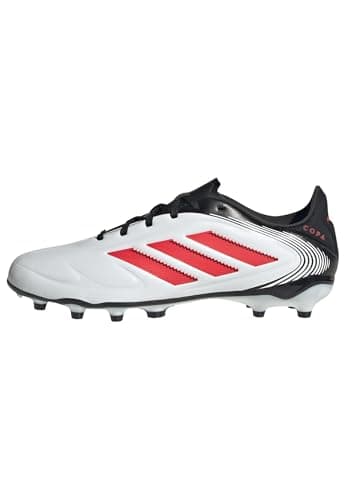
For a kid playing a grass season, the adidas Copa Pure 3 FG is the firm-ground pair we would buy first — adidas positions its kids Copa line on comfort, ball control and natural touch, and Copa is the most accommodating of the three adidas shapes on width. The budget pick is the Vizari Stealth FG, the cheapest cleat here that genuinely does the job for a first season. Every price on this page is read from the live Amazon listing, with the date it was read stamped under the button.
Firm ground — FG on the box — means molded studs on a plate rated for natural grass. It is the plate the overwhelming majority of US youth leagues are played on, which is why it is the default answer when a coach emails to say cleats are required. If that is the field your player is on every Saturday, this is the page you want.
What this page will not do is pretend FG is always right. If your club trains on artificial turf midweek and plays grass at the weekend, a multi-ground plate is the honest answer and best multi-ground soccer cleats for kids is the page for it. If the fields bake hard and dry in late summer, best soccer cleats for hard ground covers that. And firm ground vs turf cleats is the decision itself, laid out.
How we sorted these
The plate has to be FG or FG-rated. A turf outsole on a grass field gives up grip in exactly the moment a kid plants to turn. Every pick here is sold as firm ground or firm-ground-capable by its own maker.
Width before badge. The published cross-brand fit guidance ranks the adidas shapes F50 narrowest, Predator in the middle and Copa most accommodating. On a growing foot that spread matters more than the logo, which is why the widest-fitting silo leads this page.
Playing volume, not price. One session a week is a different purchase from four. The level block below maps the picks to the levels this site uses throughout.
A real budget option, named as such. Entry-tier FG cleats at U6 to U8 are not a compromise — growth ends the pair long before the shoe does, so the cheapest pair that does the job gets called out rather than buried at the bottom.
Quick picks
Tap any row to jump to the full write-up. The price in each button is the one Amazon reported on the date stamped under it — tap through for today’s number, which is the only one that can be relied on.
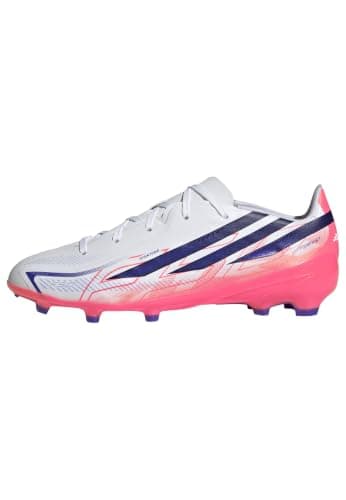
adidas F50 Hyperfast League Kids FGThe right speed cleat for a slim-footed winger or striker playing on grass, and the wrong shoe for almost everyone else.
U9–U10, U11–U12, U13+ travel & club
FG (firm ground)
Narrow through the forefoot and midfoot, true to length.
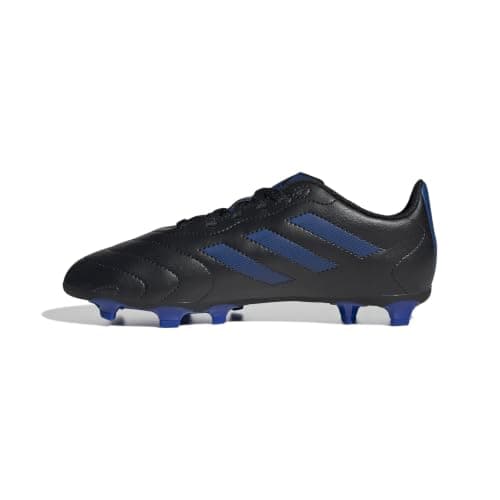
adidas Goletto VIII Firm GroundThe sensible answer when the honest requirement is a cleat that survives one rec season and costs as little as possible.
U6, U7–U8 rec, U9–U10
FG
Runs slightly generous in width and true in length.
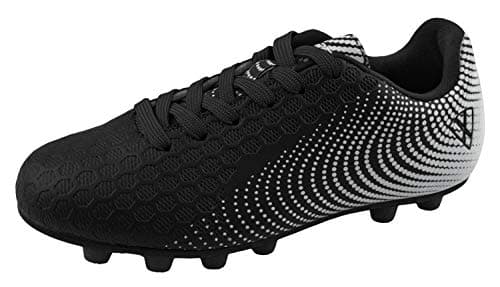
Vizari Stealth Firm GroundThe honest choice for a first-season player: enough cleat to play in, not enough money to regret if they switch to basketball.
U6, U7–U8 rec
FG
True to standard US kids' sizing and reasonably generous in width.
A first season on grass needs a molded stud and a shoe that fits, and nothing further. At this price the pair being outgrown in five months costs almost nothing.
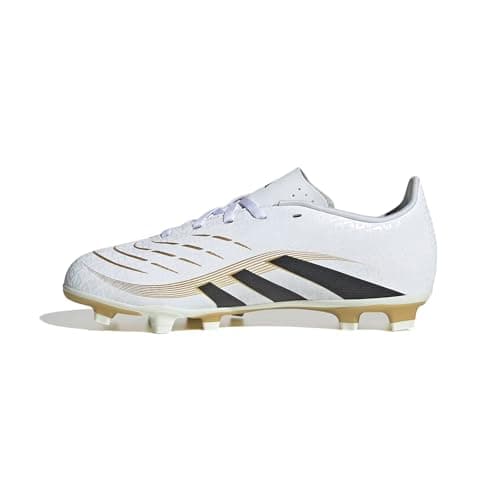
The cheapest step into the Predator shape, which sits in the middle of the adidas width range — a safer bet than a speed silo on a foot that is still broadening.
Comfort and touch in the most accommodating adidas shape, for the age where training volume rises and blisters start deciding whether a kid enjoys the season.
The honest choice for a first-season player: enough cleat to play in, not enough money to regret if they switch to basketball.
Best for
A first pair for a U6–U8 who may not stick with the sport
Levels
U6 — first kicks · U7–U8 rec
Type / surface
FG
How it fits
True to standard US kids' sizing and reasonably generous in width. Check the toddler sizes especially — they run closer to sneaker sizing than cleat sizing.
What we like
One of the few brands that makes a genuine toddler-through-big-kid run in one model
Priced below the major brands' entry cleats, which is the right call for a first season
Simple hook-free construction with nothing fiddly for small hands
Where it falls short
Materials are visibly cheaper than a Goletto or Ultra Play and will not survive a second season of heavy use
Limited colorways compared with the big brands, which matters more to an eight-year-old than to you
Manufacturer’s published specs
Lightweight synthetic upper with a molded rubber firm-ground sole (Vizari)
Padded collar and supportive footbed
Sold in toddler, little kid and big kid sizing
These are the manufacturer’s own claims, not measurements we took.
An FG plate is tuned for grass with soil under it. The studs are long enough to bite into turf that gives, spaced so the plate releases rather than sticking, and set on a sole stiff enough to turn a plant into a change of direction. Put that same plate on a rubber-crumb field and the studs cannot sink, so the grip comes from the stud tips rather than the whole plate — which is the feeling kids describe as slipping.
Put a turf outsole on grass and the opposite happens: dozens of small rubber nubs ride on top of the blades. On a dry, freshly cut field it is survivable. On a wet one it is not. That asymmetry is the reason surface is the first thing to get right and the badge is the last.
Plate by surface. A league or club rule always overrules a row here, so check the registration email before buying.
If the field is
Buy
Why
Natural grass, most weeks
Firm ground (FG)
The plate is designed for soil that gives, and nothing else grips as well
Grass and artificial turf in the same week
Multi-ground (MG)
One pair covers both, with a compromise at each end
Artificial turf, most weeks
Turf (TF) outsole
Short rubber studs spread load across a surface that cannot be penetrated
Indoor court or futsal
Flat indoor sole (IN)
Studs of any length are unsafe and usually banned on a hard court
Baked, rock-hard summer grass
FG or turf, not metal
Soccer cleats are not made with metal spikes, and youth leagues rarely permit them
Scroll the table sideways on a narrow screen.
Fit, which decides this purchase more than the plate does
Every pair on this page is a reasonable cleat. Any of them is a bad cleat on the wrong foot. Three things are worth knowing before you order.
Do not size up a full size to buy time. The heel slips, the foot slides forward on every plant, and you get blisters instead of a season. A thumb's width at the toe is the whole allowance — how should kids soccer cleats fit has the detail.
The check that prevents most first-game complaints: a thumb's width at the toe, with the heel locked and no lateral slide.
How far up the FG range to actually go
Junior cleats are cheaper than adult ones across every brand, and the ladder inside each brand is steeper than the gap between brands. In practice there are three tiers, and the right one is set by how often the kid plays rather than by how seriously the family takes it.
Entry tier, roughly under $40: a molded FG plate and a synthetic upper. Correct for U6 through U9, and correct for anyone who will outgrow the pair inside two seasons. Best soccer cleats under $50 is that whole band, ranked.
Mid tier, roughly $50 to $100: a better upper, a stiffer and lighter plate, and a shape that genuinely differs between silos. This is the step that pays for a kid training midweek as well as playing weekends — best soccer cleats under $100 covers it, and best soccer cleats under $150 is the ceiling above it.
Top junior tier, $100 and up: worth it only for a player who plays four times a week and has stopped changing size every season. Are expensive soccer cleats worth it works through the arithmetic rather than asserting an answer.
Common questions
What does FG mean on soccer cleats?+
Firm ground. It describes a plate with molded studs designed for natural grass with soil under it, which is the surface most US youth leagues play on. FG is the default plate for a grass season and the one a coach means when the registration email says cleats. The other labels you will see are MG (multi-ground), TF (turf), AG (artificial grass), IN (indoor) and SG (soft ground, which uses metal studs and is rarely permitted at youth level).
Are firm ground cleats OK on artificial turf?+
They work on a dry, well-maintained turf field and they are a poor choice on anything else. The studs cannot penetrate rubber crumb, so grip comes from the stud tips instead of the whole plate, which is what children describe as slipping. If turf is where your player trains most weeks, buy a turf outsole or a multi-ground plate instead and keep the FG pair for grass.
What are the best firm ground cleats for a 9 year old?+
At U9 to U10 the right pair is an entry or lower-mid FG model in a shape that suits the foot, not a top-tier boot. The adidas Predator Club FG is our pick for that age: it is the cheapest step into the Predator shape, which sits in the middle of the adidas width range, so it is a safer bet than a narrow speed silo on a foot that is still broadening. Measure first, because length and width decide this far more than the model does.
How long do firm ground cleats last for a kid?+
Usually one to two seasons, and almost always the foot ends the pair rather than the shoe. That is why the entry tier is the correct tier for younger players: paying three times as much does not buy three times the life when the player grows out of the pair in eight months. Check the toe, the stud tips and the sole-to-upper bond at the end of each season.
Do you need firm ground and turf cleats both?+
Only if your player genuinely plays on both surfaces every week. A club player training midweek on turf and playing Saturdays on grass is better served by two pairs or one multi-ground plate; a rec player on grass needs one pair of FG and nothing else. Buying two pairs for a U8 is the most common way families overspend in this category.
Are laceless firm ground cleats a good idea for kids?+
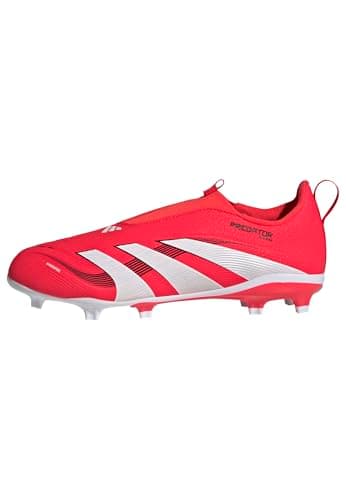
They can be, with one caveat: a laceless upper cannot be adjusted, so it has to fit the foot as sold. On a wide or high-volume foot that is a real risk. The upside is a clean strike surface and nothing for a seven-year-old to tie wrong. Buy them where you can try them on if that is at all possible.
Sources
adidas — kids' soccer — Verified current availability of the adidas models named here, plus adidas's published material and construction claims.
adidas — kids' Copa Pure — adidas's own positioning of the kids' Copa Pure line around comfort, ball control and natural touch.
Nike — kids' soccer cleats and shoes — Verified that each Nike model named on this page is currently sold, and the source for Nike's own published upper, plate and surface descriptions.
Vizari Sports — youth cleats and indoor shoes — Verified the Vizari models named here are currently sold, including the toddler size range and the indoor line, plus Vizari's published material claims.
Unisport — adidas Predator vs F50 vs Copa — Position mapping for the adidas silos — Predator for number 8s and 10s, F50 for wingers, attacking fullbacks and forwards, Copa for center-backs, defensive midfielders and classic number 9s — plus the width ranking (F50 narrowest, Predator middle, Copa most accommodating).