Heads up: we earn a commission if you buy through our links, at no extra cost to you. It never changes which product we recommend — here’s how that works.
The short answer
In junior sizing, $150 buys essentially anything — when we checked Nike's own kids' listing on 29 September 2026, its entire junior range ran from about $45 at the Club tier to $150 at the very top. So the real decision is not what fits the budget but how far up the range your kid's playing volume justifies going.
A price-capped page is normally a list of compromises. This one is not, and it is worth saying so plainly rather than inventing a constraint that does not exist. If the question behind the budget is whether to spend more at all, are expensive soccer cleats worth it answers that one directly.
Junior cleats are cheaper than adult ones across every brand. On Nike's own kids' soccer listing, checked on 29 September 2026, junior Club-tier models were listed from around $45, the Academy tier from around $60 to $80, and only the very top junior models reached $140 to $150. A $150 ceiling therefore covers the whole range rather than cutting it off.
Those are the manufacturer's list prices on the day we looked. Prices move, and we do not hold live pricing — every button on this page opens the current Amazon listing so you see today's number rather than ours. Use the tiers below as the guide and the listing as the source of truth.
Start here
Pick by your kid’s level
The right answer changes with the level, not just the shoe size. Find your kid’s bracket and start there.
Nowhere near the cap and the right answer anyway. At this age growth ends the pair long before the shoe does, so the entry tier is the correct tier rather than a sacrifice.
The mid tier, and the point where a step up genuinely pays: better upper and plate for a kid training midweek as well as playing weekends. Still well inside the budget.
Tap any row to jump to the full write-up. The price in each button is the one Amazon reported on the date stamped under it — tap through for today’s number, which is the only one that can be relied on.
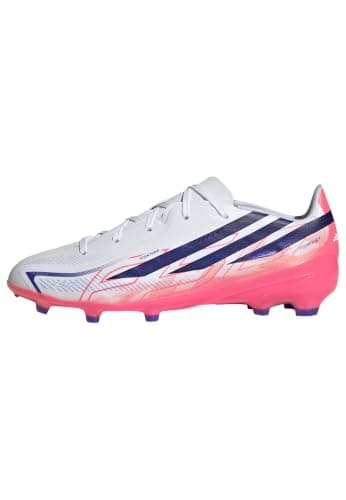
adidas F50 Hyperfast League Kids FGThe right speed cleat for a slim-footed winger or striker playing on grass, and the wrong shoe for almost everyone else.
U9–U10, U11–U12, U13+ travel & club
FG (firm ground)
Narrow through the forefoot and midfoot, true to length.
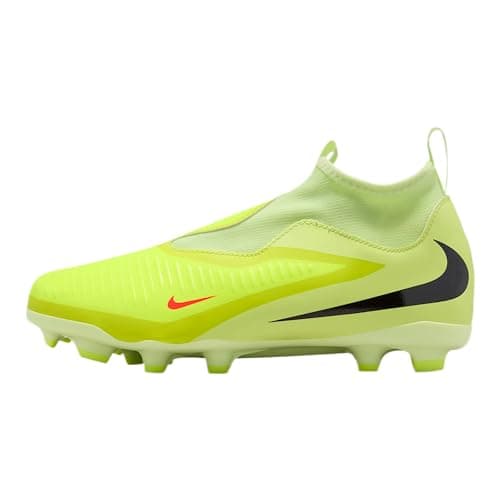
Nike Jr. Phantom 6 High Academy FG/MGThe junior cleat to pick if your kid wants a collar, on the clear understanding that it is a fit feature and a proper brace is a different product.
U9–U10, U11–U12, U13+ travel & club
FG/MG
Average-to-wide forefoot like the rest of the Phantom line, true to length.
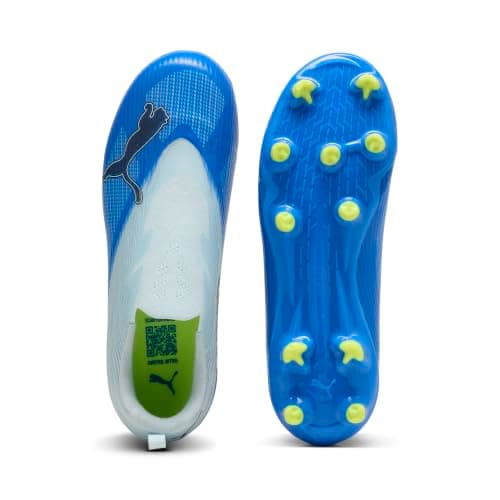
PUMA Ultra 7 Match LL FG/AG JuniorA good dual-surface option for an older player with an average-to-wide foot, and the wrong purchase for a narrow one.
U11–U12, U13+ travel & club
FG/AG
Fits a generous average width with no way to snug it down, and runs slightly short like the rest of the PUMA junior range.
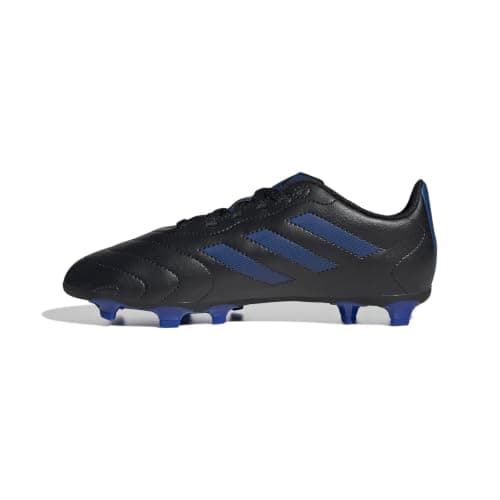
adidas Goletto VIII Firm GroundThe sensible answer when the honest requirement is a cleat that survives one rec season and costs as little as possible.
U6, U7–U8 rec, U9–U10
FG
Runs slightly generous in width and true in length.
Product photos come from each item’s current Amazon listing.
The junior price ladder, and what each step buys
Manufacturer and retailer list prices for junior sizing, checked 29 September 2026. Prices change; the buy buttons show today's.
Tier
Typical junior list price
What the money buys
Who it is for
Entry / Club
About $35–55
A simple synthetic upper and a molded plate
Rec players, one session a week
Mid / Academy or League
About $60–80
Better upper, better plate, more consistent fit
Two or three sessions a week
Upper mid / collared
About $75–90
A knitted collar, usually on the same plate
Kids who want the collar
Pro / Elite
About $140–150
The thinnest upper and lightest plate in the line
Committed players, four-plus sessions
Scroll the table sideways on a narrow screen.
Read that table as a question about your kid's week, not about your budget. The right answer for most families is the second row, and for a lot of families it is the first.
Why the top of the range rarely makes sense in junior sizing
The window is short. A growing foot goes up a size or more a year, and a cleat that fits in September often does not by March. A Pro-tier upper built to last two seasons never gets to prove it.
Protection runs backwards. Higher tiers use thinner uppers, because the design goal is ball feel. A kid taking stray kicks has more material between foot and boot in a Club-tier cleat than a Pro one.
The plate gets stiffer. A stiff performance plate returns energy for a player fast enough to load it, and feels hard underfoot for one who is not.
None of that means the top tier is bad. It means it is built for a player whose playing volume can reach it, which at U12 is a minority.
Where the same money is better spent
If your budget is genuinely $150 and your kid is at the entry or mid tier, the leftover is not wasted — there are two purchases that will change their season more than a tier upgrade.
A second pair for the other surface. A turf pair alongside firm-ground game cleats is the highest-value second purchase in youth soccer, and two entry-tier pairs comfortably fit inside $150. See the turf shoe picks.
Shin guards that fit and a decent pair of socks. The gear kids actually complain about is rarely the cleat. The slip-in guard picks and the sock picks are both cheap fixes for a genuine annoyance.
Buying at the cap sensibly
If your kid genuinely is at four sessions a week and the top of the range is justified, two things keep the purchase sensible.
Buy the plate that matches where they actually play — a Pro-tier firm-ground cleat used mostly on artificial turf is money spent on a stud pattern being ground down. And buy to fit now, with a thumb's width at the toe and no more; performance cleats have no room built in and sizing up to extend the window turns a good cleat into a bad one.
If you want to go the other way entirely, the budget picks cover what the cheap tier genuinely gives up, and the answer is less than you would expect.
1. Nike
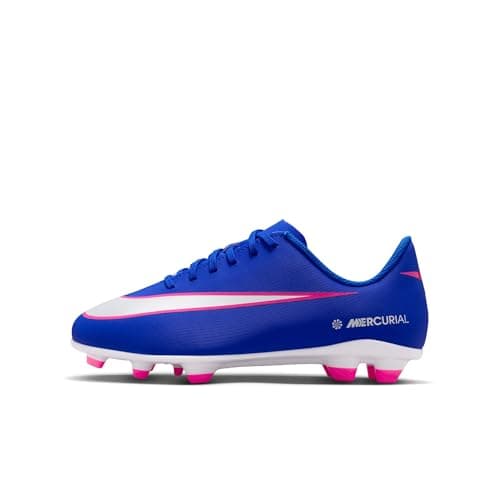
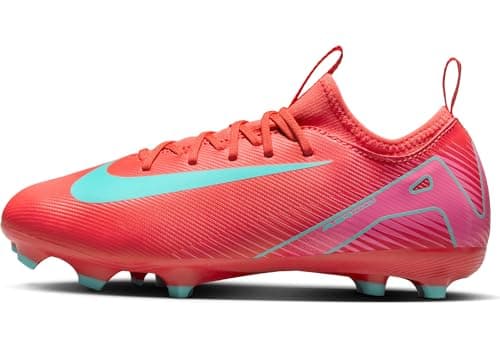
Nike Jr. Mercurial Vapor 16 Academy FG/MG
Worth the step up only when the volume of play justifies it — two or three sessions a week, not one Saturday game.
Best for
A U10–U13 player who plays two or three times a week
Levels
U9–U10 · U11–U12 · U13+ travel & club
Type / surface
FG/MG
How it fits
Same narrow Mercurial shape as the Club. True to length. If the Club fit, this fits.
What we like
Noticeably better upper and plate than the Club tier, which matters once a kid is training midweek as well as playing weekends
Same last as the Club, so a player moving up from Club will not have to relearn the fit
Where it falls short
Costs meaningfully more than the Club for a difference a rec-only player will not notice
Still a narrow last — this is not the line for a wide foot
Manufacturer’s published specs
Step up from the Club tier within the same Mercurial 16 family (Nike)
FG/MG plate configuration
Low-top
Big kids' sizing
These are the manufacturer’s own claims, not measurements we took.
The junior cleat to pick if your kid wants a collar, on the clear understanding that it is a fit feature and a proper brace is a different product.
Best for
A U10+ player who wants a collar and a reliable striking surface
Levels
U9–U10 · U11–U12 · U13+ travel & club
Type / surface
FG/MG
How it fits
Average-to-wide forefoot like the rest of the Phantom line, true to length. The collar is snug — a high instep will notice it going on, which eases after a session or two.
What we like
The closest thing to a supportive collar available in a junior soccer cleat, and it is Nike's own claim rather than a retailer's
The Phantom touch zone genuinely helps a kid learning to strike cleanly rather than toe-poke
FG/MG plate covers a schedule split between grass games and turf training
Where it falls short
A knitted collar is not a brace — independent coverage of these collars is clear they are built for fit and feel, not structural ankle stability
Harder to pull on than a low-cut cleat, and a younger kid will need help the first few times
Costs more than the low-cut Phantom for a feature whose real benefit is comfort
Manufacturer’s published specs
High-cut Dynamic Fit collar that Nike describes as providing ankle support and keeping growing feet secure through quick turns (Nike)
NikeSkin touch zone positioned for clean strikes, with an expanded engineered-mesh touch area (Nike)
A good dual-surface option for an older player with an average-to-wide foot, and the wrong purchase for a narrow one.
Best for
A U11+ player on mixed grass and artificial grass who wants no laces
Levels
U11–U12 · U13+ travel & club
Type / surface
FG/AG
How it fits
Fits a generous average width with no way to snug it down, and runs slightly short like the rest of the PUMA junior range. Not the pick for a slim foot.
What we like
A dual-surface plate and a clean striking surface in one junior shoe, which is an unusual combination at this price
Lighter than most junior cleats carrying a comparable plate
No laces to come undone mid-match, and no lace pressure across the instep
Where it falls short
Laceless means no adjustment at all, so a narrow foot slides inside it and a growth spurt cannot be accommodated
PUMA junior sizing is the least consistent of the big three — a model to try on rather than guess
Manufacturer’s published specs
Laceless construction — the LL in the model name (PUMA)
FG/AG outsole PUMA rates for firm natural grass and artificial grass
Lightweight synthetic upper, junior sizing
These are the manufacturer’s own claims, not measurements we took.
The safest default cleat for a rec player between U7 and U12, as long as the foot is average width or narrower.
Best for
The default first real cleat, U7 through U12
Levels
U7–U8 rec · U9–U10 · U11–U12
Type / surface
MG (multi-ground)
How it fits
Runs true to length but narrow. Order the regular size with a thumb's width at the toe and do not go up a full size to buy time — the heel will slip and blister.
What we like
Multi-ground plate means one pair covers a rec season split between grass and turf fields
The Club tier is the cheapest step into the Mercurial line, so the shoe looks like what the older kids wear without the Academy or Pro price
Wide size run from little kid up through big kid, so siblings can stay in one model
Where it falls short
Narrow through the midfoot like most of the Mercurial line — a genuinely wide foot will feel it
Synthetic upper does not stretch and mold the way leather does, so it will not grow with the foot at all
Manufacturer’s published specs
Synthetic leather upper with textured detailing for grip on the ball (Nike)
Molded studs on a plastic plate, rated by Nike for natural grass and artificial grass
Low-top collar
Sold in little kids' and big kids' sizing
These are the manufacturer’s own claims, not measurements we took.
In junior sizing, $150 covers essentially the whole range — Nike's own kids' listing ran from about $45 at the Club tier to $150 at the very top when we checked on 29 September 2026. So rather than hunting for the best cleat that fits the cap, pick the tier that matches your child's playing volume: entry for one session a week, mid for two or three.
How much should I spend on youth soccer cleats?+
Less than most people expect. For a rec player training once a week the entry tier is the correct tier, not a compromise — a growing foot ends the pair long before the materials do. Step up to the mid tier at two or three sessions a week, and only consider the top of a line at four or more.
Are expensive soccer cleats worth it for kids?+
Rarely. Higher tiers use thinner uppers and stiffer plates, both aimed at ball feel for a player fast enough to load them — which means less protection and a harder ride for a young rec player, at several times the price, on a foot that will grow out of it inside a season.
Is $150 a lot for youth soccer cleats?+
It is at or near the top of the junior range rather than a mid-range budget. Junior cleats cost considerably less than adult ones, so $150 reaches the Pro tier in most junior lines. If your child plays once or twice a week, spending a third of that gets them a cleat that does the job.
What should I buy with the money left over?+
A second pair for the other surface, if they train on turf and play on grass — two entry-tier pairs fit comfortably inside $150 and solve a problem a single better cleat cannot. After that, shin guards that actually fit, which is the piece of kit kids complain about most.
Sources
Nike — kids' soccer cleats and shoes — Verified that each Nike model named on this page is currently sold, and the source for Nike's own published upper, plate and surface descriptions.
Nike — kids' Mercurial Vapor 17 Academy AG — Confirms Nike currently lists a junior Mercurial Vapor 17 Academy in an AG (artificial grass) plate alongside the MG, TF and IC versions, and the current price of each junior tier.
Soccer Wearhouse — artificial ground (AG) soccer cleats — Verified that junior FG/AG models are genuinely stocked rather than adult-only, including the PUMA Ultra 7 Match LL FG/AG Junior and Ultra Nitro 7 LL FG/AG Junior, and the prices they are currently listed at.
adidas — kids' soccer — Verified current availability of the adidas models named here, plus adidas's published material and construction claims.