Heads up: we earn a commission if you buy through our links, at no extra cost to you. It never changes which product we recommend — here’s how that works.
The short answer
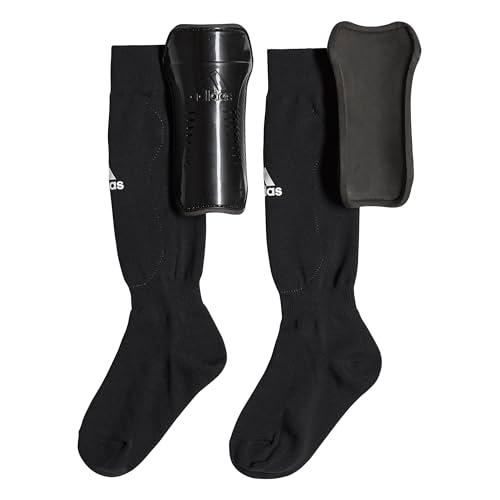
The most comfortable youth shin guard here is the adidas Performance Youth Sock Shin Guard — the shell is built into the sock, so there is no strap, no edge and nothing to slip. The budget pick is the Syhood Shin Guards with Socks, the cheapest complete sleeve set on the site. For an older player who wants a strapped guard, the Mitre Aircell Carbon is the comfortable one. Prices are read live from Amazon with the date under every button.
Comfort gets treated as the soft criterion in this category and it is actually the decisive one. A shin guard that pinches at the ankle, slides down the calf or digs in at the top edge comes off at half time, goes in the bag, and protects nothing for the rest of the season. Every parent who has argued with a nine-year-old at the touchline already knows this.
So this page ranks on construction rather than on padding. Four things decide whether a child keeps a guard on: how it is held in place, how much shell edge touches the leg, whether it wraps the ankle, and how much of the leg it covers. The protection figures matter — and we get to them — but they only matter for a guard that is still on the leg in the second half.
What makes a youth guard comfortable
The comfort-protection trade in this category is close to linear, which is the useful thing to know. Rows describe construction types, not our own testing — this site does not lab-test and publishes no scores.
Construction
Comfort
Protection
Who it suits
Shell built into the sock
Highest — no strap, no loose edge
Lowest shell area
U6-U10, and any child who keeps taking guards off
Slip-in shell plus a separate sleeve
High, if the sleeve is the right size
Mid — a real shell, no ankle wing
U9 upward, the mainstream choice
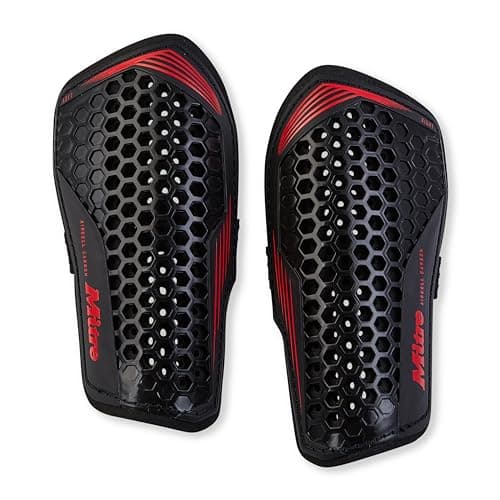
Strapped guard, no ankle wing
Mid — one strap, adjustable
Mid-high
U10+ who wants the guard to stay exactly put
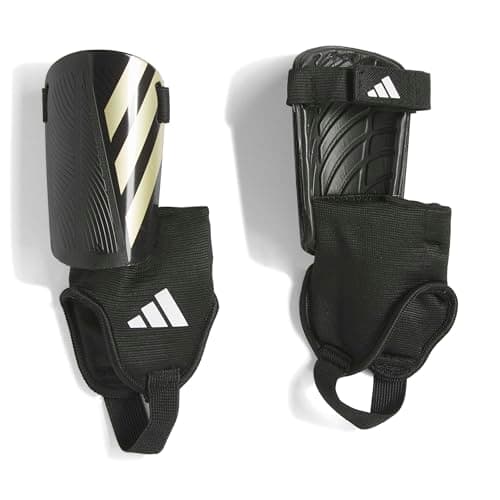
Strapped guard with ankle wings
Lowest — wings rub at the ankle bone
Highest
U7-U11 in a physical league, and nervous first seasons
Built-in mini pad sleeve
High — nothing rigid at all
Lowest of the real guards
U11+ copying the professional look
Scroll the table sideways on a narrow screen.
How we sorted these
Held in place without a strap, where possible. A sock-integrated or sleeve-held guard removes the single commonest comfort complaint, which is the strap edge at the back of the calf.
No ankle wings unless the league needs them. Ankle wings are the most protective option and the least comfortable, because they sit on a bone. They are ranked lower here on purpose, and we say when they are the right buy anyway.
Shell edge over shell area. A smaller shell with a soft border is more comfortable than a bigger one with a hard edge, and a child notices the edge long before they notice the coverage.
Still legal. Law 4 requires the guard to be covered by the socks, so anything that cannot be covered is not a comfortable option, it is an unusable one.
A named cheapest-comfortable pick. Not the cheapest guard on Amazon — the cheapest in our registry that a child will actually keep on.
Quick picks
Tap any row to jump to the full write-up. The price in each button is the one Amazon reported on the date stamped under it — tap through for today’s number, which is the only one that can be relied on.
#
Product
Best for
Surface
Fit notes
Price
1
adidas Performance Youth Sock Shin GuardsThe safe default in a badly documented category: a recognizable brand, height-based sizing and the format coaches expect, as long as you check the chart rather than the age on the box.
U7–U8 rec, U9–U10
Sleeve with a removable shell
Sized by height, not by shoe size, and the bands are narrow — measure the child rather than guessing from their age.
Syhood Soccer Shin Guards with Socks for KidsThe honest budget answer for a first set: not integrated, not documented, but it puts a guard and a sock long enough to cover it in the same box.
U6, U7–U8 rec, U9–U10
Guards plus knee-high socks, sold together
Sold in S and M bands rather than by height or shoe size, so read the retailer's dimensions.
Product photos come from each item’s current Amazon listing.
The picks in full
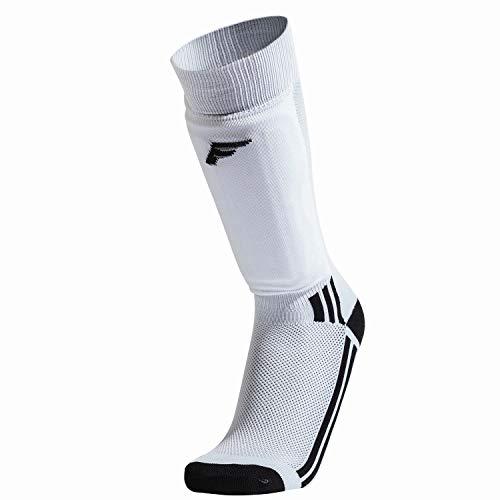
1. adidas
adidas Performance Youth Sock Shin Guards
The safe default in a badly documented category: a recognizable brand, height-based sizing and the format coaches expect, as long as you check the chart rather than the age on the box.
Best for
The default shin sock, U7 through U10
Levels
U7–U8 rec · U9–U10
Type / surface
Sleeve with a removable shell
How it fits
Sized by height, not by shoe size, and the bands are narrow — measure the child rather than guessing from their age. Because the reported fit runs small, a child near the top of a band should go up. The shell should sit with its top roughly two finger-widths below the kneecap and cover down to the top of the boot.
What we like
The only option here from a brand a parent already recognizes, which matters when a coach says "shin guards" and you have thirty seconds in an aisle
The sleeve-plus-shell format is the one most coaches mean by a shin sock, so it is the least likely to be queried at a check-in
Height-based sizing bands rather than foot size, which is the correct way to size a guard and is the thing slip-in guards get wrong
Where it falls short
The published youth size charts for these disagree between retailers by as much as a full band, so order from a retailer whose chart you can read and expect to check it
Reviewers on multiple listings report the sizing runs small — if the child is near the top of a band, the next size up is the safer order
One colorway per listing, so matching a team kit means finding a different listing rather than a different option
Manufacturer’s published specs
Sold as a sock-style guard with a shell held in a sleeve, with no straps (listing)
Listed in youth Small, Medium and Large, sized by the player's height rather than by foot size (retailer charts)
Black/White colorway on this listing
adidas Performance Hardgoods is named as the manufacturer on the listing
These are the manufacturer’s own claims, not measurements we took.
The right first pair for a young child, because it is the one product here that cannot be assembled wrongly or half-lost.
Best for
A first season, U6 through U8
Levels
U6 — first kicks · U7–U8 rec
Type / surface
True 2-in-1 sock with integrated guard
How it fits
Sized XS through L by the retailer's chart rather than by foot size. This is the smallest-fitting option here, which is why it is the U6 pick, and because the guard is fixed you want the size that puts the shell over the shin bone now rather than one bought for next season.
What we like
A genuine one-piece item, which is the entire point for a young child — there is nothing to lose, nothing to put on in the wrong order and nothing for a four-year-old to get backwards
Machine washable as a single thing, so the guard actually gets washed instead of living in the bag all season
Starts at an Extra Small, which is a real size for a four- or five-year-old rather than an adult small relabeled
Where it falls short
One-piece means the guard cannot be removed, so the protection and the sock wear out together and you replace both at once
The shell is fixed in place, so if it sits wrong on a particular child there is no adjusting it — the only fix is a different size
The listing states ages 4 to 12 for a product sold in discrete sizes, which is a range too broad to order from; go by the size chart, not the age claim
Manufacturer’s published specs
Described on the listing as a "2-In-1 Protective Combo" — the sock and the guard are one item
"Impact-Resistant Shell" and an "Air-Cooled Breathable Design" (listing)
Machine washable (listing)
Rated by the listing for ages 4 to 12
This listing is the Extra Small, Black/White
These are the manufacturer’s own claims, not measurements we took.
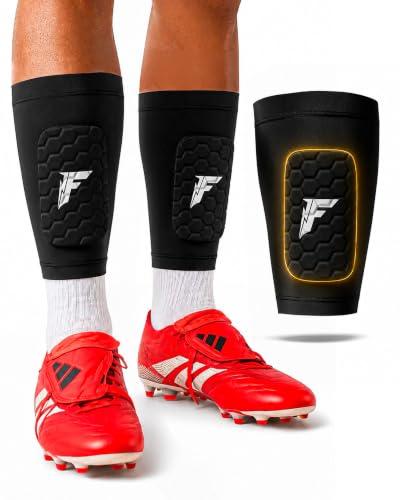
Flair Futbol Built-in Shin Guard Sleeves (Kids 6-10, 12 x 7 cm)
An honest minimalist option for an older player who would otherwise wear nothing — and the wrong purchase for a young rec player, who needs coverage rather than discretion.
Best for
A travel or club player who wants the pro-style mini pad
Levels
U11–U12 · U13+ travel & club
Type / surface
Sleeve with a built-in mini pad
How it fits
Sized by age band rather than height, and this listing is the Kids 6-10. A sleeve must be snug to work: if it can be pulled down with one finger it will migrate, and the grip strip only helps if the sleeve is the right diameter to start with.
What we like
The smallest pad area of anything here, which is exactly what an older player who hates bulky guards is actually asking for
The silicone grip strip addresses the real failure of sleeve-style guards, which is the sleeve creeping down the calf over ninety minutes
A built-in pad cannot migrate inside a pocket mid-game, which is the other failure of pocketed sleeves
Where it falls short
Roughly three times the price of everything else on this page, for less coverage rather than more — you are paying for minimalism
A 12 x 7 cm pad is a deliberate reduction in protection, and that is the wrong trade for a younger player and arguably for any rec player
The pad is not removable, so a damaged pad means replacing the sleeve
Law 4 requires a shinguard of "appropriate size" and leaves the referee to judge it — a mini pad is more likely to be questioned than a full shell
Manufacturer’s published specs
Pad built into the sleeve rather than inserted, described on the listing as "Ultra-Lightweight CTP Protection Shin Pads"
Silicone grip strip to stop the sleeve sliding (listing)
Pad stated as 12 x 7 cm on this listing
This listing is the Kids 6-10 size, in black
Sold by the brand as "Pro Level Soccer Shin Guard Socks" (listing)
These are the manufacturer’s own claims, not measurements we took.
The honest budget answer for a first set: not integrated, not documented, but it puts a guard and a sock long enough to cover it in the same box.
Best for
A complete first set in a color a child picks
Levels
U6 — first kicks · U7–U8 rec · U9–U10
Type / surface
Guards plus knee-high socks, sold together
How it fits
Sold in S and M bands rather than by height or shoe size, so read the retailer's dimensions. Buy the set whose sock actually covers the guard — that is the Law 4 requirement and the reason to buy them together at all.
What we like
Guard and sock in one order and in matching colors, which removes the most common oversight — buying guards and discovering Law 4 requires a sock long enough to cover them
Sold in colors beyond black and white, and at these ages the kit a child chooses is the kit they will put on without an argument
Cheap enough that outgrowing it in a season is not a problem
Where it falls short
Two separate items rather than an integrated sock guard, so there is still a guard that can be left in the car
An ages 3 to 15 range on a short size run tells you nothing — go by the retailer's measurements
A marketplace brand with no published specification and no stated shell material, so there is nothing to verify about the protection itself
Each listing is a single size and color, so a size exchange may mean a different listing
Manufacturer’s published specs
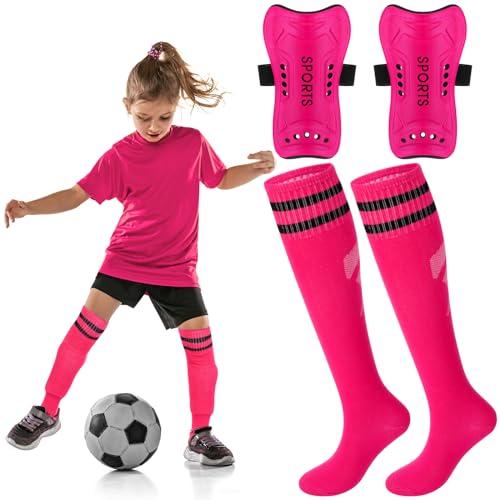
Guards and knee-high striped socks supplied together as a set (listing)
Described as lightweight protective shin pads (listing)
This listing is the S size in pink
Listed for ages 3 to 15
These are the manufacturer’s own claims, not measurements we took.
Ankle wings are the most protective thing in this category and the least comfortable, and both halves of that are true at once. The wing sits over the ankle bone, which is the part of the lower leg with the least soft tissue to cushion anything — so a wing that is slightly the wrong size rubs on exactly the spot a child will complain about.
That does not make them a bad buy. For a U8 in a league where tackles land anywhere, or for a child who has already been caught once and is now nervous, the wing is the right purchase and the comfort cost is worth paying. What it does mean is that wings should be a decision rather than a default, which is how they usually get sold.
The check that predicts comfort better than any spec: with the sock on, can the child squat fully without the top edge of the guard catching below the knee?
Size is most of comfort
A guard that is the wrong size cannot be made comfortable by construction. Too long and the top edge catches below the knee every time the child squats or sprints; too short and it slides, which means the sleeve or strap has to be over-tightened to hold it, which is its own discomfort.
The measurement that matters is the distance from just below the knee to the top of the ankle bone, and it is sized by height in most brands' charts rather than by age. A tall nine-year-old and a short twelve-year-old are frequently the same guard size, which is why buying by age band is the commonest sizing mistake in this category.
This sounds like a side issue and it is not. A guard that has been through a hot wash or a dryer is a less comfortable guard: a manufacturer's own shin-guard care guidance warns against heat for exactly that reason, because heat distorts the shell and hardens the foam backing that sits against the leg.
The same applies to the sleeve or sock holding it. A compression sleeve that has lost its elastic no longer holds the guard, so the child pulls it tighter, and the sleeve that was comfortable in September is the thing they are complaining about in March. Replacing an eight-dollar sleeve is usually cheaper than replacing the guard.
What are the most comfortable shin guards for youth soccer?+
Sock-integrated guards, where the shell is built into the sock itself — the adidas Performance Youth Sock Shin Guard is our pick. There is no strap, no loose shell edge against the calf and nothing that can rotate around the leg mid-game, which removes the three things children actually complain about. The trade is a smaller shell area than a strapped guard.
Are slip-in or strapped shin guards more comfortable?+
Slip-in, in almost every case. A strap means an edge across the back of the calf and a tension a child can get wrong, while a slip-in shell held by a sleeve or sock spreads the hold over the whole lower leg. Strapped guards earn their place when a guard absolutely must not move — which is a real requirement for some older players.
Do ankle shin guards hurt?+
They can, because the wing sits over the ankle bone, which has the least soft tissue of anywhere on the lower leg. A slightly mis-sized wing rubs exactly there. That does not make them a bad buy for a young player in a physical league, where the extra protection is worth the comfort cost — but wings should be a deliberate choice rather than the default.
What size shin guards should my child wear?+
Size by the measurement from just below the knee to the top of the ankle bone, and use the brand's own chart, which is usually keyed to height rather than age. A tall nine-year-old and a short twelve-year-old are often the same size. Buying by age band is the most common sizing mistake here, and a guard that is too long catches below the knee every time the child squats.
Why does my child keep taking their shin guards off?+
Almost always one of three things: a strap edge digging into the calf, an ankle wing rubbing the ankle bone, or a guard that is too long and catches below the knee when they squat. All three are fixed by construction or size rather than by padding, which is why this page ranks guards on how they are held and how much edge touches the leg.
Can comfortable shin guards still be legal?+
Yes. Law 4 requires shin guards to be of a suitable material and an appropriate size and to be covered by the socks, with the player responsible for suitability — it does not specify a thickness or a shell area. A sock-integrated guard that the socks cover satisfies all of that. What is not legal is a guard the socks cannot cover, which rules out some oversized options.
Sources
Coaching American Soccer — Law 4, The Players' Equipment — The Law 4 requirements quoted on this site: footwear is compulsory but cleats are not specified; shinguards must be of suitable material, appropriate size and covered by the socks, with the player responsible for suitability; a player must not use equipment that is dangerous; and the referee-level guidance that worn, pointed or exposed-shaft studs and shoes with sharp metal or pointed spikes are not permitted.
IFAB Laws of the Game — Law 4, The Players' Equipment — The Law text quoted on this site: undershorts and tights must be the same color as the main color of the shorts or the lowest part of the shorts, and players of the same team must wear the same color; shinguards must be of suitable material and appropriate size, covered by the socks, with the player responsible for their suitability; non-dangerous protective equipment of soft, lightweight padded material is permitted; and a player must not use equipment or wear anything that is dangerous, which must be removed rather than taped or covered. Law 4.3 is also the source for the kit-color rules quoted here: the two teams must wear colors that distinguish them from each other and the match officials, and each goalkeeper must wear colors that are distinguishable from the other players and the match officials. Law 4.4 names gloves, headgear, facemasks and knee and arm protectors of soft, lightweight padded material as permitted non-dangerous protective equipment, and separately permits goalkeepers caps and tracksuit bottoms.
Reusch — Shinguard Attrakt Supreme (care instructions) — A manufacturer's own care instructions for a hard-shell shinguard, quoted on this site: remove dirt with a soft brush and wipe with a damp cloth; do not use solvents or other cleaners as they may cause damage; do not expose the product to excessive heat or strong sunlight; store in a dry and ventilated area, otherwise the performance of the shinguard reduces significantly.
Authentic Soccer — Kwik Goal Shinguard Compression Sleeve — The retailer listing carrying Kwik Goal's own specification for the shinguard compression sleeve, and the source for every figure quoted about it: Polyester Lycra construction, a Youth and an Adult size listed as 5 in and 8 in, machine washable, and the stated purpose that it "Holds shin guard in place without tape" and "Helps reduce cramping and fatigue". The listing names no insert pocket, which is the distinction the shin-socks page draws between a plain compression sleeve and a pocketed one.