Heads up: we earn a commission if you buy through our links, at no extra cost to you. It never changes which product we recommend — here’s how that works.
The short answer
For a coach or team parent the pick is the Athllete Youth & Adult Soccer Pinnies, 12 pack — twelve mesh vests in one color splits a standard rec squad into two sides, which is what a weekly small-sided session needs. The budget pick is the PEASUG 12-piece pack, and for station work it is genuinely the better buy because it comes in four colors. If you are running a yard game with no team kit at all, the ATHLOVA six-red-six-blue pack marks both sides from one box. Prices come from the live price layer with an as-of date under each button.
Pinnies are the least glamorous purchase in youth soccer and one of the most useful, because almost everything a coach wants to run depends on being able to tell two groups apart. Without them, every small-sided game starts with five minutes of "who is on my team" and ends with a goal nobody can score because nobody knows which way they are going.
The decision is almost entirely about arithmetic, and it is the arithmetic most buyers get wrong. Twelve vests in one color makes exactly one team. Twelve vests in four colors makes four teams of three, which is what a station session or a 3v3 tournament actually needs.
What each pack can actually run
Pack contents are each listing's own stated count and colorway. The teams column is simple arithmetic from those counts — it is the number that decides whether a session works.
Pack
Teams it makes
Best for
Athllete 12 pack, one color
One marked team against one unmarked
A weekly 6v6 or 7v7 scrimmage with a single squad
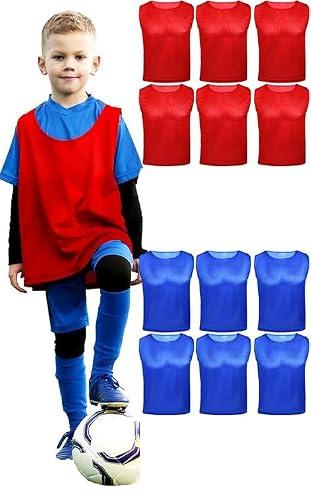
ATHLOVA 6 red + 6 blue
Two marked teams of six
A yard game, or a squad where nobody is in team kit
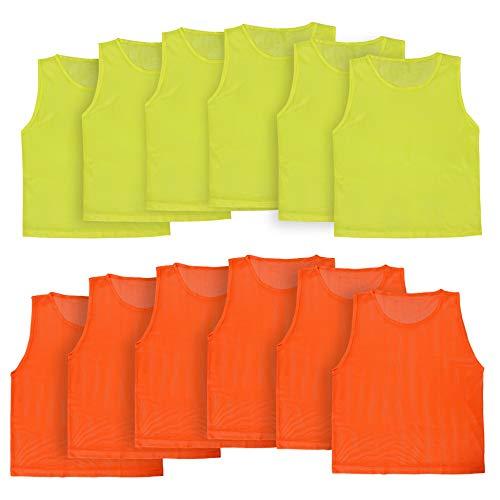
PEASUG 12 pieces, four colors
Four teams of three
Station work, 3v3 rotations and possession grids
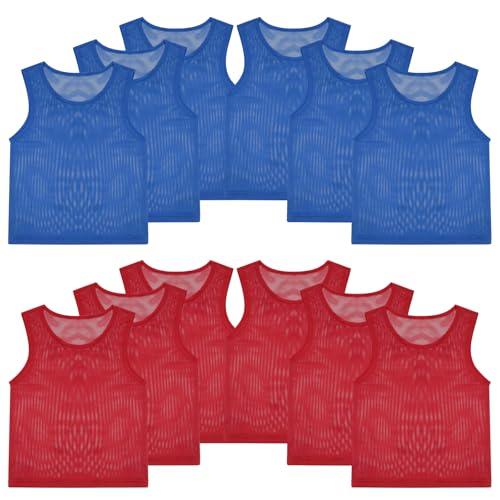
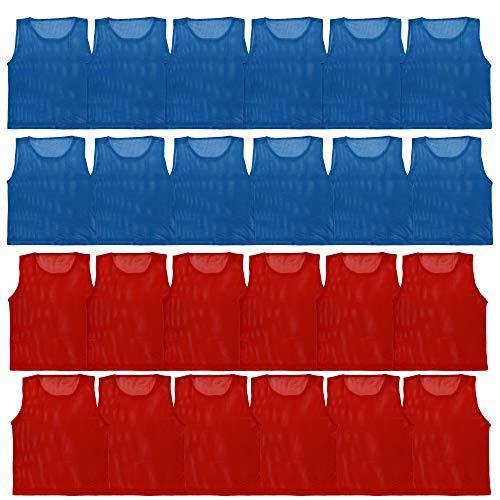
Athllete LITEMESH 24 pack
Two full teams, or three teams of eight
A club, or a coach running age groups back to back
Scroll the table sideways on a narrow screen.
How we sorted these
Teams, not vests. A pack is ranked by how many distinguishable groups it can create, which is the only thing the purchase is for.
Mesh weight, honestly. A lighter mesh is cooler in September and tears sooner. Both halves are stated for each pick rather than only the flattering one.
Sized to go over a jersey. Pinnies are cut generously on purpose. Where a pack is youth-only and will be tight on an older squad, we say so.
Quick-dry where it is published. Pinnies get used wet and stored damp more than any other kit item, so a stated quick-dry fabric is a real advantage.
A named budget pick. The cheapest pack in our registry with a live price — which on this page is also the most flexible, and we say so rather than hiding it.
Quick picks
Tap any row to jump to the full write-up. The price in each button is the one Amazon reported on the date stamped under it — tap through for today’s number, which is the only one that can be relied on.
Product photos come from each item’s current Amazon listing.
The picks in full
1. Athllete
Athllete Youth & Adult Soccer Pinnies (12 Pack)
The default team purchase: twelve mesh vests in one color, which is exactly what a weekly small-sided session needs.
Best for
A coach or team parent running small-sided games, U7 upward
Levels
U7–U8 rec · U9–U10 · U11–U12 · U13+ travel & club
Type / surface
Mesh scrimmage vest, 12 per pack
How it fits
Pinnies are sized generously on purpose, because they go over a jersey and sometimes over a jacket. Buying the youth size for a U13 squad is the common mistake.
What we like
Twelve is the right number: it covers one team in a 6v6 or 7v7 session without a second purchase
Mesh goes over a jersey or a cold-weather layer without overheating the player
A brand that sells almost nothing but pinnies, so the size run is built for teams
Where it falls short
Mesh snags on velcro and on goal netting, and a torn vest cannot be repaired
One color per pack, so a squad that needs three teams needs two packs
Manufacturer’s published specs
Twelve vests per pack, which splits a standard rec squad into two sides (listing)
Mesh construction, described as a practice jersey rather than a solid bib (listing)
Listed across youth and adult sizing in the same range (listing)
These are the manufacturer’s own claims, not measurements we took.
The pick for anyone who needs both teams marked: two colors in one box, which is what a parent running a yard game actually needs.
Best for
A parent or coach who needs two distinguishable sides from one pack
Levels
U7–U8 rec · U9–U10 · U11–U12
Type / surface
Mesh scrimmage vest, two colors per pack
How it fits
Kids' sizing, cut to go over a jersey. On a U12 squad the larger players will find these snug — size up a pack or choose the youth/adult range instead.
What we like
Two colors in one pack is the practical answer to a backyard or driveway game, where nobody is wearing a team kit
Quick-dry matters because pinnies get used wet and stored damp more than any other kit item
Both sides are marked, so neither team is 'the ones in whatever they wore'
Where it falls short
Six per side caps the session at 6v6, so a full 9v9 squad needs a second pack
Red and blue are fixed, which clashes with some clubs' kit colors
Manufacturer’s published specs
Two colors in one pack — six red and six blue (listing)
Described as lightweight, breathable and quick-dry (listing)
Listed in kids' sizing (listing)
These are the manufacturer’s own claims, not measurements we took.
PEASUG Pinnies Scrimmage Vests (12 Pieces, Four Colors)
The budget pick, and genuinely the better choice for station work: four colors for less than most single-color packs cost.
Best for
The cheapest way to mark sides at a backyard or practice game
Levels
U6 — first kicks · U7–U8 rec · U9–U10 · U11–U12
Type / surface
Lightweight mesh vest, four colors per pack
How it fits
Youth sizing, cut loose to go over a jersey. Four colors at three each is the constraint to plan around: it suits 3v3 and station drills, not a scrimmage.
What we like
Cheapest pinnie pack in this registry with a live price, and four colors means three or four teams rather than two
Four colors is genuinely more useful than twelve of one for station work and rotations
Low enough cost that losing a few over a season does not matter
Where it falls short
Three per color caps each team at three players, so this is for small-sided and station work, not for 7v7 sides
The thinnest mesh here and the least durable — expect replacements rather than repairs
Manufacturer’s published specs
Twelve pieces in four colors — blue, red, yellow and orange (listing)
Lightweight mesh, listed as practice jerseys and team bibs (listing)
Listed for youth (listing)
These are the manufacturer’s own claims, not measurements we took.
The standard advice is to buy twelve pinnies in one color, and for one specific thing — a weekly scrimmage with a single squad — that is right. For almost everything else it is the wrong shape of pack.
US Youth Soccer's published small-sided formats progress through 4v4, 7v7, 9v9 and then 11v11, and the younger half of that progression is built on small numbers. A U8 session is a set of 4v4 games running simultaneously, not one big game — and four simultaneous games need four distinguishable groups, which twelve vests in one color cannot produce.
So the honest recommendation for a coach of younger players is the multi-color pack, even though it is the cheapest one on this page. Backyard soccer drills for kids is the page that puts these to use, and best soccer training equipment for kids covers the cones and markers that go with them.
Pinnies are a cones-and-markers purchase, not a kit purchase — bought by whoever ends up running the session, usually a parent.
Sizing: check the oldest player, not the youngest
Pinnies are cut generously because they go over a jersey and sometimes over a jacket, which means they rarely come up too small for the player they were bought for. The failure happens at the other end of the squad.
A youth-only pack on a U13 squad will be tight on the biggest two or three players, and a tight mesh vest is the one that gets stretched over a shoulder and torn. The packs listed in a youth-and-adult range avoid that, which is why the 12-pack rather than the youth-only 24-pack is the top pick despite costing more per vest.
Two of these packs are standard mesh and two are described as a lighter mesh, and the difference is real in both directions. A lighter mesh is noticeably cooler in late-summer sessions, which is when children refuse to wear pinnies at all — so lighter mesh genuinely gets worn more.
A lighter mesh is also a thinner mesh, and it tears. Pinnies snag on velcro, on goal netting and on the fence, and a torn mesh vest cannot be repaired — it is simply out of the pack. For a club buying for a season that trade is worth making at the lower per-vest cost; for a parent buying one pack to last three years it is not.
The other half of pinnie longevity is washing, and it is the same rule as every other kit item: cold wash, no dryer. How to wash a soccer jersey covers the method, and it applies to mesh more than to anything else.
Common questions
What are the best soccer pinnies for kids?+
The Athllete Youth & Adult Soccer Pinnies 12 pack for a weekly scrimmage: twelve mesh vests in one color split a standard rec squad into two sides, and the youth-and-adult size run covers the size spread in an older squad. For station work and 3v3 rotations the PEASUG 12-piece pack in four colors is both the cheapest and the more useful shape.
How many pinnies do I need for a youth soccer team?+
Think in teams rather than vests. Twelve in one color makes one marked team against one unmarked, which suits a single-squad scrimmage. Twelve in two colors makes two marked teams of six. Twelve in four colors makes four teams of three, which is what a younger session built on simultaneous 4v4 games actually needs. Twenty-four runs three teams of eight.
What size pinnies for youth soccer?+
Pinnies are cut generously because they go over a jersey, so size by the biggest player in the squad rather than the smallest — a youth-only pack will be tight on the largest players in a U13 group, and a tight mesh vest is the one that tears. Packs listed across youth and adult sizing avoid that problem.
Are lightweight mesh pinnies better?+
They are cooler and they tear sooner, and both matter. A lighter mesh is noticeably more comfortable in late-summer sessions, which is when children refuse to wear pinnies at all. But it snags on velcro, netting and fences, and a torn vest cannot be repaired. At club scale the lower per-vest cost makes the trade worth it; for one pack meant to last three years it does not.
Can pinnies be used as practice jerseys?+
Not really. A pinnie is a marker, not a shirt: no number, no badge, no durability, and it is designed to go over clothing rather than to be worn against the skin. For a training top a child will actually wear, buy a practice jersey — our practice-jersey roundup covers those separately.
How do you wash soccer pinnies?+
Cold wash, no dryer — the same rule as every other synthetic kit item, and it matters more for mesh than for anything else because heat distorts the fabric and makes it brittle. Pinnies also get stored damp more often than any other item, so hanging them to dry before they go back in the bag is what actually extends the pack's life.
Coaching American Soccer — Law 4, The Players' Equipment — The Law 4 requirements quoted on this site: footwear is compulsory but cleats are not specified; shinguards must be of suitable material, appropriate size and covered by the socks, with the player responsible for suitability; a player must not use equipment that is dangerous; and the referee-level guidance that worn, pointed or exposed-shaft studs and shoes with sharp metal or pointed spikes are not permitted.