Heads up: we earn a commission if you buy through our links, at no extra cost to you. It never changes which product we recommend — here’s how that works.
The short answer
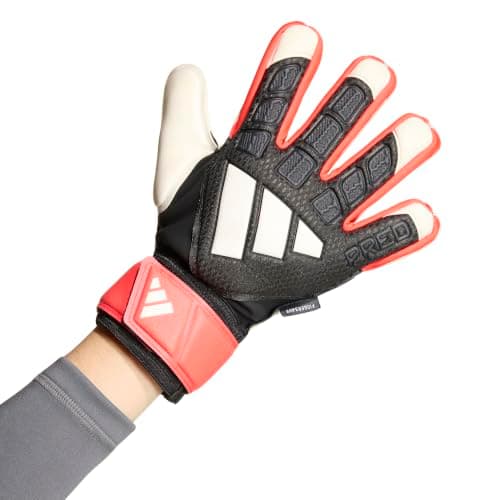
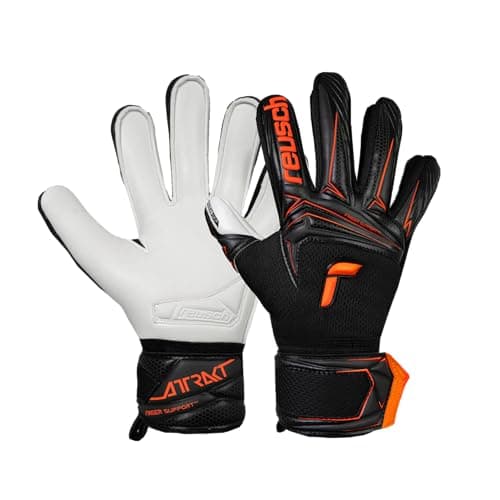
For a high school keeper, buy for cut and fit first, latex second, and surface third. The Reusch Attrakt Advance Finger Support is the pick for a keeper at the top of junior sizing: an Evolution Negative Cut on a junior-specific construction, with integrated Finger Support through every finger and the thumb. Measure across the palm and add about an inch to get the size — by high school most keepers have crossed into adult glove sizes 8 and up.
High school is where keeper gloves stop being a protective purchase and start being a performance one. Up to about U12, the questions are whether the glove lets a kid close their hand and whether it has finger spines. From fourteen, a keeper who has chosen the position is diving at real shot speed on a full-size goal, and the glove's cut, latex and surface match all start to show up in whether they hold the ball.
What changes when a keeper reaches high school
Three things, and the first one is just arithmetic. The hand crosses out of junior sizing: youth keeper gloves top out around size 7, and a high school keeper is usually a 8, 9 or 10. That matters more than it sounds, because most junior gloves are adult gloves scaled down — the finger stalls end up the wrong length relative to the palm width — and the moment a keeper is in genuine adult sizing, that distortion disappears.
The second is that cut becomes a real decision rather than a spec-sheet line. The third is volume: a high school keeper trains most days of the week in season, which means latex wear stops being a curiosity and starts being a budget item.
The same position, two different purchases. The crossover happens at hand size, not at a birthday.
Youth keeper (U9-U12)
High school keeper
Glove size
Junior 4-7
Adult 8-10
What to buy for
Fit and finger protection
Cut, latex and surface
Fit distortion
Common — scaled-down adult patterns
Gone, once in adult sizing
Latex wear
Outgrown before worn out
Worn out, often twice a season
Pairs needed
One
Often two: match and training
Scroll the table sideways on a narrow screen.
Measuring has not changed and is still the thing most people skip: measure across the palm at its widest point just below the knuckles, in inches, and add about one. Then have them make a fist. If they cannot close the hand comfortably, the glove is wrong whatever the chart said. The youth goalie glove size chart has the conversions and the full method.
Start here
Pick by your kid’s level
The right answer changes with the level, not just the shoe size. Find your kid’s bracket and start there.
The best-fitting glove here for a keeper still at the top of junior sizing. An Evolution Negative cut that rolls the latex around the fingertips for a snug, direct feel, with Finger Support spines that stop backward flex, plus a DuraGuard patch at the palm base where a keeper pushes up off the ground.
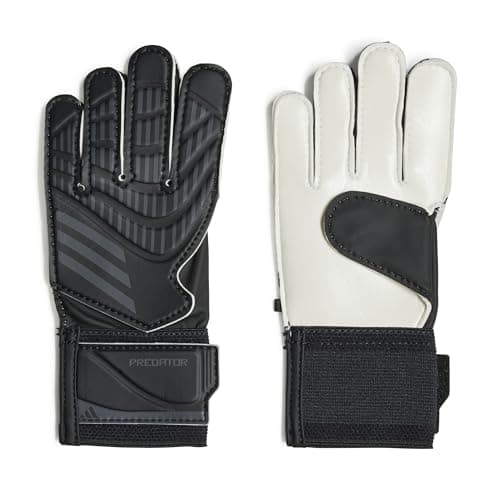
adidas Youth Predator Match Fingersave Goalkeeper Gloves
For a keeper who has already jammed a finger, and for anyone whose school plays on hard ground. Listed by adidas for ages 8 to 16, a flat-stitched negative cut with Soft Grip Pro latex and fixed Fingersave spines — the most substantial finger protection on this page.
The cut is how the latex palm is joined to the rest of the glove, and it sets the fit more than the size does. Three shapes cover almost everything sold.
Negative cut — stitching and gussets inside the glove. The snuggest fit and the most direct feel on the ball, and the choice most high school keepers end up preferring. The trade-off is that the fingers and thumbs show wear quicker than looser cuts.
Flat cut — external stitched gussets with one piece of latex across the palm. The most latex surface on the ball and the roomiest fit. Often the starter or training shape.
Roll finger — the backhand joins the palm directly with no gussets, so the latex rolls around the fingers. A spacious fit with a lot of latex on the ball, and more durable than a negative cut.
If the keeper has an opinion, follow it — this is a feel decision and they are the one catching. If they do not, start with a negative cut at this age and keep a flat or roll finger pair for training, where durability matters more than the last few percent of feel. Goalie glove cuts explained goes through all of it including hybrids.
Quick picks
Tap any row to jump to the full write-up. The price in each button is the one Amazon reported on the date stamped under it — tap through for today’s number, which is the only one that can be relied on.
Product photos come from each item’s current Amazon listing.
Finger spines at high school age
Finger protection is a genuine question at this age and the honest answer is split. The injury it addresses — a hyperextended or jammed finger — is real and gets more likely as shot speed rises. What spines cost is feel: they stiffen the glove, and some keepers find it changes how a catch lands.
The useful distinction is removable versus fixed. Reusch's Finger Support spines adapt to the shape of the finger and prevent backward flex while the brand states they do not compromise mobility; the adidas Fingersave spines in the Predator Match are fixed and non-exchangeable, which is why that glove is the more protective and the stiffer of the two. A keeper coming back from a finger injury wants the fixed version. A keeper who has never had one and dislikes stiff gloves is better served by the Reusch. Finger protection vs no finger protection works through both sides.
1. Reusch
Reusch Attrakt Advance Finger Support Junior
The best-fitting youth keeper glove here, and the right pick for a kid who genuinely plays in goal every week.
Best for
A regular U11+ keeper who wants finger protection
Levels
U9–U10 · U11–U12 · U13+ travel & club
Type / surface
Finger support (integrated)
How it fits
Measure across the palm and add about an inch to find the glove size. A keeper glove should have roughly a fingertip's gap at the end — too tight and they cannot make a fist.
What we like
The genuine youth-specific last matters more than any single feature — most junior gloves are shrunken adult gloves and fit badly
Finger support is the one protective feature that addresses the actual common keeper injury at this age: a hyperextended finger
Reusch's grip latex is a real step up from generic junior gloves
Where it falls short
Grip latex wears fast on hard or artificial surfaces — expect visible palm wear within a season
More expensive than a rec keeper who plays one rotation in goal per game needs
Manufacturer’s published specs
Integrated Finger Support, which Reusch states stabilizes all fingers and the thumb without sacrificing mobility (Reusch)
Grip Advance latex palm (Reusch)
Evolution Negative Cut, wrapping the latex round the fingertips (Reusch)
AIRVENTSYSTEM mesh panels and DURAGUARD reinforcement in high-wear zones (Reusch)
Construction Reusch states is tailored specifically to junior keepers (Reusch)
These are the manufacturer’s own claims, not measurements we took.
A high school keeper trains most days in season. Grip latex is a soft natural material that abrades from the first save, and on artificial surfaces it wears much faster — manufacturers say so themselves. One good pair worn every day is a pair that has lost its grip by midseason and still costs full price.
The arrangement that works is a match pair and a training pair in the same brand's sizing: the cheaper glove takes the training hours, the better glove takes the games and lasts because it only plays once or twice a week. If the school trains on artificial grass, the turf glove picks are the training half of that pairing. If budget is tight enough that two pairs is not realistic, the budget youth glove picks are honest about what you give up.
Whatever you buy, pre-wash it before the first game — a new glove still has manufacturing preservatives on the latex, and washing them off is what activates the grip. How to break in goalie gloves has the routine, and how long goalie gloves last covers when to stop nursing a pair along.
The rest of the kit changes at this age too: a keeper on a full-size goal spends more time on the ground, which is what youth goalkeeper pants are for, and a high school keeper on a mixed schedule needs the surface conversation from best soccer cleats for goalkeepers.
Common questions
What size goalie gloves does a high school keeper wear?+
Usually adult 8 to 10. Measure across the palm at its widest point just below the knuckles in inches and add about one — that number is the glove size. Then have them make a fist: if they cannot close the hand comfortably, the glove is too small or too stiff regardless of what the chart said.
What are the best goalie gloves for high school soccer?+
Buy for cut and fit first. The Reusch Attrakt Advance Finger Support is the pick for a keeper at the top of junior sizing — an Evolution Negative Cut with integrated Finger Support and DURAGUARD reinforcement in the high-wear zones. For a keeper who has jammed a finger before, the adidas Predator Match Fingersave has fixed spines and is the more protective, stiffer option.
Which glove cut is best for a high school keeper?+
Most end up preferring a negative cut, which puts the stitching inside the glove for the snuggest fit and the most direct feel on the ball. The trade-off is that negative cuts show wear on the fingers and thumbs faster. A flat or roll finger cut is roomier, puts more latex on the ball and lasts longer, which makes it the better training shape.
Should a high school keeper get Fingersave gloves?+
It depends on history and preference, not on age. Spines address a real injury — a hyperextended finger — and the cost is feel, because they stiffen the glove. A keeper coming back from a finger injury should take the fixed-spine option; a keeper who has never had one and dislikes stiff gloves is better off with a removable system or none.
How many pairs of goalie gloves does a high school keeper need?+
Two is usually cheaper than one. Grip latex abrades from the first save and wears much faster on artificial surfaces, so a single good pair trained in every day loses its grip by midseason. A cheaper training pair plus a match pair in the same brand's sizing keeps usable grip for the whole season.
Can a high school keeper use junior gloves?+
Only if their hand is still in junior sizing, which tops out around size 7. It is worth checking rather than assuming, because junior gloves are often adult patterns scaled down, with finger stalls the wrong length relative to the palm — a distortion that disappears as soon as the keeper is genuinely in adult sizes.
Sources
Reusch Attrakt Advance Finger Support Junior goalkeeper gloves — The retailer spec sheet for the junior Reusch glove this site recommends, and the source for its cut: an Evolution Negative Cut, described as wrapping the latex around the fingertips for a second-skin feel and improved ball control, with Grip Advance latex, DURAGUARD reinforcement in the high-wear zones, integrated Finger Support that stabilizes all fingers and the thumb, AIRVENTSYSTEM mesh panels, and a construction Reusch states is tailored specifically to junior keepers.
KeeperSport — adidas Predator Match Fingersave Junior — The retailer spec sheet for the junior adidas Predator Match Fingersave, and the source for its cut: listed as a negative cut (NC), flat-stitched, with Soft Grip Pro palm latex, fixed non-exchangeable Fingersave finger spines against hyperextension, a latex thumb wrap, a rib-mesh-and-latex backhand, a punching zone and a half-wrap wrist strap with an elastic band.
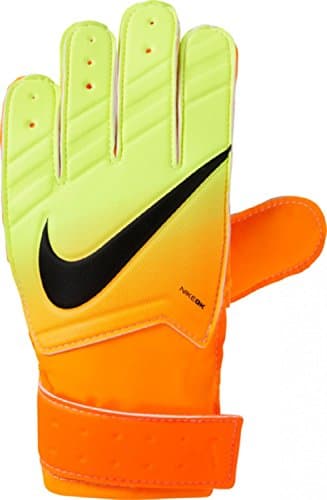
Unisport — Nike Goalkeeper Gloves Match (kids) — The retailer spec sheet for the kids' Nike Match glove, and the source for its cut: a flat cut, also described as a traditional cut, with 3 mm soft latex for ball feel and a Tri-Vario closure. Also the source for the retailer positioning it as a starter or training glove.
One Glove — goalkeeper glove cut guide — A glove manufacturer's own cut guide and the source for the cut definitions quoted on this site: flat palm has external stitched gussets between fingers and palm with one piece of latex attached to the back and is 'known for great latex coverage on the ball'; roll finger connects the backhand directly to the palm with no gussets so the latex rolls around the fingers, giving 'a fairly spacious fit that provides a lot of latex coverage on the ball'; negative is built like a flat cut but with the stitching and gussets inside the glove, which 'provides a much tighter and snug fit with control on the ball that is more true to your hand'. Also the source for the snugness ranking — flat and roll finger at the loose end, negative at the snug end — and for hybrids combining a negative lower section with a roll-finger or flat upper.
The One Glove Co — goalkeeper glove care guide — A glove manufacturer's own care guide and the source for the glove-care facts quoted on this site: pre-wash a new pair before first use and let them dry naturally, to remove manufacturing preservatives from the latex and activate it; dampen the palms occasionally in use because 'latex is not designed to be dry'; wash immediately after use in warm water at a maximum of 30C, squeeze rather than twist the water out, and dry naturally away from direct heat or light, since heat and UV dry the latex out and make it brittle; wrap in a towel and press rather than scrub; allow about 24 hours to dry, then store cool and out of direct sunlight with the palms not touching, because palms left in contact stick together and tear when peeled apart; never store them unwashed. Also the source for the wear facts: latex wear is normal and 'can even start from the very first save'; latex degradation depends on the surface and the volume of saves; gloves are predominantly designed for natural surfaces unless a specialist 3G/astro latex is specified, and 'if you are using a goalkeeper glove on an artificial surface such as 3G or astro turf you will be placing a higher level of stress on the latex, therefore it will wear much quicker'; negative-cut gloves show wear on the fingers and thumbs quicker than looser cuts because of the tighter fit and internal stitching, while roll finger and classic-fit cuts fare better; and using the palms to push up off the ground in training adds avoidable wear.