Cleats
Soccer vs football vs baseball cleats for kids
One swap is usually fine. The other two are not, and one of them is a safety rule.
By Ryder M. · Published September 27, 2026
Heads up: we earn a commission if you buy through our links, at no extra cost to you. It never changes which product we recommend — here’s how that works.

The short answer
Soccer cleats have no toe stud; football and baseball cleats do. That single difference is why a soccer cleat is usually accepted in flag football, and why a football or baseball cleat is usually not allowed in soccer — the front toe stud is a hazard in a tackle. Soccer cleats are also lower cut and lighter.
This question comes up every autumn, when a family has a pair of cleats in the closet from one sport and a sign-up form for another. The answer is not symmetric, which is the part that surprises people.
The differences that actually matter
| Soccer | Football | Baseball | |
|---|---|---|---|
| Toe stud | None | Yes | Yes |
| Cut | Low | Low, mid or high | Low or mid |
| Stud shape | Molded conical or bladed | Molded or detachable | Often metal at older ages |
| Weight | Lightest | Heavier | Heavier |
| Toe reinforcement | Minimal — it is a striking surface | Reinforced | Reinforced |
The toe stud is the whole story. Football and baseball both involve driving forward off the front of the foot, so their cleats have a stud right at the toe for push-off. Soccer does not — the front of the foot is a striking surface for the ball, so a stud there would sit exactly where the boot contacts the ball, and would be pointing forward into whatever else it hits.
Which swaps are allowed
Soccer cleats for flag football: usually yes
This is the swap that generally works. A soccer cleat has no toe stud, so there is nothing about it that flag football rules typically prohibit, and flag football does not involve the line contact that makes a reinforced toe useful.
Check the specific league, since rules vary, but it is usually fine. What your kid gives up is push-off from the toe, which matters less in flag football than in tackle.
Football or baseball cleats for soccer: usually no
This is the one to expect a referee to stop. The toe stud is a hazard in a soccer tackle — a foot arriving studs-first with a forward-pointing spike at the toe is a different proposition from one with a flat front. Most soccer leagues prohibit it explicitly.
Metal studs, which appear on baseball cleats at older ages, are prohibited in essentially all youth soccer outright.
Soccer cleats for baseball: not ideal
Generally permitted, and not great. Baseball involves sprinting from a standing start and sliding, both of which benefit from the toe stud and the reinforced toe a soccer cleat lacks. It will work for a young recreational player; it is a compromise.
What to do if your kid plays two sports
Two honest options, and the right one depends on which sport they play more.
- Buy soccer cleats and use them for both, if soccer is the main sport and the other is flag football. The soccer cleat is the more permissive of the two, so it is the one that gets accepted in more places.
- Buy two pairs, if they play tackle football or competitive baseball. At that point the toe stud is doing real work and a soccer cleat is genuinely the wrong shoe — and the football or baseball cleat will be refused at a soccer game.
If they play soccer plus an indoor winter sport on a gym floor, that is a third category again: indoor facilities require flat non-marking soles, and no outdoor cleat qualifies. See the indoor picks.
Soccer cleats that work across the widest range of uses
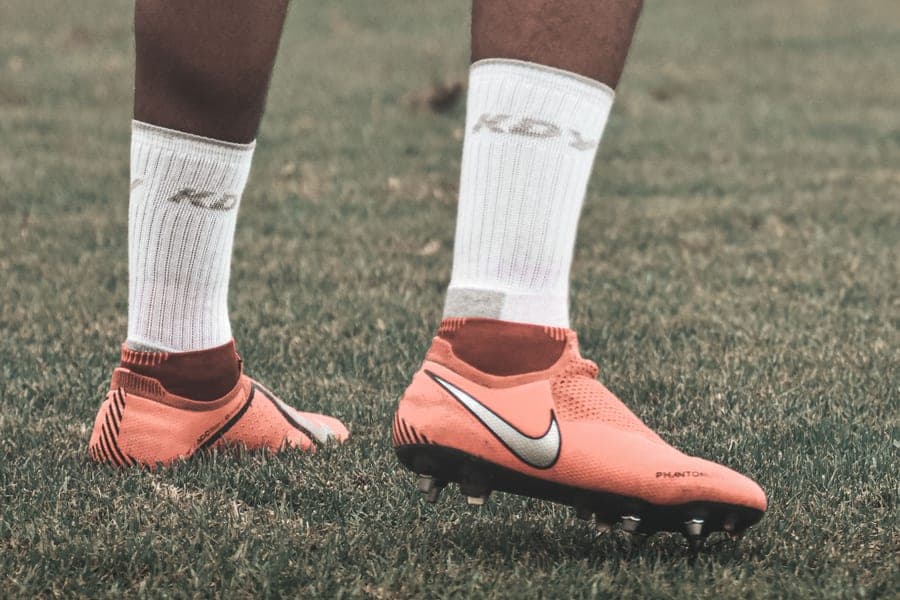
Nike
Nike Jr. Mercurial Vapor 16 Club MG
The safest default cleat for a rec player between U7 and U12, as long as the foot is average width or narrower.
adidas
adidas Goletto VIII Firm Ground
The sensible answer when the honest requirement is a cleat that survives one rec season and costs as little as possible.
Nike
Nike Jr. Mercurial Vapor 16 Club Turf
The right second pair once a kid is training on artificial turf every week, and a bad only-pair if games are on grass.
Photos are licensed representative stock images, not the exact models.
What about softball cleats?
Functionally the same category as baseball: toe stud, reinforced toe, and metal studs at older ages. The same answers apply — a soccer cleat will do for a young recreational softball player, and a softball cleat will not be allowed at a soccer game.
How to tell them apart in the closet
Turn the shoe over and look at the very front of the sole. If there is a stud at the toe, it is a football, baseball or softball cleat. If the front is flat with the first studs set back from the tip, it is a soccer cleat.
That check takes three seconds and settles the question more reliably than the branding on the box, which is frequently vague in the youth market.
Common questions
Are youth football and soccer cleats the same?
No. The key difference is that football cleats have a stud at the toe for pushing off and soccer cleats do not, because the front of a soccer boot is a striking surface for the ball. Football cleats are also heavier with a reinforced toe, and often available in mid or high cut.
Are kids soccer cleats and baseball cleats the same?
No. Baseball cleats have a toe stud and a reinforced toe, and at older ages often metal studs — all of which soccer cleats lack. A soccer cleat will do for a young recreational baseball player, but a baseball cleat will generally not be allowed at a soccer game.
Can kids wear soccer cleats for flag football?
Usually yes. Soccer cleats have no toe stud, which is the feature most likely to be prohibited, and flag football does not involve the line contact that makes a reinforced toe useful. Check your specific league's rules, but this is the swap that generally works.
Can you wear football cleats for soccer?
Usually not. Most soccer leagues prohibit the front toe stud because it is a hazard in a tackle, and a referee is likely to stop it at a check. Metal studs, which appear on some baseball and softball cleats, are prohibited in essentially all youth soccer.
Are kids soccer cleats and softball cleats the same?
No — softball cleats are functionally in the same category as baseball: a toe stud, a reinforced toe, and sometimes metal studs. A soccer cleat is an acceptable compromise for recreational softball; a softball cleat will not be allowed at a soccer game.
Sources
- Nike — kids' soccer cleats and shoes — Verified that each Nike model named on this page is currently sold, and the source for Nike's own published upper, plate and surface descriptions.
- adidas — kids' soccer — Verified current availability of the adidas models named here, plus adidas's published material and construction claims.
Read next
- Firm ground vs turf vs artificial grass cleatsThe FG, AG, TF and MG decision table, whether one pair can cover a mixed schedule, and the cost of guessing wrong.
- Best indoor soccer shoes for kidsNon-marking indoor picks from U7 up, why turf shoes will not do, and what a futsal season needs.
- Best soccer cleats for 8 year oldsCleat picks for an 8 year old by foot width and surface, plus when the step up in price is actually worth it.
- Youth soccer cleat size chartUS, EU and centimeter conversions with approximate ages, plus how each brand's junior sizing actually runs.
- U7–U8 rec: the first real kitAges 6 to 8. Still a size 3 ball, but this is where the first real pair of cleats earns its place.
- Best budget youth soccer cleatsCheap cleats that are actually worth buying, and exactly what each step up in price buys you.