Cleats
Soccer cleats vs flag football cleats
There is no such thing as a flag football cleat. There is a rule, and soccer cleats pass it.
By Ryder M. · Published October 6, 2026
Heads up: we earn a commission if you buy through our links, at no extra cost to you. It never changes which product we recommend — here’s how that works.
The short answer
Soccer cleats are fine for flag football and legal in essentially every league, because the universal footwear rule bans metal — one published rulebook puts it as "rubber-molded cleats are the only cleats permitted, removable or metal cleats are prohibited" — and soccer cleats are molded plastic with no metal spikes. The one thing they lack is the toe stud a football cleat has, which matters for a lineman and not for a flag player.
If you have a kid who plays both sports, this is a question about whether you need to buy twice. Usually you do not, and the direction matters: soccer cleats work for flag football, while football cleats are a problem on a soccer field.
The rule, and why soccer cleats pass it
Flag football leagues write their own rulebooks, so there is no single sentence that governs every league in the country. The pattern is consistent, though. The University of Cincinnati's published flag football rules state it as plainly as anyone: rubber-molded cleats are the only cleats permitted, and removable or metal cleats are prohibited.
Soccer cleats clear that bar without an argument. Under Armour's own guide to cleat types states that soccer cleats are not made with metal spikes, and junior soccer cleats are molded plastic studs on a one-piece plate. Check your own league's sheet before the first game anyway — leagues differ on whether cleats are required at all, and some youth programs run in sneakers.
| Soccer cleat | Football cleat | Legal in flag football? | |
|---|---|---|---|
| Studs | Molded plastic, no metal | Molded plastic or detachable | Soccer: yes. Detachable: usually no |
| Toe stud | None | Yes, at the tip | Not a rule issue either way |
| Cut | Low | Low, mid or high | Not a rule issue |
| Weight | Lighter | Heavier | Not a rule issue |
| Metal spikes | Never made with them | Available in some models | Banned everywhere |
The toe stud, which is the only real construction difference
This is the difference that shows up in every comparison and it is worth understanding rather than memorizing. Football cleats have a stud at the very tip of the toe. Soccer cleats do not, and that is deliberate: a soccer player's toe area has to strike a ball cleanly, so a stud there would be in the way.
What the toe stud does is give grip for driving forward out of a static stance — a lineman's first step. Flag football has no line play and no stance to drive out of, so the feature is close to irrelevant. A flag player is running, cutting and stopping, which is exactly what a soccer plate is laid out for.
Molded cleats that work for both
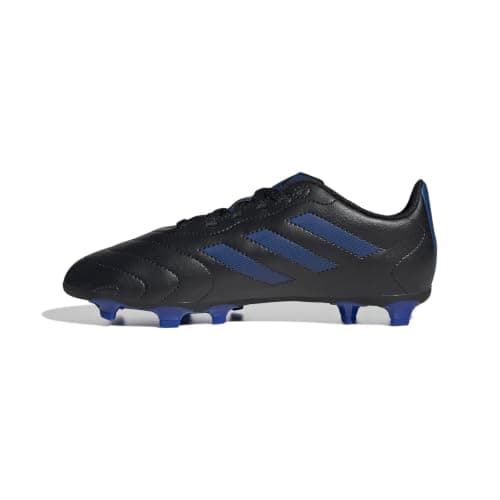
adidas
adidas Goletto VIII Firm Ground
The sensible answer when the honest requirement is a cleat that survives one rec season and costs as little as possible.
$33.67View on Amazon#ad — we may earn a commission · price as of October 16, 2026
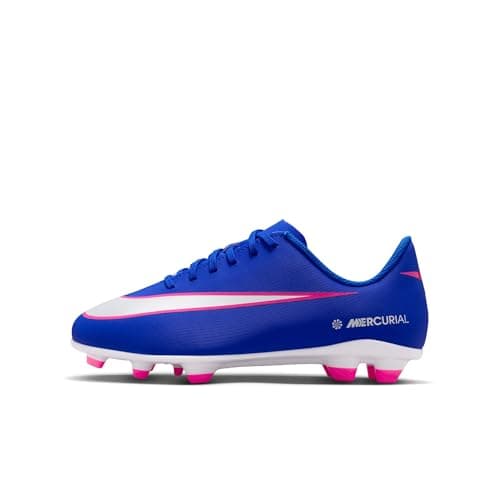
Nike
Nike Jr. Mercurial Vapor 16 Club MG
The safest default cleat for a rec player between U7 and U12, as long as the foot is average width or narrower.
$60.88View on Amazon#ad — we may earn a commission · price as of October 16, 2026
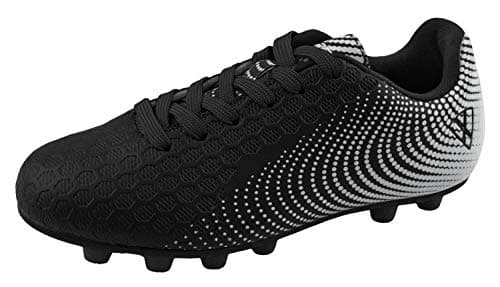
Vizari
Vizari Stealth Firm Ground
The honest choice for a first-season player: enough cleat to play in, not enough money to regret if they switch to basketball.
$12.08$36.97−67%View on Amazon#ad — we may earn a commission · price as of October 16, 2026
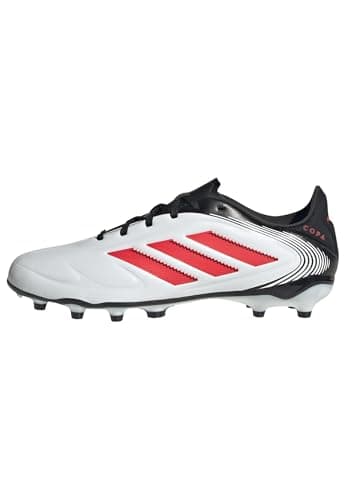
adidas
adidas Copa Pure 3 League Firm Ground (Kids)
The best mainstream junior cleat for a wide foot, and a real help to a player still learning first touch.
$60.00View on Amazon#ad — we may earn a commission · price as of October 16, 2026
Product photos come from each item’s current Amazon listing.
What a flag football player actually wants in a cleat
Flag football is almost all acceleration, lateral cuts and hard stops, usually on grass and often on hard late-season ground. From a footwear point of view that is closer to soccer than to tackle football.
- A molded firm-ground plate. Enough bite for a cut on grass, no metal, no detachable studs to fall foul of a rulebook.
- Low cut. Lighter and freer for a player who is changing direction constantly. A mid or high football cut is built to protect against pile-ups that do not happen in flag.
- Light. Flag football is a running game. The weight advantage of a soccer cleat is a genuine one here.
- A fit that holds the heel. Hard stops are where a loose heel becomes a blister. Same rule as soccer — see how cleats should fit.
Read that list back and it describes a junior soccer cleat. Which is why the sensible purchase for a two-sport kid is one good pair of molded soccer cleats rather than two mediocre pairs.
When to buy a second pair anyway
Three situations, and only three.
- The seasons overlap and the surfaces differ. A soccer season on grass and a flag season on hard turf is a plate mismatch, not a sport mismatch. A turf shoe is the second pair, not a football cleat.
- The kid plays tackle football too. Then the toe stud matters and a football cleat is the correct purchase for that sport specifically.
- The soccer pair is already worn out. Rounded studs are a referee problem in soccer and no advantage anywhere. When to replace them has the checks.
What about sneakers for flag football?
Plenty of youth flag programs allow sneakers and plenty of young kids play in them without any problem. The trade-off is the same as in soccer: on dry, short grass a sneaker is fine, and on wet or long grass a flat sole slides on every cut.
If your kid already owns soccer cleats, there is no reason to buy anything. If they own nothing and are trying flag football first, a molded soccer cleat is the purchase that covers both sports — which is the practical answer to the whole question.
Common questions
Can you wear soccer cleats for flag football?
Yes, in essentially every league. The consistent flag football footwear rule bans metal and usually detachable studs — one published rulebook states that rubber-molded cleats are the only cleats permitted — and soccer cleats are molded plastic with no metal spikes. Check your own league's rules sheet, because leagues write their own and some do not require cleats at all.
What is the difference between soccer cleats and football cleats?
The toe stud. Football cleats have a stud at the very tip of the toe for driving forward out of a stance; soccer cleats deliberately do not, because the toe area has to strike a ball cleanly. Football cleats are also heavier and available in mid and high cuts, while soccer cleats are low-cut and lighter.
Are there cleats made specifically for flag football?
Not really. Brands market molded football cleats toward flag players, but there is no distinct flag football construction and no rule that requires one. What the rules require is molded, non-metal studs, which both soccer cleats and molded football cleats satisfy.
Are metal cleats allowed in flag football?
No. The ban on metal is the one footwear rule that is consistent across flag football at every level, because a metal spike on a player who gets stepped on causes a cut rather than a bruise. Most rulebooks also prohibit detachable studs even when the stud itself is rubber.
Can you wear football cleats for soccer?
It is the direction that causes problems. The toe stud catches when a player plants to strike the ball, the heavier build slows a young player down, and some leagues treat the stud as a safety concern. If a kid plays both and you are buying one pair, buy the soccer cleat.
Do kids need cleats for flag football?
Many youth programs allow sneakers and plenty of young players use them. The practical line is the same as in soccer: sneakers are fine on dry, short grass and slide on wet or long grass. If the kid already owns molded soccer cleats, those are the right shoes and you do not need to buy anything.
Sources
- University of Cincinnati Campus Recreation — flag football 7v7 rules — A published flag football rulebook, cited as a representative example of the footwear rule: 'Rubber-molded cleats are the only cleats permitted. Removable or metal cleats are prohibited.' Used for the shape of the rule, not as a universal rule — flag football leagues publish their own.
- UA Playbooks (underarmour.com) — types of cleats explained: football, soccer, baseball and more — The source for the toe-stud distinction — soccer cleats have no stud at the tip of the toe, baseball and softball cleats and lacrosse cleats do — and for the statement that soccer cleats are not made with metal spikes.
- Coaching American Soccer — Law 4, The Players' Equipment — The Law 4 requirements quoted on this site: footwear is compulsory but cleats are not specified; shinguards must be of suitable material, appropriate size and covered by the socks, with the player responsible for suitability; a player must not use equipment that is dangerous; and the referee-level guidance that worn, pointed or exposed-shaft studs and shoes with sharp metal or pointed spikes are not permitted.
- Nike — kids' soccer cleats and shoes — Verified that each Nike model named on this page is currently sold, and the source for Nike's own published upper, plate and surface descriptions.
- adidas — kids' soccer — Verified current availability of the adidas models named here, plus adidas's published material and construction claims.
Read next
- Soccer vs football vs baseball cleats for kidsWhich cleat swaps between sports are allowed, which are refused, and why the toe stud is the whole answer.
- Soccer cleats vs softball cleatsWhy the toe cleat decides everything, which direction the swap actually works, and what youth leagues allow.
- Soccer cleats vs lacrosse cleatsThe toe stud, stud length and cut compared, which direction the swap works for youth players, and the verdict.
- Are metal cleats allowed in youth soccer?What Law 4 says about footwear and studs, what referees are told to look for, and the molded alternatives that are always allowed.
- Best youth turf soccer shoesTurf shoe picks by age and width, and why the turf outsole does more for comfort than any upper.
- When to replace kids' soccer cleatsThe four signs a pair is finished, how often replacement actually happens, and what to check every two months.