Heads up: we earn a commission if you buy through our links, at no extra cost to you. It never changes which product we recommend — here’s how that works.
The short answer
Both brands aim their speed silos at forwards: Nike positions the Mercurial for forwards and wide midfielders who prioritize pace, and adidas positions the F50 for forwards, wingers and attacking fullbacks. Both are also the narrowest lasts each brand makes — which is the reason a striker cleat goes wrong more often than any other.
A youth striker's game comes down to two moments repeated over and over: the first touch that sets the ball up, and the three yards of acceleration that gets there before the defender. Nothing else on the field is as compressed.
The brands have a line for exactly this. Nike positions the Mercurial for forwards and wide midfielders who prioritize pace and continuous ball contact. adidas positions the F50 for forwards, wingers and attacking fullbacks whose game is built around pace. If you only read the marketing, the answer is obvious.
The catch is that both of those lines are the narrowest each brand builds. A speed cleat works by locking the foot down, and a locked-down fit on a broad or growing foot is not fast — it is a blister at half time and a kid who stops making the run. So this page names the speed picks, and then names the alternative for the majority of feet they do not suit.
Start here
Pick by your kid’s level
The right answer changes with the level, not just the shoe size. Find your kid’s bracket and start there.
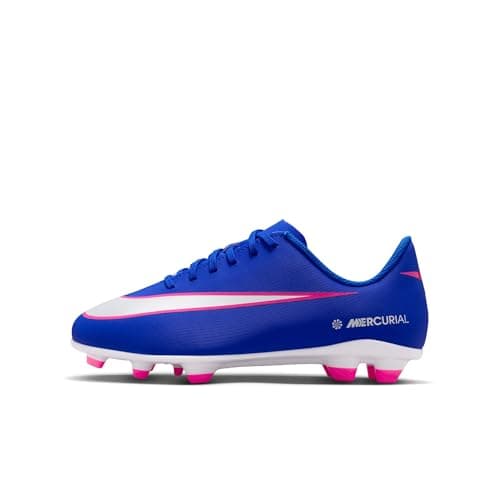
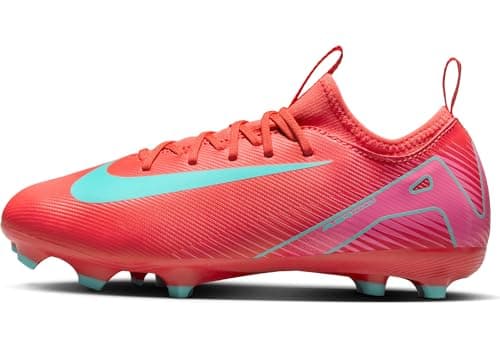
The cheapest step into the Mercurial line, which is the shoe most young strikers actually want, on a multi-ground plate that covers a mixed schedule. Narrow, so check the width before you commit.
The step up that starts to matter once a kid trains midweek as well as playing weekends — same last as the Club, so nothing is relearned, with a better upper and plate.
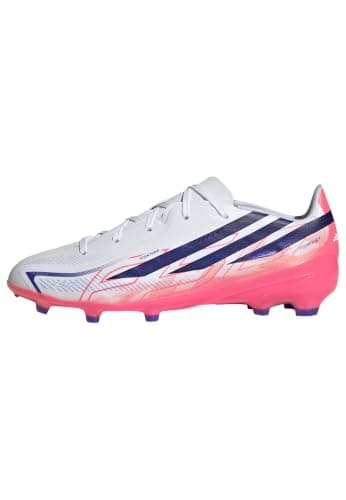
The lightest adidas junior cleat at a sensible price, and the firm-ground plate bites properly into real grass. For a genuinely quick player with a slim foot playing games on grass.
Tap any row to jump to the full write-up. The price in each button is the one Amazon reported on the date stamped under it — tap through for today’s number, which is the only one that can be relied on.
adidas F50 Hyperfast League Kids FGThe right speed cleat for a slim-footed winger or striker playing on grass, and the wrong shoe for almost everyone else.
U9–U10, U11–U12, U13+ travel & club
FG (firm ground)
Narrow through the forefoot and midfoot, true to length.
Product photos come from each item’s current Amazon listing.
The fit trap, in one paragraph
A speed cleat is narrow on purpose. The whole design idea is that the foot does not move inside the shoe, so every bit of push goes into the ground. On the right foot that feels excellent. On a broad foot it feels like a vice, and on a foot that has grown half a size since you bought it there is no adjustment available to give back.
The practical rule: if your kid has ever complained that a Mercurial or an F50 was tight across the middle, they are not a candidate for a speed cleat, no matter what position they play. Buy the striking line instead.
The alternative for a broad-footed striker
If speed lines are out, the next best thing for a forward is the line built around hitting the ball rather than the one built around running: the adidas Predator or the Nike Phantom. A striker's other job is finishing, and a textured strike zone helps a shot taken in a hurry.
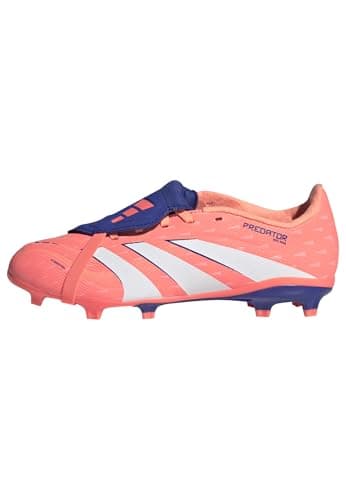
The Predator League with its fold-over tongue is the strongest version of this for an older player, and the Predator Club is the cheap version of the same idea. For width beyond that, the wide feet picks are the right starting point — fit first, position second.
Does stud pattern matter for finishing?
More than the upper does, and it is the thing most families get wrong. Acceleration from a standing start is entirely about the plate finding purchase in the surface it is on.
Surface
Right plate
What happens with the wrong one
Natural grass, soft or wet
FG firm ground
Turf nubs cannot bite; the kid slips on the first step
Long-pile artificial grass
AG or FG/AG
Long FG studs sit on top and catch unpredictably
Short, hard artificial turf
TF turf
FG studs concentrate load on a few points and the feet ache
A mixed schedule, one pair
MG or FG/AG
Adequate everywhere, best nowhere — the right trade for one pair
Scroll the table sideways on a narrow screen.
A striker in the wrong plate loses far more than the difference between a Club and a Pro upper. The surface decision page is the one to read before this one if you are not sure.
Should you buy the Pro tier for a young striker?
Almost never, and there are two reasons rather than one.
Cost against growth. A Pro-tier junior cleat is a multiple of the Club tier on a foot that will grow out of it inside a season. The upper does not last long enough to be reached.
Protection runs backwards up the range. The upper gets thinner as the tier goes up, because the design goal is ball feel. A striker takes more stray kicks to the foot than most players, and the Club tier has more material between the kick and the bone.
There is a real case for a mid tier once a kid is training two or three times a week. There is very rarely one for the top of a line before the feet stop growing. When to replace a pair sets out how short that window actually is.
1. Nike
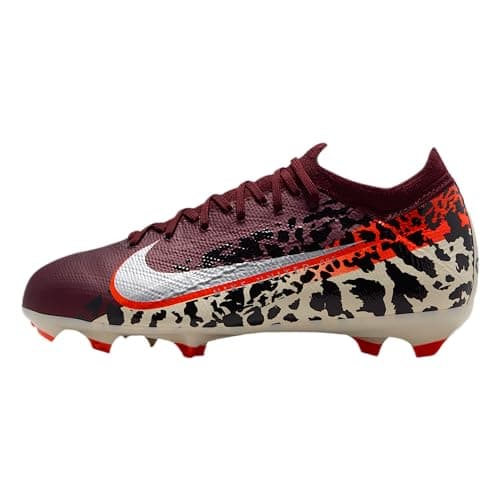
Nike Jr. Mercurial Vapor 16 Academy FG/MG
Worth the step up only when the volume of play justifies it — two or three sessions a week, not one Saturday game.
Best for
A U10–U13 player who plays two or three times a week
Levels
U9–U10 · U11–U12 · U13+ travel & club
Type / surface
FG/MG
How it fits
Same narrow Mercurial shape as the Club. True to length. If the Club fit, this fits.
What we like
Noticeably better upper and plate than the Club tier, which matters once a kid is training midweek as well as playing weekends
Same last as the Club, so a player moving up from Club will not have to relearn the fit
Where it falls short
Costs meaningfully more than the Club for a difference a rec-only player will not notice
Still a narrow last — this is not the line for a wide foot
Manufacturer’s published specs
Step up from the Club tier within the same Mercurial 16 family (Nike)
FG/MG plate configuration
Low-top
Big kids' sizing
These are the manufacturer’s own claims, not measurements we took.
The safest default cleat for a rec player between U7 and U12, as long as the foot is average width or narrower.
Best for
The default first real cleat, U7 through U12
Levels
U7–U8 rec · U9–U10 · U11–U12
Type / surface
MG (multi-ground)
How it fits
Runs true to length but narrow. Order the regular size with a thumb's width at the toe and do not go up a full size to buy time — the heel will slip and blister.
What we like
Multi-ground plate means one pair covers a rec season split between grass and turf fields
The Club tier is the cheapest step into the Mercurial line, so the shoe looks like what the older kids wear without the Academy or Pro price
Wide size run from little kid up through big kid, so siblings can stay in one model
Where it falls short
Narrow through the midfoot like most of the Mercurial line — a genuinely wide foot will feel it
Synthetic upper does not stretch and mold the way leather does, so it will not grow with the foot at all
Manufacturer’s published specs
Synthetic leather upper with textured detailing for grip on the ball (Nike)
Molded studs on a plastic plate, rated by Nike for natural grass and artificial grass
Low-top collar
Sold in little kids' and big kids' sizing
These are the manufacturer’s own claims, not measurements we took.
The speed lines, if the foot suits them: Nike aims the Mercurial at forwards and wide midfielders who prioritize pace, and adidas aims the F50 at forwards and wingers. Both are the narrowest lasts each brand makes, so for a broad-footed striker the better answer is a striking line — the Predator or the Phantom — which helps a shot taken in a hurry without the vice-like fit.
Are Mercurial cleats good for a young striker?+
They are the line Nike points at forwards, and the Club tier is an affordable way into it. The one thing to check first is width: the Mercurial last is narrow through the midfoot, and if your kid has found that line tight before, no amount of position-matching makes it the right shoe.
Do strikers need lightweight cleats?+
Less than the marketing suggests. The difference between junior tiers is tens of grams on a shoe outgrown within a year, and it is dwarfed by whether the plate matches the surface. Get firm ground on grass and a turf outsole on hard artificial turf, and the plate will do more for a first three yards than any weight saving.
Should I buy Pro level cleats for my child?+
Rarely. A Pro-tier junior cleat costs several times the entry tier on a foot that will outgrow it in months, and the upper actually gets thinner as the tier rises because the goal is ball feel — so a striker who takes stray kicks gets less protection for more money. A mid tier is defensible at two or three sessions a week.
What cleats should a striker wear on turf?+
A turf outsole, not firm-ground studs. On short, hard artificial turf the many short nubs of a turf shoe spread the player's weight instead of concentrating it on a few stud points, which is both more comfortable and more predictable off the first step. On long-pile artificial grass an AG or FG/AG plate is the right call instead.
Sources
Nike — Mercurial, Phantom and Tiempo compared by playing style — Nike's own statement of which silo suits which position: Mercurial 'built for speed; best for forwards and wide midfielders', Phantom 'built for precision; best for central midfielders and playmakers', Tiempo 'built for comfort and control'. The source for every Nike position claim on this site.
Unisport — adidas Predator vs F50 vs Copa — Position mapping for the adidas silos — Predator for number 8s and 10s, F50 for wingers, attacking fullbacks and forwards, Copa for center-backs, defensive midfielders and classic number 9s — plus the width ranking (F50 narrowest, Predator middle, Copa most accommodating).
Nike — kids' soccer cleats and shoes — Verified that each Nike model named on this page is currently sold, and the source for Nike's own published upper, plate and surface descriptions.
adidas — kids' soccer — Verified current availability of the adidas models named here, plus adidas's published material and construction claims.
Vizari Sports — youth cleats and indoor shoes — Verified the Vizari models named here are currently sold, including the toddler size range and the indoor line, plus Vizari's published material claims.