Heads up: we earn a commission if you buy through our links, at no extra cost to you. It never changes which product we recommend — here’s how that works.
The short answer
Midfield is the one position where the upper matters more than the plate weight. adidas points the Predator at number 8s and 10s and players who see a lot of the ball; Nike points the Phantom at central midfielders and playmakers who need accuracy in drives and passes. Both put a textured striking surface where a midfielder hits the ball.
Count the touches. Over a youth game a central midfielder will receive, control and pass the ball more often than any other player on the field — more than the striker, considerably more than the center-back. Most of those touches are a first-time pass, a driven ball across the field, or a controlled receive under pressure.
That is why midfield is the position where a better upper is a genuine upgrade rather than a badge. A textured strike zone gives a slightly more consistent contact, and over a hundred touches slightly more consistent adds up to a kid who trusts their passing.
Both brands agree on this and both have a line for it. adidas positions the Predator for number 8s and 10s, attacking midfielders, set-piece takers and players who see a lot of the ball. Nike positions the Phantom for central midfielders and playmakers who rely on accuracy in drives, passes and shots.
Start here
Pick by your kid’s level
The right answer changes with the level, not just the shoe size. Find your kid’s bracket and start there.
The cheapest way into the line built around striking, and the textured strike zone genuinely does help a kid learning to pass the ball rather than poke it. Middle-of-the-road width, so it is a safe guess if you do not know the foot shape.
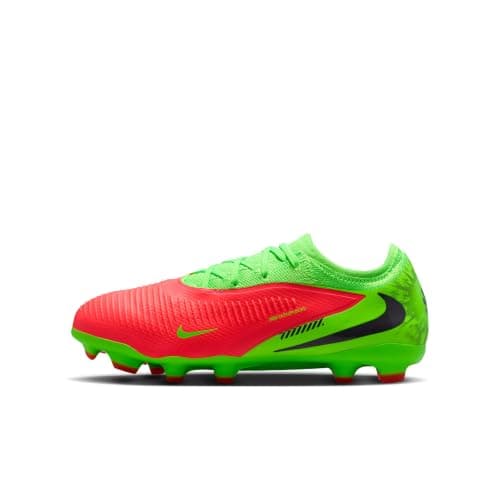
The Nike version of the same idea, with more forefoot room than the Mercurial and an FG/MG plate that covers a mixed schedule. The better pick for a midfielder whose kid is Nike-loyal.
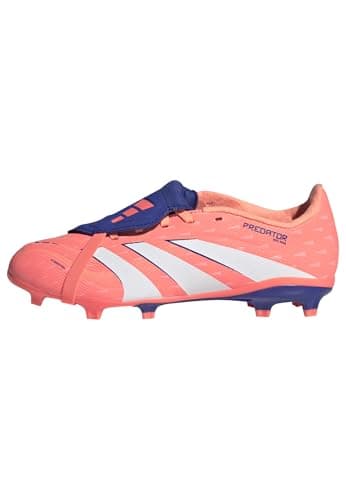
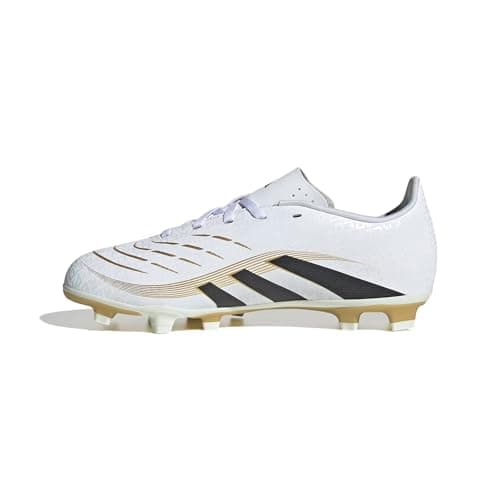
adidas Predator League Fold-Over Tongue Firm Ground (Kids)
The fold-over tongue takes the laces off the striking surface entirely, which is a real difference on a driven ball — and the point at which a player striking the ball this often can feel it.
Tap any row to jump to the full write-up. The price in each button is the one Amazon reported on the date stamped under it — tap through for today’s number, which is the only one that can be relied on.
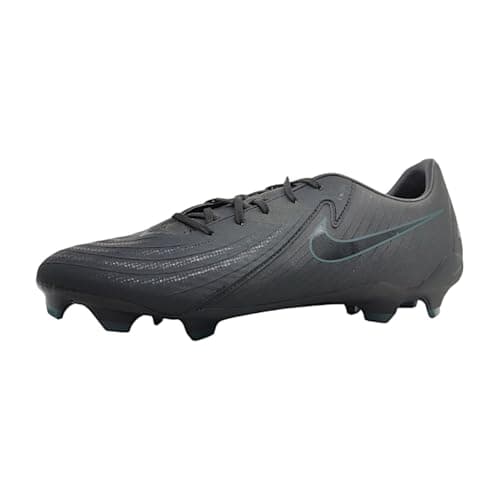
Nike Jr. Phantom GX II Academy FG/MGThe better Nike choice for a midfielder or defender who needs a reliable striking surface more than a few grams saved.
U9–U10, U11–U12, U13+ travel & club
FG/MG
Slightly more forefoot volume than a Mercurial at the same size.
Nike Jr. Phantom 6 Low Pro MGOnly worth it for a committed older player playing several times a week; the Academy tier covers everybody else for far less.
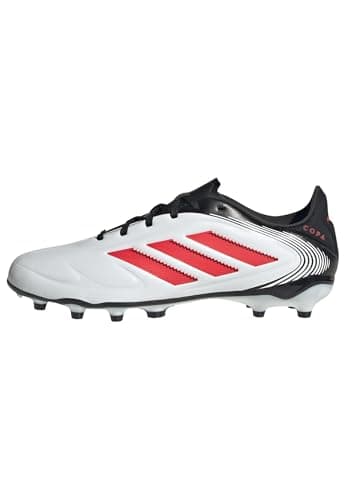
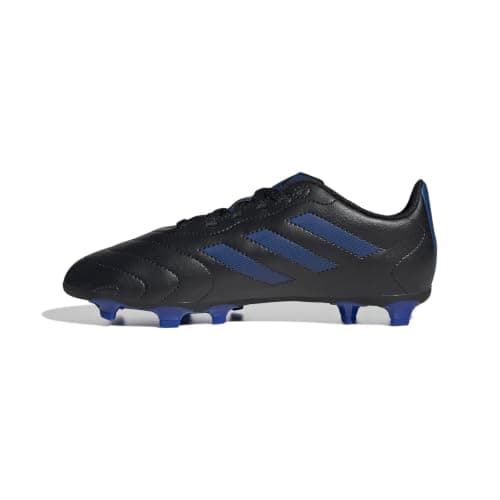
adidas Goletto VIII Firm GroundThe sensible answer when the honest requirement is a cleat that survives one rec season and costs as little as possible.
U6, U7–U8 rec, U9–U10
FG
Runs slightly generous in width and true in length.
Product photos come from each item’s current Amazon listing.
What a striking surface actually is
Worth understanding, because it is the feature you are paying for and the marketing around it is dense.
Texture. Raised rubber or printed elements over the instep and laces, where the foot meets the ball on a pass or a driven shot. More grip on the ball means marginally more predictable spin and less slip on a wet ball.
Lace coverage. A fold-over tongue or a laceless upper removes the laces from the contact area entirely. This is the most noticeable version of the idea and the most expensive.
Upper softness. A softer upper deadens a receive, so a hard pass drops at the feet rather than bouncing away. This is the Copa and Tiempo argument rather than the Predator one, and it matters as much for a midfielder as texture does.
For a youth player the first two are the ones with a claim to being worth money, and only once they are playing enough to notice. The third is really a comfort feature with a passing benefit attached.
Defensive midfield is a different brief
A number 6 who sits in front of the back four is closer to a defender than to a 10. They turn more, sprint less, stand more and clear more. adidas points that role at the Copa rather than the Predator, and that is the right instinct.
If your kid plays holding midfield, read the defender picks alongside this page — the comfort-and-width argument there applies to them more than the striking-surface argument here.
How much tier is worth buying
Tier against playing volume. This is the judgment the price tiers are actually asking you to make.
Playing volume
Tier worth buying
Why stop there
One game a week
Entry (Club / Goletto)
Growth ends the pair long before the upper does
Game plus one training
Entry or mid
A textured entry-tier upper already gives most of the benefit
Two or three sessions a week
Mid (Academy / League)
The upper and plate upgrades become noticeable at this volume
Four or more, competitive club
Mid or Pro
Only here does a Pro-tier upper repay its cost before it is outgrown
Scroll the table sideways on a narrow screen.
If that table has you at the entry tier, that is the correct answer rather than a compromise — the budget picks go into why.
Does a midfielder need a lighter cleat for covering ground?
Midfielders cover more distance than anyone, so the question is fair. The answer is still no, at youth level.
The difference between a junior speed cleat and a junior control cleat is tens of grams on a shoe a child will outgrow in eight months. Set against that, the speed lines are the narrowest lasts either brand makes. Trading a comfortable fit for a few grams is a bad trade at any age and a particularly bad one on a growing foot.
The exception is a midfielder who plays wide and whose game is genuinely running past people. That is a winger in a midfield shirt, and the winger picks are the right page.
Set-piece takers
If your kid takes the corners and free kicks, this is the one place the striking-surface argument goes furthest. adidas names set-piece takers specifically in its Predator positioning, and a fold-over tongue or laceless upper is at its most useful on a struck ball from a standing start with no pressure — which is exactly what a set piece is.
Laceless comes with a real caveat on a growing foot: there is no adjustment at all, so the fit you get is the fit you keep. The laceless picks cover when that is and is not a good idea.
1. adidas
adidas Predator Club Firm Ground (Kids)
The value entry into the Predator line, and a genuinely useful shoe for a player working on striking.
Best for
A U9+ player who strikes the ball a lot
Levels
U9–U10 · U11–U12 · U13+ travel & club
Type / surface
FG
How it fits
True to length, average width — sits between the narrow F50 and the roomy Copa Pure. A reasonable default if you do not know the foot shape.
What we like
The textured strike zone genuinely does give a more consistent contact, which helps a kid learning to strike rather than poke the ball
Cheapest way into the Predator line, and it is the line most kids actually want
Middle-of-the-road width — not as narrow as the F50, not as roomy as the Copa
Where it falls short
The textured upper traps mud and needs cleaning more often than a smooth synthetic
Firm-ground plate only, so it is the wrong pair for a turf-heavy training schedule
Manufacturer’s published specs
Entry tier of adidas's Predator line
Textured strike zone on the upper — the feature the Predator line is built around
Firm-ground plate, kids' sizing
Fold-over tongue construction on some colorways
These are the manufacturer’s own claims, not measurements we took.
The lines built around striking the ball. adidas points the Predator at number 8s and 10s and players who see a lot of the ball; Nike points the Phantom at central midfielders and playmakers who rely on accuracy in passes and drives. Both put a textured strike zone where a midfielder contacts the ball, which is the one upper feature a high-touch player genuinely notices.
Are Predator cleats good for midfielders?+
Yes, and it is the role adidas designed the line around. The textured strike zone gives a more consistent contact on a driven pass, and the fold-over tongue on the mid tier takes the laces off the striking surface entirely. The entry Club tier already carries the texture, so a rec player does not need to buy up the line to get the idea.
Should a defensive midfielder wear the same cleats as an attacking midfielder?+
Not necessarily. A holding midfielder turns, stands and clears more than they create, which is closer to a center-back's brief — adidas points that role at the Copa rather than the Predator. If your kid sits in front of the back four, read the defender page alongside this one and weigh comfort and width over striking texture.
Do midfielders need lightweight cleats?+
No. The weight difference between junior speed and control lines is tens of grams on a shoe that will be outgrown within a year, and the speed lines are also the narrowest lasts on the market. Giving up a comfortable fit for a few grams is a poor trade on a growing foot.
What cleats are best for taking free kicks?+
A cleat with the laces off the striking surface — a fold-over tongue or a laceless upper. adidas names set-piece takers in its Predator positioning for exactly this reason, and a struck ball from a standing start is where the feature is most noticeable. Laceless has no adjustment at all, so it is the wrong choice for a foot mid-growth-spurt.
Sources
Nike — Mercurial, Phantom and Tiempo compared by playing style — Nike's own statement of which silo suits which position: Mercurial 'built for speed; best for forwards and wide midfielders', Phantom 'built for precision; best for central midfielders and playmakers', Tiempo 'built for comfort and control'. The source for every Nike position claim on this site.
Unisport — adidas Predator vs F50 vs Copa — Position mapping for the adidas silos — Predator for number 8s and 10s, F50 for wingers, attacking fullbacks and forwards, Copa for center-backs, defensive midfielders and classic number 9s — plus the width ranking (F50 narrowest, Predator middle, Copa most accommodating).
Nike — kids' soccer cleats and shoes — Verified that each Nike model named on this page is currently sold, and the source for Nike's own published upper, plate and surface descriptions.
adidas — kids' soccer — Verified current availability of the adidas models named here, plus adidas's published material and construction claims.
Vizari Sports — youth cleats and indoor shoes — Verified the Vizari models named here are currently sold, including the toddler size range and the indoor line, plus Vizari's published material claims.