Heads up: we earn a commission if you buy through our links, at no extra cost to you. It never changes which product we recommend — here’s how that works.
The short answer
Wingers are the position both brands name first for their speed lines: adidas points the F50 at wingers, attacking fullbacks and forwards built around pace, and Nike points the Mercurial at forwards and wide midfielders. Both are narrow by design — the fit check matters more here than on any other position page.
Most position-based cleat advice is a stretch at youth level. This page is the exception, and it is worth saying why.
A winger's game is a straight line at speed, a change of direction at the end of it, and then the same thing again. That is the only outfield role where the thing a speed cleat does — lock the foot down so nothing is lost between the foot and the ground — maps onto what the player is actually asked to do. adidas names wingers and attacking fullbacks in its F50 positioning; Nike names wide midfielders in its Mercurial positioning. They are describing the same player.
The condition attached is the same one on the striker page, and it is not small: these are the narrowest lasts either brand builds, and a narrow last on a broad foot is slower, not faster.
Start here
Pick by your kid’s level
The right answer changes with the level, not just the shoe size. Find your kid’s bracket and start there.
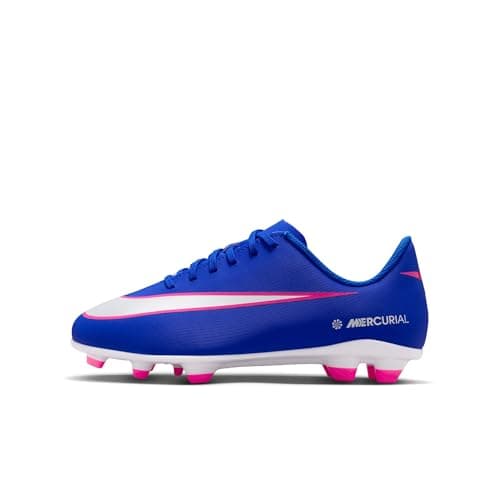
The entry point to the Mercurial line on a multi-ground plate. At this age the wide player is usually just the fastest kid in the team, and the Club tier is all the cleat that needs.
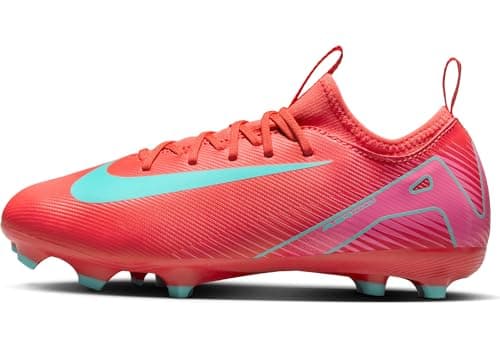
The lightest adidas junior cleat at a mid-tier price, on a firm-ground plate that bites into real grass. The strongest case for a speed cleat is a genuinely quick U12 with a slim foot.
The one place a Pro tier is defensible: a fast, committed player whose games are genuinely on natural grass, where the firm-ground stud pattern is doing real work rather than compromising.
Tap any row to jump to the full write-up. The price in each button is the one Amazon reported on the date stamped under it — tap through for today’s number, which is the only one that can be relied on.
#
Product
Best for
Surface
Fit notes
Price
1
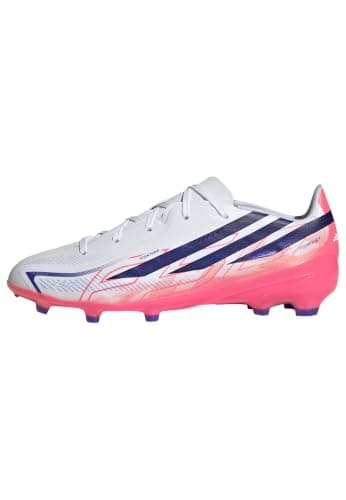
adidas F50 Hyperfast League Kids FGThe right speed cleat for a slim-footed winger or striker playing on grass, and the wrong shoe for almost everyone else.
U9–U10, U11–U12, U13+ travel & club
FG (firm ground)
Narrow through the forefoot and midfoot, true to length.
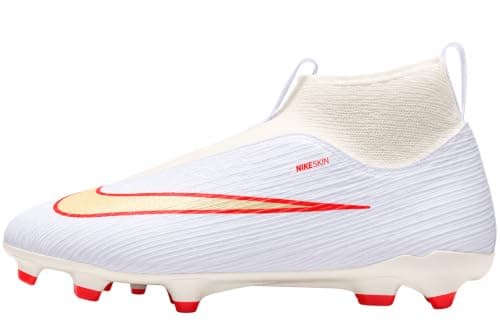
Nike Jr. Mercurial Superfly 11 Academy MGBuy it because the kid wants the collared Mercurial and the multi-ground plate fits the schedule; do not buy it as ankle support.
U11–U12, U13+ travel & club
MG (multi-ground)
Narrow, true to length, with a snug collar opening.
Product photos come from each item’s current Amazon listing.
Why a speed last works for this role and not most others
A speed cleat is a narrow last, a thin upper and a stiff plate. Each of those is a trade.
Narrow last trades comfort for a foot that does not slide inside the shoe on a hard change of direction. For a winger cutting inside at pace, that is the trade worth making.
Thin upper trades protection and ball-deadening for weight and feel. A winger takes fewer stray kicks than a striker and needs to run more than they need to cushion a receive.
Stiff plate trades comfort while standing for energy return on push-off. A winger stands still less than any player except a box-to-box midfielder.
Line those three up against a center-back's job and every one of them is the wrong trade, which is exactly why the defender picks point the other way.
The fit check, before you buy anything on this page
Do this with the cleat on the foot and your hands, not by asking. A kid who wants the shoes will say they fit.
Length. A thumb's width between the longest toe and the end. Not two — a cleat bought to last until spring is a cleat that slides all season.
Width across the ball of the foot. Press down across the widest part. If you can feel the foot pressing out against the upper on both sides, this is not a speed-cleat foot.
Heel. Have them rise onto the toes. If the heel lifts clear of the footbed, the shoe is too long or too wide at the back, and a winger's change of direction will produce a blister within two sessions.
How cleats should fit covers all three in more detail, including the trick for measuring at home without a foot gauge.
If the foot is too broad for a speed cleat
This is most feet, so it is not a consolation section. The wide-footed winger's answer is a line built on a wider last with as light a build as that allows: the Nike Phantom runs noticeably roomier than the Mercurial, and the PUMA Ultra sits between the two with a forgiving upper.
You give up some lockdown and gain a kid who can still run in the second half. Start from the wide feet picks and treat the position as the tie-breaker.
Wingers and turf
A specific warning for this position. A winger's game is repeated hard acceleration and deceleration, and doing that in firm-ground studs on hard artificial turf is the single most punishing combination in youth soccer for feet and heels.
If your kid plays wide and trains weekly on turf, a turf pair is the highest-value second purchase available to you — ahead of a better game cleat. The turf shoe picks cover it, and if the heels have already started hurting, cleats for Sever's disease explains what is probably going on.
1. adidas
adidas F50 Hyperfast League Kids FG
The right speed cleat for a slim-footed winger or striker playing on grass, and the wrong shoe for almost everyone else.
Best for
A fast U10+ player with a slim foot, on natural grass
Levels
U9–U10 · U11–U12 · U13+ travel & club
Type / surface
FG (firm ground)
How it fits
Narrow through the forefoot and midfoot, true to length. This is the adidas line for a slim foot and the one to avoid for a wide one.
What we like
The lightest adidas junior cleat at a sensible price, and weight is the one thing a genuinely quick kid actually feels
A locked-down narrow fit is what a sprinter wants, and besides the Mercurial it is the only mainstream junior line built that way
Where it falls short
The narrowest junior last adidas makes — a broad foot will be sore by half time
Firm-ground plate only, so it is the wrong single pair for a turf-heavy training schedule
Manufacturer’s published specs
League is the mid tier of the current junior F50 Hyperfast range
F50 is adidas's speed silo, positioned for wingers, attacking fullbacks and forwards
Firm-ground plate; kids' sizing
These are the manufacturer’s own claims, not measurements we took.
The speed lines, and this is the position they were designed for — adidas names wingers and attacking fullbacks in its F50 positioning, and Nike names wide midfielders in its Mercurial positioning. The condition is fit: both are the narrowest lasts each brand makes, so a broad-footed winger is better served by the roomier Nike Phantom or PUMA Ultra.
Are F50 cleats good for a young winger?+
Yes, if the foot is slim. The junior F50 is the lightest cleat adidas makes in kids' sizing and the line is aimed squarely at wingers. It is also the narrowest adidas last, and the firm-ground versions are grass-only — so check both the width and the surface before ordering.
Should an attacking fullback wear defender or winger cleats?+
Winger cleats. An attacking fullback is a defender whose job is mostly running, and adidas names attacking fullbacks alongside wingers in its speed-line positioning. If your kid plays fullback but sits in rather than overlapping, the defender page is the better fit.
Do wingers need firm ground cleats?+
They need the plate that matches the surface, and for a winger getting it wrong costs more than for most players. Repeated hard acceleration in firm-ground studs on hard artificial turf is the most punishing combination in youth soccer for feet and heels, so if training is weekly on turf, a turf pair is the best second purchase available.
Is a collared cleat better for a winger?+
No — a knitted collar is a fit and feel feature, not a support or performance one. The collared Mercurial Superfly and the low-cut Vapor share the same last and plate, so pick whichever your kid prefers to wear and do not pay extra expecting the collar to do anything for stability.
Sources
Unisport — adidas Predator vs F50 vs Copa — Position mapping for the adidas silos — Predator for number 8s and 10s, F50 for wingers, attacking fullbacks and forwards, Copa for center-backs, defensive midfielders and classic number 9s — plus the width ranking (F50 narrowest, Predator middle, Copa most accommodating).
Nike — Mercurial, Phantom and Tiempo compared by playing style — Nike's own statement of which silo suits which position: Mercurial 'built for speed; best for forwards and wide midfielders', Phantom 'built for precision; best for central midfielders and playmakers', Tiempo 'built for comfort and control'. The source for every Nike position claim on this site.
Nike — kids' soccer cleats and shoes — Verified that each Nike model named on this page is currently sold, and the source for Nike's own published upper, plate and surface descriptions.
adidas — kids' soccer — Verified current availability of the adidas models named here, plus adidas's published material and construction claims.
Vizari Sports — youth cleats and indoor shoes — Verified the Vizari models named here are currently sold, including the toddler size range and the indoor line, plus Vizari's published material claims.