Heads up: we earn a commission if you buy through our links, at no extra cost to you. It never changes which product we recommend — here’s how that works.
The short answer
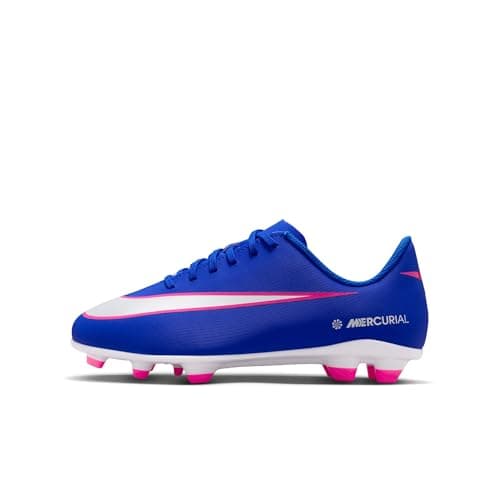
For a kid who plays games on grass and trains on turf, buy a multi-ground (MG) plate rather than two pairs — and in junior sizing the Nike Jr. Mercurial Vapor 16 Club MG is the cheapest honest version of it. MG covers short natural grass and hard artificial turf. It does not properly cover long-pile artificial grass, which wants an AG plate instead.
Almost every youth schedule now splits surfaces. Games are on a grass field, winter training is in a turf barn, and nobody wants to buy two pairs of cleats for a foot that will have changed size by spring. MG is the plate the brands built for exactly that, and it mostly works.
What MG actually means
A multi-ground plate carries more studs than a firm-ground plate, each one shorter, arranged so the load spreads instead of concentrating on six long points. On short grass it bites well enough. On hard artificial turf it does not leave a kid standing on half a dozen pressure points, which is the thing an FG plate does badly and the reason turf-only shoes exist.
Nike labels these junior models FG/MG or MG; adidas and PUMA use FG/AG for their own dual-surface plates, which is a different split. The three-way distinction is set out in firm ground vs turf vs AG, and it matters more than the marketing suggests.
Start here
Pick by your kid’s level
The right answer changes with the level, not just the shoe size. Find your kid’s bracket and start there.
The entry step into the Mercurial line on a multi-ground plate — the cheapest way to get a genuine MG sole in junior sizing, and enough cleat for a player training once a week.
The pick if the foot is broad. Tiempo is Nike's comfort line and the most generous junior last it makes, and the MG plate covers the same split schedule as the Mercurial.
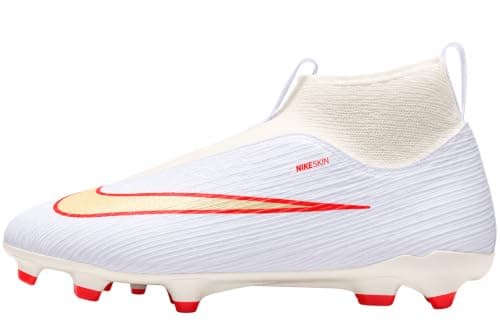
MG plate plus the collar older players ask for, with a NikeSkin touch zone that helps a kid who is working seriously on striking. Buy the collar for fit and feel, not as ankle protection.
Tap any row to jump to the full write-up. The price in each button is the one Amazon reported on the date stamped under it — tap through for today’s number, which is the only one that can be relied on.
#
Product
Best for
Surface
Fit notes
Price
1
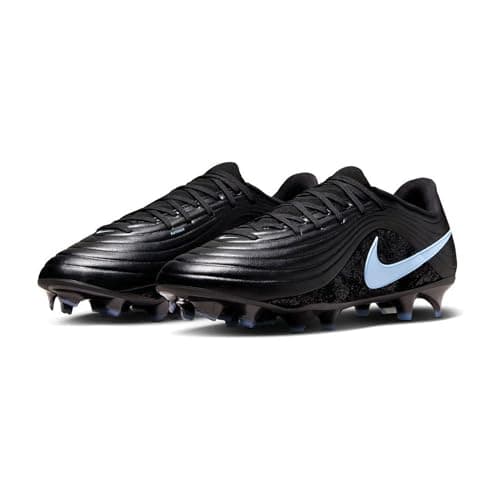
Nike Jr. Mercurial Vapor 16 Club MGThe safest default cleat for a rec player between U7 and U12, as long as the foot is average width or narrower.
Nike Jr. Tiempo Maestro Academy MGThe comfort-first Nike junior cleat, and the sensible pick for a defender, a keeper, or a kid who plays in discomfort and has stopped mentioning it.
U9–U10, U11–U12, U13+ travel & club
MG (multi-ground)
The most generous Nike junior last — closer to the adidas Copa than to the Mercurial.
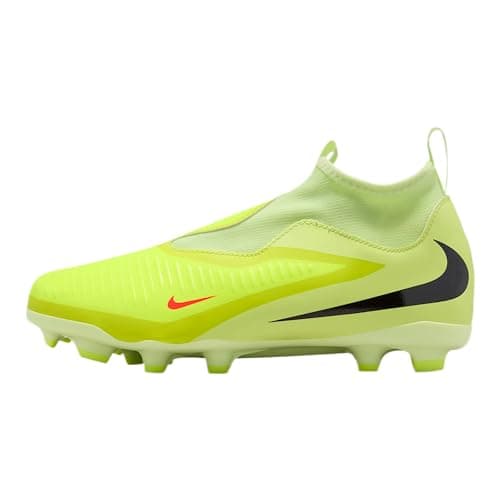
Nike Jr. Phantom 6 High Academy FG/MGThe junior cleat to pick if your kid wants a collar, on the clear understanding that it is a fit feature and a proper brace is a different product.
U9–U10, U11–U12, U13+ travel & club
FG/MG
Average-to-wide forefoot like the rest of the Phantom line, true to length.
Nike Jr. Mercurial Superfly 11 Academy MGBuy it because the kid wants the collared Mercurial and the multi-ground plate fits the schedule; do not buy it as ankle support.
U11–U12, U13+ travel & club
MG (multi-ground)
Narrow, true to length, with a snug collar opening.
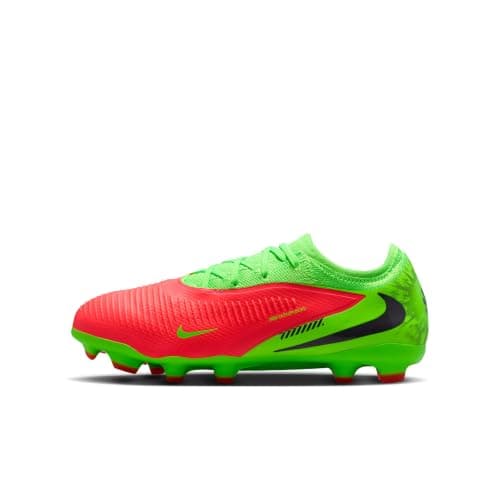
Nike Jr. Phantom 6 Low Pro MGOnly worth it for a committed older player playing several times a week; the Academy tier covers everybody else for far less.
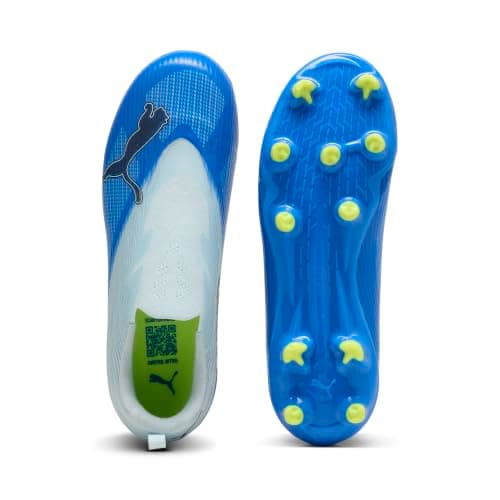
PUMA Ultra 7 Match LL FG/AG JuniorA good dual-surface option for an older player with an average-to-wide foot, and the wrong purchase for a narrow one.
U11–U12, U13+ travel & club
FG/AG
Fits a generous average width with no way to snug it down, and runs slightly short like the rest of the PUMA junior range.
Product photos come from each item’s current Amazon listing.
Match the plate to the week, not to the game
The mistake is buying for Saturday. A rec player on a grass field once a week should buy FG and stop reading. MG earns its money when the majority of the hours are on turf and the games are on grass, which is the usual winter pattern.
Plate codes as the brands use them. Nike labels dual-surface junior models FG/MG; adidas and PUMA label theirs FG/AG.
Your week looks like
Buy
Why
Grass games, grass practice
Firm ground (FG)
Longest studs, best bite on natural grass. MG buys you nothing.
Grass games, turf practice
Multi-ground (MG)
The split this plate exists for. One pair, both surfaces.
Hard turf only, no grass
Turf (TF)
Rubber-nub sole, most comfortable on an abrasive hard surface.
Long-pile 3G artificial grass
AG
Shorter, more numerous studs that sit into the pile without catching.
Indoor court
Indoor (IC/IN)
Flat non-marking gum rubber. No studs at all.
Scroll the table sideways on a narrow screen.
Can you just wear FG cleats on turf?
Kids do it constantly and nothing dramatic happens. The two real costs are comfort and wear: six long studs on an unyielding surface concentrate pressure under the forefoot, and abrasive turf rounds the stud tips faster than grass does. Worn, rounded studs are also the thing referees look at, and the guidance behind Law 4 is clear that worn or pointed studs are not permitted.
So it is a tolerance question rather than a safety one, up to the point where the studs are visibly rounded. If the kid is on turf more than half the time, MG is the cheaper answer over a season than replacing FG cleats early — and when to replace them covers how to tell.
1. Nike
Nike Jr. Mercurial Vapor 16 Club MG
The safest default cleat for a rec player between U7 and U12, as long as the foot is average width or narrower.
Best for
The default first real cleat, U7 through U12
Levels
U7–U8 rec · U9–U10 · U11–U12
Type / surface
MG (multi-ground)
How it fits
Runs true to length but narrow. Order the regular size with a thumb's width at the toe and do not go up a full size to buy time — the heel will slip and blister.
What we like
Multi-ground plate means one pair covers a rec season split between grass and turf fields
The Club tier is the cheapest step into the Mercurial line, so the shoe looks like what the older kids wear without the Academy or Pro price
Wide size run from little kid up through big kid, so siblings can stay in one model
Where it falls short
Narrow through the midfoot like most of the Mercurial line — a genuinely wide foot will feel it
Synthetic upper does not stretch and mold the way leather does, so it will not grow with the foot at all
Manufacturer’s published specs
Synthetic leather upper with textured detailing for grip on the ball (Nike)
Molded studs on a plastic plate, rated by Nike for natural grass and artificial grass
Low-top collar
Sold in little kids' and big kids' sizing
These are the manufacturer’s own claims, not measurements we took.
The comfort-first Nike junior cleat, and the sensible pick for a defender, a keeper, or a kid who plays in discomfort and has stopped mentioning it.
Best for
A U9+ defender, keeper or any player who wants comfort over speed
Levels
U9–U10 · U11–U12 · U13+ travel & club
Type / surface
MG (multi-ground)
How it fits
The most generous Nike junior last — closer to the adidas Copa than to the Mercurial. True to length, and a reasonable first try for a foot the Mercurial has pinched.
What we like
The roomiest and most forgiving Nike junior line, which makes it the Nike answer for a broad or high-volume foot
Softer, leather-feel upper is more comfortable through the long stretches of standing and jogging that make up a youth session
Multi-ground plate means one pair covers grass games and turf training
Where it falls short
Heavier than the Mercurial at the same tier, which a genuinely fast player will feel
The softer upper creases and scuffs early, so it looks worn well before it is worn out
Manufacturer’s published specs
Tiempo is Nike's touch-and-comfort silo, positioned by Nike for players who prioritize a soft, precise touch and all-day comfort (Nike)
Academy tier of the current Tiempo Maestro junior family
Multi-ground plate; junior sizing
These are the manufacturer’s own claims, not measurements we took.
The junior cleat to pick if your kid wants a collar, on the clear understanding that it is a fit feature and a proper brace is a different product.
Best for
A U10+ player who wants a collar and a reliable striking surface
Levels
U9–U10 · U11–U12 · U13+ travel & club
Type / surface
FG/MG
How it fits
Average-to-wide forefoot like the rest of the Phantom line, true to length. The collar is snug — a high instep will notice it going on, which eases after a session or two.
What we like
The closest thing to a supportive collar available in a junior soccer cleat, and it is Nike's own claim rather than a retailer's
The Phantom touch zone genuinely helps a kid learning to strike cleanly rather than toe-poke
FG/MG plate covers a schedule split between grass games and turf training
Where it falls short
A knitted collar is not a brace — independent coverage of these collars is clear they are built for fit and feel, not structural ankle stability
Harder to pull on than a low-cut cleat, and a younger kid will need help the first few times
Costs more than the low-cut Phantom for a feature whose real benefit is comfort
Manufacturer’s published specs
High-cut Dynamic Fit collar that Nike describes as providing ankle support and keeping growing feet secure through quick turns (Nike)
NikeSkin touch zone positioned for clean strikes, with an expanded engineered-mesh touch area (Nike)
All the junior MG models are Nike, and Nike's junior lines differ more in width than in plate. Mercurial is the narrow one, Phantom is average-to-wide, Tiempo is the roomiest. Picking an MG plate in the wrong last is how a parent ends up with a correctly specified cleat the kid refuses to wear.
If the foot is genuinely broad and none of the Nike lines work, the honest answer is that you cannot have MG and a wide adidas last in the same shoe — buy the Copa Pure.3 in firm ground and accept the turf compromise. A cleat that fits on the wrong plate beats a cleat that pinches on the right one.
Common questions
What soccer cleats work on both turf and grass?+
A multi-ground (MG) plate, which carries more and shorter studs than a firm-ground plate so it bites on short natural grass without concentrating pressure on hard artificial turf. In junior sizing the labeled MG models are almost all Nike — the Mercurial Vapor Club and Superfly, the Tiempo Maestro and the Phantom 6. adidas and PUMA use FG/AG plates instead, which pair grass with long-pile artificial grass rather than with turf.
Is MG the same as AG?+
No. MG is built for short natural grass plus hard artificial turf. AG is built for long-pile artificial grass — the full-size 3G pitches many clubs play on — with shorter and more numerous studs that sit into the pile rather than catching in it. If your club's home field is 3G, an AG plate is the correct purchase and MG is a compromise.
Can kids wear firm ground cleats on turf?+
They can, and most do. The costs are comfort and stud wear rather than safety: six long studs on an unyielding surface concentrate pressure under the forefoot, and abrasive turf rounds the tips faster than grass. Once the studs are visibly rounded they become a referee problem, because the guidance behind Law 4 does not permit worn or pointed studs.
Are multi-ground cleats worth it for youth soccer?+
They are worth it when the week genuinely splits — grass games, turf training — which is the usual winter pattern. For a rec player who only ever plays on grass, MG buys nothing and FG grips better. For a kid who is on hard turf most of the time, a dedicated turf shoe is more comfortable than either.
Which junior MG cleat is best for wide feet?+
The Nike Jr. Tiempo Maestro Academy MG. Tiempo is Nike's comfort-and-touch line and has the most generous junior last Nike makes, closer to an adidas Copa than to a Mercurial. If even that pinches, there is no wide adidas cleat on an MG plate — buy the Copa Pure.3 in firm ground and accept the turf compromise.
Do you need different cleats for indoor soccer?+
Yes, and MG is not it. Indoor courts need a flat non-marking gum rubber sole with no studs at all; a studded plate on a gym floor is both slippery and usually banned by the facility. Futsal and indoor shoes are a separate category with their own picks on this site.
Sources
Nike — kids' soccer cleats and shoes — Verified that each Nike model named on this page is currently sold, and the source for Nike's own published upper, plate and surface descriptions.
Nike — kids' Mercurial Vapor 17 Academy AG — Confirms Nike currently lists a junior Mercurial Vapor 17 Academy in an AG (artificial grass) plate alongside the MG, TF and IC versions, and the current price of each junior tier.
Soccer Wearhouse — artificial ground (AG) soccer cleats — Verified that junior FG/AG models are genuinely stocked rather than adult-only, including the PUMA Ultra 7 Match LL FG/AG Junior and Ultra Nitro 7 LL FG/AG Junior, and the prices they are currently listed at.
Coaching American Soccer — Law 4, The Players' Equipment — The Law 4 requirements quoted on this site: footwear is compulsory but cleats are not specified; shinguards must be of suitable material, appropriate size and covered by the socks, with the player responsible for suitability; a player must not use equipment that is dangerous; and the referee-level guidance that worn, pointed or exposed-shaft studs and shoes with sharp metal or pointed spikes are not permitted.
adidas — kids' Copa Pure — adidas's own positioning of the kids' Copa Pure line around comfort, ball control and natural touch.
Nike — Mercurial, Phantom and Tiempo compared by playing style — Nike's own statement of which silo suits which position: Mercurial 'built for speed; best for forwards and wide midfielders', Phantom 'built for precision; best for central midfielders and playmakers', Tiempo 'built for comfort and control'. The source for every Nike position claim on this site.
Unisport — adidas Predator vs F50 vs Copa — Position mapping for the adidas silos — Predator for number 8s and 10s, F50 for wingers, attacking fullbacks and forwards, Copa for center-backs, defensive midfielders and classic number 9s — plus the width ranking (F50 narrowest, Predator middle, Copa most accommodating).