Cleats
Are laceless soccer cleats good for kids?
It depends entirely on one thing, and it is not the child's age or ability.
By Ryder M. · Published October 6, 2026
The short answer
Only if the foot is average width or wider. A laceless cleat cannot be adjusted, so it fits one generous average width and nothing else — a slim foot slides inside it and the heel lifts. If the appeal is a child who cannot tie laces, a hook-and-loop strap model gives you the easy fastening and keeps the adjustment, which is the better answer for most families.
Laceless cleats arrived as a pro product and the youth versions followed, so the marketing talks about a cleaner striking surface. For a kid the real appeal is different and much more practical: nothing to tie, nothing to come undone, nothing for a parent to re-do at half time. That part is genuine.
What laces are actually for
Worth stating plainly, because it is the whole argument. Laces do two jobs on a cleat: they close the shoe down over the instep so the foot cannot slide forward or lift at the heel, and they let you change how much closure you apply, which is how one shoe fits a range of foot shapes.
A laceless cleat replaces both with a fixed elastic collar and a knitted upper. On the foot it was cut for, that is a genuinely nice fit. On a foot that is 5 mm slimmer, there is no way to take up the slack.
The three versions of laceless, ranked for a kid
- Hook-and-loop strap. A single adjustable strap across the instep. This is the one to buy: the child fastens it themselves, and you keep a real adjustment range. PUMA makes an entry turf shoe in this form.
- Fully laceless with an elastic collar. The adidas approach, available in both the entry Goletto and the Predator line in kids' sizing. Clean, fast, and fixed — correct for an average-to-wide foot only.
- Elastic lace replacements on a normal cleat. Not a product category, just a $5 fix: swap the laces for elastic ones on cleats you already own. You keep the adjustment and lose the tying. Honest answer, and the cheapest.
That third option is the one most families should try first, and it is not a cleat purchase at all. The laceless cleat picks cover the real products, including which models are actually sold in junior sizing.
Laceless and strap models in junior sizing
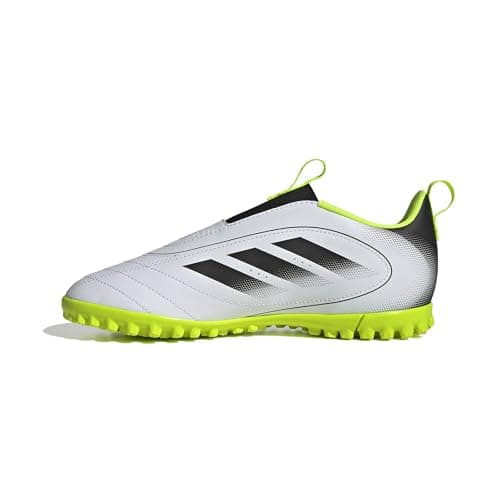
adidas
adidas Goletto IX Laceless Turf
A genuinely useful answer for the pre-lace-tying age, provided the foot is average width or wider.
$35.00View on Amazon#ad — we may earn a commission · price as of October 16, 2026
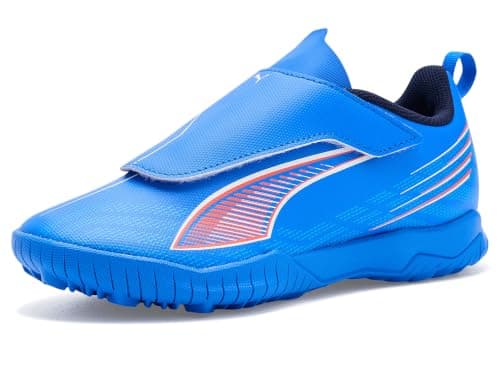
PUMA
PUMA Ultra 6 Play Hook and Loop Turf
The better no-laces option for a narrow foot, with the caveat that the strap is a wear item.
$40.30$45.00−10%View on Amazon#ad — we may earn a commission · price as of October 16, 2026
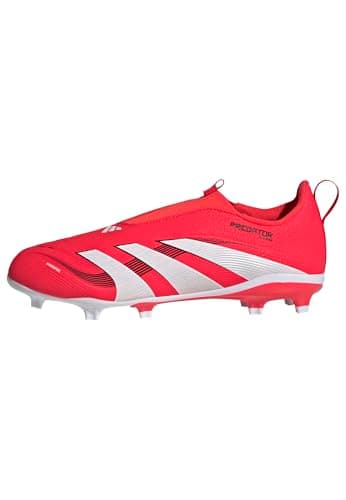
adidas
adidas Predator League Laceless Firm Ground (Kids)
A genuine performance choice for an older player with an average-to-wide foot, and the wrong purchase for a narrow one at any age.
$47.05View on Amazon#ad — we may earn a commission · price as of October 16, 2026
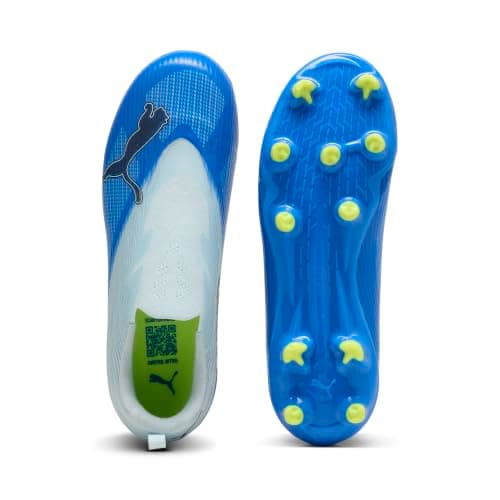
PUMA
PUMA Ultra 7 Match LL FG/AG Junior
A good dual-surface option for an older player with an average-to-wide foot, and the wrong purchase for a narrow one.
$91.30View on Amazon#ad — we may earn a commission · price as of October 16, 2026
Product photos come from each item’s current Amazon listing.
Where laceless genuinely wins
- A U6 or U7 who cannot tie laces. Independence at the sideline is worth real money to a parent, and the only alternative is a strap.
- A kid with sensory issues around lace pressure. A knitted collar spreads pressure across the instep instead of concentrating it under lace lines. This comes up more than the gear industry acknowledges.
- Fine-motor difficulty. The same argument, and the strongest version of it.
- A striker's clean instep. Real, and the least important of these reasons for anybody under about U13.
Where it goes wrong
Three failure modes, and the first is by far the most common.
| Problem | What you see | Fix |
|---|---|---|
| Slim foot | Heel lifts every stride; blister at the heel by half time | Strap model, or a laced narrow line |
| Growth spurt | Suddenly too tight across the instep with nothing to loosen | Nothing. Replace earlier than you would a laced pair |
| Hard to get on | Child needs help pulling against an elastic collar | Strap model, which opens fully |
The growth problem deserves a line of its own, because it is specific to kids and nobody mentions it in the marketing. A laced cleat absorbs a few millimeters of growth by being laced looser. A laceless one does not, so the pair ends earlier. If you are buying at the start of a growth year, that is a real cost.
Are laceless cleats worse for your touch?
The claim in both directions is overstated. Yes, a knitted laceless instep is a slightly cleaner striking surface than a laced one. No, a youth player's striking is not limited by lace knots — it is limited by technique and by a thousand fewer touches than they need. Buying laceless to improve a kid's passing is spending money on the wrong variable.
If the goal is actually more touches, a rebounder or a solo trainer does more for a season than any cleat does. The rebounder picks is the honest redirect there.
What about laceless on a narrow foot, with thicker socks?
It is the obvious workaround and it half works. A thicker sock does take up a little volume, and plenty of families get through a season this way. The problem is that the extra bulk sits in the forefoot rather than at the instep and heel, which is where the slack actually is — so the heel still lifts.
If you are already going down this road, read best cleats for narrow feet first. A laced narrow line solves the problem properly and costs the same.
Common questions
Are laceless soccer cleats good for kids?
They are good for a kid with an average or wider foot, and a poor choice for a slim one. A laceless cleat has one fixed fit, so there is no way to take up slack at the instep or heel — on a narrow foot the heel lifts every stride and that is where the blisters come from. For easy fastening without that trade, buy a hook-and-loop strap model instead.
Do laceless cleats fall off?
No. The elastic collar holds them on well enough that coming off is not the failure mode — slipping inside them is. If a kid's heel is lifting out of the heel cup as they run, the cleat is too wide for the foot and no laceless model will fix it.
Are there laceless soccer cleats for kids?
Yes. adidas sells a laceless version of its entry Goletto turf shoe and a laceless Predator in kids' sizing, and PUMA makes a hook-and-loop strap version of its entry turf shoe plus a laceless Ultra Match in junior. The category is real but much smaller than the adult one.
Are laceless cleats better for striking the ball?
Marginally, and not in a way a youth player will notice. A knitted laceless instep is a slightly cleaner surface than a laced one, but a young player's striking is limited by technique and touch volume rather than by lace knots. Buying laceless to improve passing is spending on the wrong variable.
Can you make normal cleats laceless?
Effectively, yes — swap the laces for elastic ones. It costs a few dollars, removes the tying, and keeps the adjustment range you lose with a true laceless model. For most families this is the right first experiment before buying a different cleat.
Do laceless cleats last as long as laced ones?
The shoe lasts the same. The fit does not: a laced cleat absorbs a few millimeters of growth by being laced looser, and a laceless one cannot, so it stops fitting sooner. On a child in a growth year that means replacing the pair earlier than you would a laced equivalent.
Sources
- adidas — kids' soccer — Verified current availability of the adidas models named here, plus adidas's published material and construction claims.
- Nike — kids' soccer cleats and shoes — Verified that each Nike model named on this page is currently sold, and the source for Nike's own published upper, plate and surface descriptions.
- Under Armour — how to buy soccer cleats for kids — A manufacturer's own buying guide, and the source for the statement that kids' soccer cleats are unisex and sized to normal shoe size, plus its guidance on leaving about half an inch at the toe and fitting with match socks on.
- adidas — kids' Copa Pure — adidas's own positioning of the kids' Copa Pure line around comfort, ball control and natural touch.
- Nike — Mercurial, Phantom and Tiempo compared by playing style — Nike's own statement of which silo suits which position: Mercurial 'built for speed; best for forwards and wide midfielders', Phantom 'built for precision; best for central midfielders and playmakers', Tiempo 'built for comfort and control'. The source for every Nike position claim on this site.
- Unisport — adidas Predator vs F50 vs Copa — Position mapping for the adidas silos — Predator for number 8s and 10s, F50 for wingers, attacking fullbacks and forwards, Copa for center-backs, defensive midfielders and classic number 9s — plus the width ranking (F50 narrowest, Predator middle, Copa most accommodating).
Read next
- Best laceless soccer cleats for kidsNo-laces options for kids who cannot tie them yet, plus the width catch and the free fix for laced cleats.
- Best youth soccer cleats for narrow feetWhich junior lines are built slim, why laceless is the wrong category for a narrow foot, and the lacing fixes that work.
- How should kids' soccer cleats fit?The thumb's-width rule and four hands-on fit checks — because asking a kid whether shoes fit does not work.
- Best soccer cleats for beginnersThe right first cleat at every starting age, why the cheapest tier is correct rather than a compromise, and the four beginner mistakes that cost money.
- Best youth turf soccer shoesTurf shoe picks by age and width, and why the turf outsole does more for comfort than any upper.
- U7–U8 rec: the first real kitAges 6 to 8. Still a size 3 ball, but this is where the first real pair of cleats earns its place.